A nice piece in the Orange County Register that mentions my show, among other writerly-related happenings in the O.C.
Click here.
And a piece on E.L. Doctorow in Time, pointed out to me by the illustrious Jordan Finkler.
Wednesday, March 01, 2006

Tuesday, February 28, 2006
Fat Tuesday


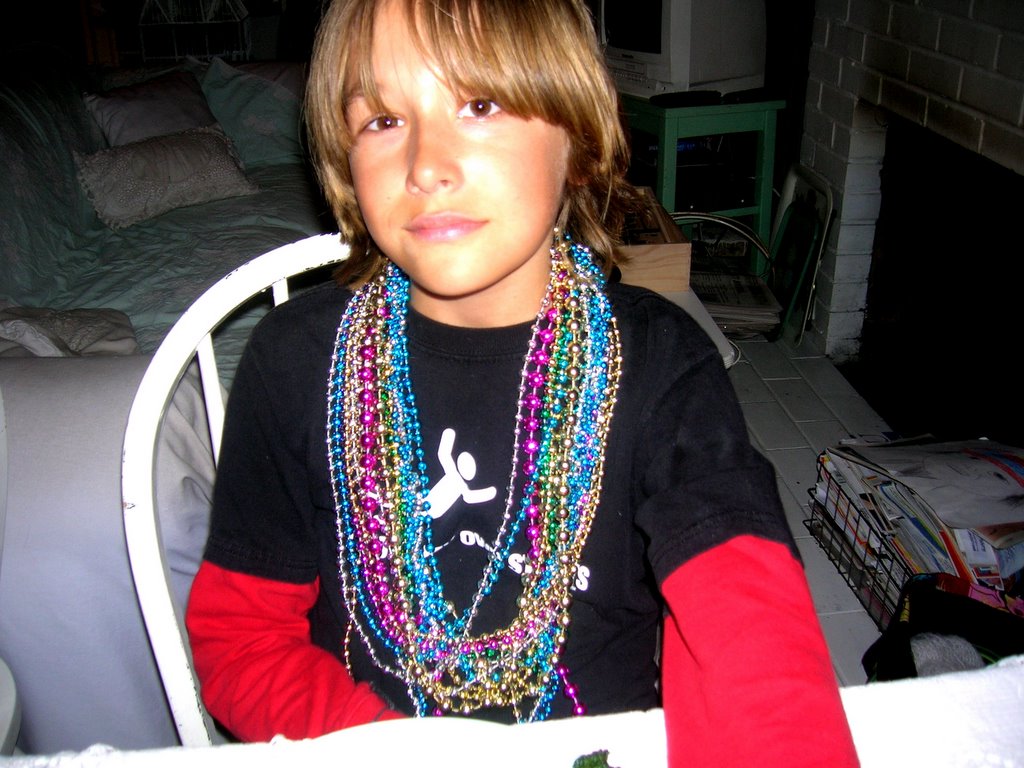
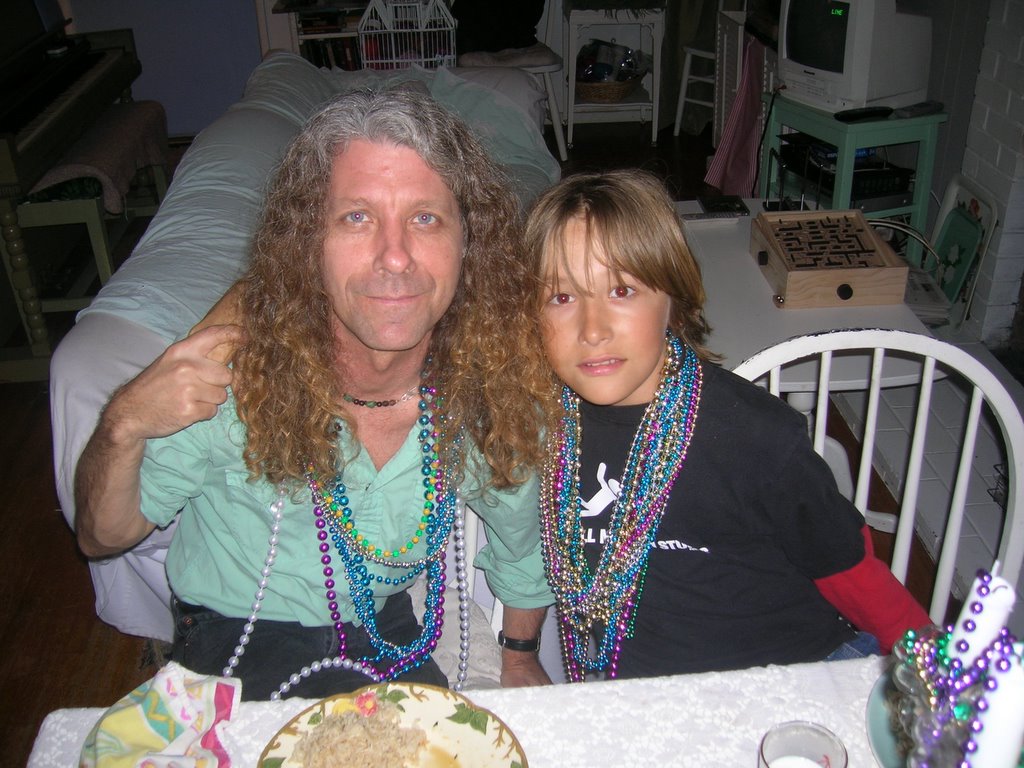
We're all Catholics around here and tomorrow is the first day of Lent, which will find us on a soup diet (except for Travis; he can eat all he wants) and no more sweets (or alcohol for me and Brian). Actually, Travis is giving up candy and soda but not all desserts. Lo que sea...... tonight, we're partying! Circus animal cookies, jelly beans, Milk Duds, white chocolate, and lots of Mardi Gras beads, wooo-hooo!
The books on the mantle have changed, too. From red (for Valentine's Day) to black, for the time of contemplation and quiet.

Wednesday, February 22, 2006
On the sun, snow and being tagged

Before I address the fact that I've been tagged, let me show you what I saw yesterday morning, our last day at Mammoth in the high Sierras. The rising sun streaked the wall of the guest room pink. Here, in Corona del Mar, architecture obscures the rising sun, oh woe.
So bleary-eyed, I pulled myself out of bed, found the camera on the nightstand, and pulled open the sliding door. The deck was icy cold. My eyes were drawn to the light on snow (the title to one of my favorite novels by Anita Shreve).
Now... about being tagged ....
Fellow ASJA member and blogger Candy Harrington (http://barrierfreetravels.com) tagged me this morning. What this means is I need to answer the questions below, or not play. Of course I'll play. Here goes:
Four Jobs in My Life
Parts runner for a Volvo dealer
Countergirl at Dunkin' Donuts
Avon lady (at 17)
Baker (first job in San Francisco)
Four Films I Could Watch Over and Over
Out of Towners (the original, with Jack Lemmon and Sandy Dennis)
Some Like it Hot (Jack Lemmon, again)
The Odd Couple
Bladerunner
Dead Calm
(whoops...that's five)
Four Places I Have Lived
Plainfield, Vermont
San Francisco
Altoona, Pennsylvania
Corona del Mar, California
Four TV Series I Like
I pretty much don't watch TV, but my 11-year-old son and I will watch...
The old Dick Van Dyke show
Turner Classic Movie Channel
Knitty Gritty on DIY Network
Unwrapped on the Food Network
Four Places I've Been on Vacation
Rajasthan, India
Palm Springs, CA
the outback of Maine (camping)
Singapore
Four Foods I love
Hot fudge sundaes (which I stay away from but find greatly compelling)
Tofu turkey (homemade)
Butterfingers
Risotto
Four Websites I Visit Daily
asja.org (The American Society of Journalists and Authors' forum)
writingclasses.com (Gotham Writers' Workshop (online; one place I teach)
knittersreview.com/forum (knitting forum; yes...I'm obsessed!)
laobserved.com (LAObserved: Los Angeles media, news, sense of place)
Four Places I'd Rather Be Right Now
As I answer this question, I am at one of the four places I'd rather be (if I were home): Mammoth Lakes, CA, in the Sierras
Italy
Somewhere in Vermont where the snow grows deep
New Zealand
Four Bloggers Who Should Play
Victor Infante (http://ocvictor.livejournal.com)
Joshua Berman (http://blog.stonegrooves.net)
Anne Elliott (http://assbackwords.blogspot.com)
Bookish Wendy (http://thebookishgirl.blogspot.com)
Thursday, February 16, 2006
The most important part of a writer's anatomy
Ayelet Waldman, author of Love and Other Impossible Pursuits, and wife of Michael Chabon, was on my show yesterday. At the end of my show, I usually ask my guests for advice for the writers out there.
Ayelet talked about the girls in prison that she teaches and that she asked them what was the most important part of a writer's anatomy. (What do you think it is? Before you read on, guess.... I asked my own students last night and they said, "The eyes," "the brain," "the heart." Her students gave similar answers. Yes, they are all important but that's not it.)
"Your butt!" she said. Because if your butt's not in the chair, nothins' gonna happen. No writing is going to get done.
Yep. A writer's butt reigns supreme.
Ayelet talked about the girls in prison that she teaches and that she asked them what was the most important part of a writer's anatomy. (What do you think it is? Before you read on, guess.... I asked my own students last night and they said, "The eyes," "the brain," "the heart." Her students gave similar answers. Yes, they are all important but that's not it.)
"Your butt!" she said. Because if your butt's not in the chair, nothins' gonna happen. No writing is going to get done.
Yep. A writer's butt reigns supreme.
Tuesday, February 14, 2006
Valentine's Day, book cover blurbs and more
Holidays are always festive around here. Brian should hold a class for men: How to do a holiday right.
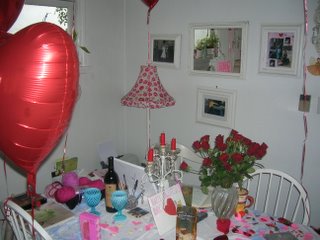
From the bedroom to the living room and dining room, it's about four steps. But there were paper hearts, pink and red, strewn across the hardwood floor leading to the dining room table clotted with Valentine's Day gifts (Chet Baker CD, knitting books, journal, tank top, Jelly Belly candies) and more hearts and balloons. This is where I work, a foot away from the roses, transcribing my free writes from my Moleskine into the computer.
Travis is in holiday mode, just like his dad. A "you are the best mom" card and cut out hearts, too.
Of course after my protein smoothie I scarfed a ton of raspberry and blackberry candies. It's Valentine's Day, right?
Here's a piece from yesterday's New York Times about being careful which blurbs you wish for.
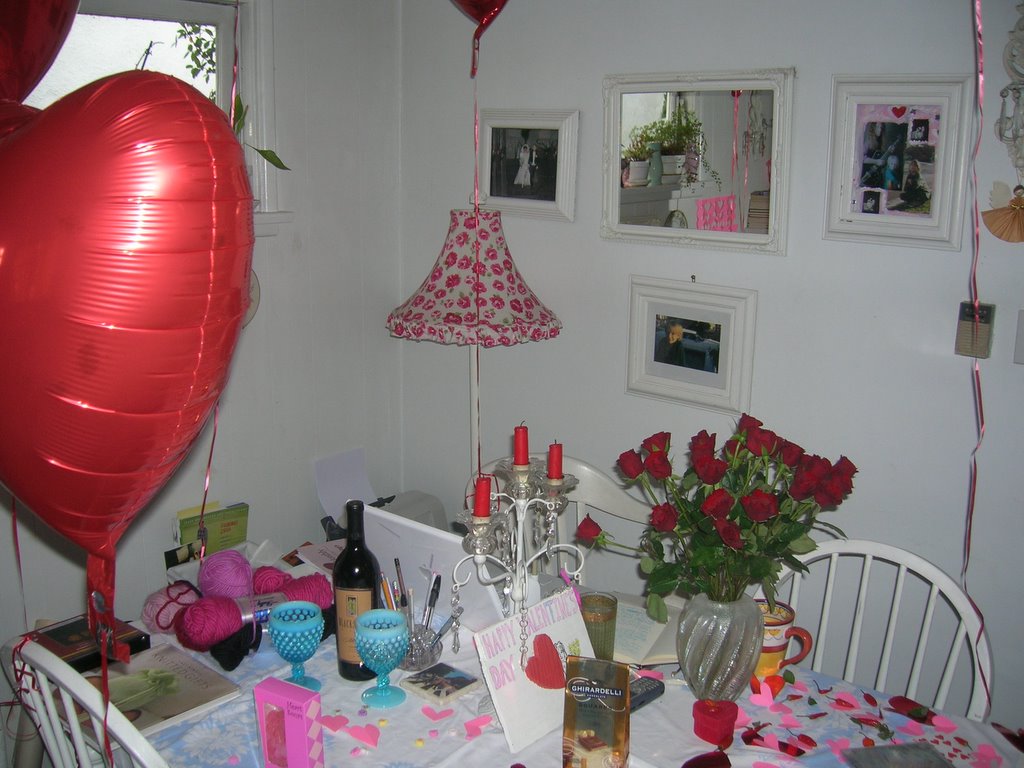
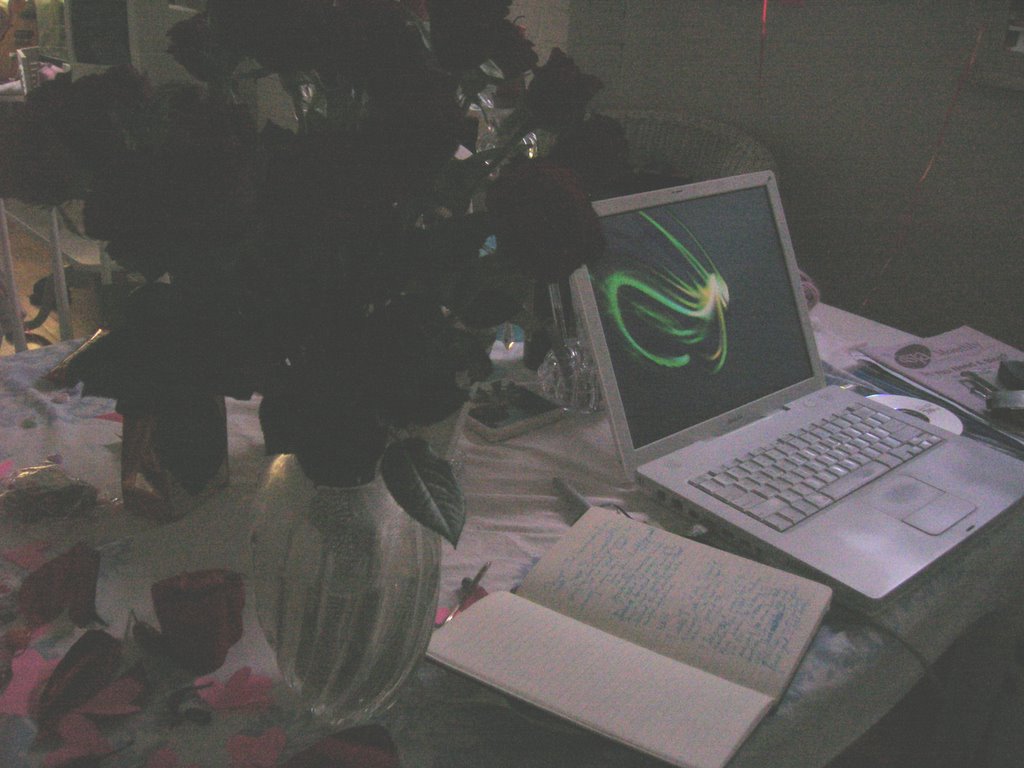
From the bedroom to the living room and dining room, it's about four steps. But there were paper hearts, pink and red, strewn across the hardwood floor leading to the dining room table clotted with Valentine's Day gifts (Chet Baker CD, knitting books, journal, tank top, Jelly Belly candies) and more hearts and balloons. This is where I work, a foot away from the roses, transcribing my free writes from my Moleskine into the computer.
Travis is in holiday mode, just like his dad. A "you are the best mom" card and cut out hearts, too.
Of course after my protein smoothie I scarfed a ton of raspberry and blackberry candies. It's Valentine's Day, right?
Here's a piece from yesterday's New York Times about being careful which blurbs you wish for.
Saturday, February 11, 2006
Fiction's compelling nature
Tuesday, February 07, 2006
No lawyers?
Lawyers are ubiquitous, right? Not so in Frey's case. (I know, I know, I'm still writing about this. Forgive me!) It seems everyone wants to place blame on Sean McDonald or Nan Talese or James Frey. And while all of them are somewhat to blame, I suppose, the publishing house's in-house lawyer should be the one focused on, don't you think?
What about the laywer?? Prior to Pen on Fire being published, I had a long talk with Harcourt's lawyer. My book was being vetted--a writing book!
Didn't Frey's book go through a thorough vetting? So easy to place blame after the fact, isn't it?
Frey's editor wouldn't have been the one to ask all those questions. This is what lawyer's do--they ask those legal questions. Or should.
Just my humble three cents.
What about the laywer?? Prior to Pen on Fire being published, I had a long talk with Harcourt's lawyer. My book was being vetted--a writing book!
Didn't Frey's book go through a thorough vetting? So easy to place blame after the fact, isn't it?
Frey's editor wouldn't have been the one to ask all those questions. This is what lawyer's do--they ask those legal questions. Or should.
Just my humble three cents.
Monday, February 06, 2006
Friday, February 03, 2006
Fiction or nonfiction? Who cares!
I keep going back to that Eleanor Roosevelt quote I like so well--one of my favorite quotes, really.
She said, "The reason fiction is more interesting than any other form of literature to those of us who really like to study people is that, in fiction, the author can tell the whole truth without hurting anyone--or humiliating himself--too much."
I don't get that memoir or nonfiction sells better than fiction. I read fiction for the essential truth. We all know that a lot of fiction writers embellish what happened with made up stuff. That's the fun of it. And certainly we know that memoirs--and not just Big Jim's--are replete with made up stuff. That's not so fun.
What about Hemingway's best book (in my opinion), A Moveable Feast, or Kerouac's On the Road? Are they fiction? Are they nonfiction? Who cares!
Mostly I care about the quality of writing and whether it moves me in some way--mostly whether it moves me to keep reading.
Right now I'm listening to Jennifer Weiner's Good in Bed, which, by the way, is not what it seems. I really wish she had given this first book of hers a different title. So I'm lying down at my acupuncturist's this morning listening to it on CD and he comes in to check the needles and he asks what I'm listening to. I couldn't say, "Oh, it's Good in Bed. It sounds like some sort of porno dealybob. So I say, "Oh, it's a book by Jennifer Weiner. Her movie, In Her Shoes, just came out on DVD," as if this has anything to do with what I'm listening to.
Anyway, getting back to my point--I think I had a point.... Oh! Yes! It is that so much of Weiner's book seems autobiographical--the main character is an overweight woman, she's a writer in college and afterward--and I think, This must be from Weiner's life. But so much else obviously is made up, and I like that about the book, and about fiction--that you can embellish what did happen with what didn't.
This is what I love about writing fiction, too: I can tell the truth in fiction in ways I could never do in nonfiction.
I think I'm feeling a little sorry for Frey about now. He obviously had a story that entranced so very many. Would they have been less involved if he'd sold it as fiction? Wouldn't it be nice to drop categories and focus more on good stories, good writing?
She said, "The reason fiction is more interesting than any other form of literature to those of us who really like to study people is that, in fiction, the author can tell the whole truth without hurting anyone--or humiliating himself--too much."
I don't get that memoir or nonfiction sells better than fiction. I read fiction for the essential truth. We all know that a lot of fiction writers embellish what happened with made up stuff. That's the fun of it. And certainly we know that memoirs--and not just Big Jim's--are replete with made up stuff. That's not so fun.
What about Hemingway's best book (in my opinion), A Moveable Feast, or Kerouac's On the Road? Are they fiction? Are they nonfiction? Who cares!
Mostly I care about the quality of writing and whether it moves me in some way--mostly whether it moves me to keep reading.
Right now I'm listening to Jennifer Weiner's Good in Bed, which, by the way, is not what it seems. I really wish she had given this first book of hers a different title. So I'm lying down at my acupuncturist's this morning listening to it on CD and he comes in to check the needles and he asks what I'm listening to. I couldn't say, "Oh, it's Good in Bed. It sounds like some sort of porno dealybob. So I say, "Oh, it's a book by Jennifer Weiner. Her movie, In Her Shoes, just came out on DVD," as if this has anything to do with what I'm listening to.
Anyway, getting back to my point--I think I had a point.... Oh! Yes! It is that so much of Weiner's book seems autobiographical--the main character is an overweight woman, she's a writer in college and afterward--and I think, This must be from Weiner's life. But so much else obviously is made up, and I like that about the book, and about fiction--that you can embellish what did happen with what didn't.
This is what I love about writing fiction, too: I can tell the truth in fiction in ways I could never do in nonfiction.
I think I'm feeling a little sorry for Frey about now. He obviously had a story that entranced so very many. Would they have been less involved if he'd sold it as fiction? Wouldn't it be nice to drop categories and focus more on good stories, good writing?
Tuesday, January 31, 2006
Five favorite books?
Quick! If you had to name five must-read novels, what would they be? What comes to mind immediately?
One of my Gotham students asked me to name just five. Impossible! But I tried.
I said:
Underworld by Don DeLillo
Henderson the Rain King by Saul Bellow
Good Grief by Lolly Winston
Little Earthquakes by Jennifer Weiner
Then I said, Light on Snow by Anita Shreve comes before Good Grief
Jane Eyre by Charlotte Bronte (Then I think I changed it to Anna Karenina by Leo Tolstoy)
And now I can think of dozens more that are favorites.
So, name the first five favorite books that come to mind.
One of my Gotham students asked me to name just five. Impossible! But I tried.
I said:
Underworld by Don DeLillo
Henderson the Rain King by Saul Bellow
Good Grief by Lolly Winston
Little Earthquakes by Jennifer Weiner
Then I said, Light on Snow by Anita Shreve comes before Good Grief
Jane Eyre by Charlotte Bronte (Then I think I changed it to Anna Karenina by Leo Tolstoy)
And now I can think of dozens more that are favorites.
So, name the first five favorite books that come to mind.
Sunday, January 29, 2006
Astrology's take
Saturday, January 28, 2006
Heart? Intuition? Fun?
Okay, so Blogger straightened some things out. My main headline is now black instead of hot pink. This is good. I don't like the brown headings, though, at the start of each post. Do you?
My friend Sara suggests I do my own blog and she says she'll show me how so I can just link it to my Web site and not be so reliant on Blogger. Did I tell you Sara is an angel? (Sara, if you check in here, post your blog URL under comments if you're okay with that so everyone can visit).
So it's Saturday morning and I read an email from an author friend whose book came out last year and has done respectably. He was working on another proposal that his agent thought would sell--sort of a sequel. He says he woke up, shaking in his PJs, afraid that it was the wrong thing to be working on, and told his agent he changed his mind and was going to go in another direction. His heart just wasn't in it, not like the first book which was straight from the heart.
I wrote back to him, said his email raised an important question: How do you know when what your agent has in mind for you is the right thing, or not? In this wooly world of publishing, whose advice do you take? It's hard even listening to your own heart, your own intuition amid the din of what's selling.
Does it come down to having fun? What do you enjoy working on? If you enjoy it, then that's what you should be working on, and if you don't, scrap it?
Let's hear your comments....
My friend Sara suggests I do my own blog and she says she'll show me how so I can just link it to my Web site and not be so reliant on Blogger. Did I tell you Sara is an angel? (Sara, if you check in here, post your blog URL under comments if you're okay with that so everyone can visit).
So it's Saturday morning and I read an email from an author friend whose book came out last year and has done respectably. He was working on another proposal that his agent thought would sell--sort of a sequel. He says he woke up, shaking in his PJs, afraid that it was the wrong thing to be working on, and told his agent he changed his mind and was going to go in another direction. His heart just wasn't in it, not like the first book which was straight from the heart.
I wrote back to him, said his email raised an important question: How do you know when what your agent has in mind for you is the right thing, or not? In this wooly world of publishing, whose advice do you take? It's hard even listening to your own heart, your own intuition amid the din of what's selling.
Does it come down to having fun? What do you enjoy working on? If you enjoy it, then that's what you should be working on, and if you don't, scrap it?
Let's hear your comments....
Friday, January 27, 2006
These heading colors are driving me nuts...
...and depending what browser you use, formatting is off. Frustrating! No matter which template I choose for this blog, the headings remain hot pink and brown. Ergh. I've written to Blogger. No reply. Anyone know how to fix this?
Regarding other things in the news (I said I wasn't going to write about you-know-who anymore), I liked what Michael Wolff said (I think it was him) on Larry King Live last night, that we'd stay focused on the current debacle until another one takes its place. That's how we are, isn't it? Gotta have drama in our lives, the bigger, the better.
Being one who so easily can see both sides of a situation, and who hates conflict, I say, Publishers: Learn from this. Writers: Learn from this. Readers: Learn from this.
And let's move on.
Regarding other things in the news (I said I wasn't going to write about you-know-who anymore), I liked what Michael Wolff said (I think it was him) on Larry King Live last night, that we'd stay focused on the current debacle until another one takes its place. That's how we are, isn't it? Gotta have drama in our lives, the bigger, the better.
Being one who so easily can see both sides of a situation, and who hates conflict, I say, Publishers: Learn from this. Writers: Learn from this. Readers: Learn from this.
And let's move on.
Thursday, January 26, 2006
Something's funky here
Sorry--Blogger.com has made some changes and caused my blog to look tres funky! Don't blame me.....! Hopefully it will change back soon.
Wednesday, January 25, 2006
Okay, one last post: Frey on Oprah tomorrow
From Publishers Weekly.com:
Frey Live on 'Oprah'
Our earlier report of James Frey's rumored appearance on the Oprah Winfrey show has been confirmed by a release from Harpo Productions. The author of A Million Little Pieces will break his post-Larry King silence to appear on a live hour-long show that will air tomorrow (Thursday, Jan. 26). Other guests will include publisher Nan Talese and "some of the country's leading journalists"--to address the headlines and controversy surrounding his memoir. No word on whether the Smoking Gun's William Bastone will be among them.
Frey Live on 'Oprah'
Our earlier report of James Frey's rumored appearance on the Oprah Winfrey show has been confirmed by a release from Harpo Productions. The author of A Million Little Pieces will break his post-Larry King silence to appear on a live hour-long show that will air tomorrow (Thursday, Jan. 26). Other guests will include publisher Nan Talese and "some of the country's leading journalists"--to address the headlines and controversy surrounding his memoir. No word on whether the Smoking Gun's William Bastone will be among them.
I am so sick of Frey's name in the news
This is from Publishers Weekly.com:
Frey Headed to Oprah?
With James Frey continuing to be the subject of intense media scrutiny, the author of A Million Little Pieces is reportedly headed to the Oprah Winfrey Show. Two separate sources said that Frey will be in Winfrey's studio tomorrow (Thursday), though it was unclear if the appearance will be live or taped for a future date. No one at Random House/Doubleday was available for comment at press time.
.......
I want to say that after this post right here and now, I will not post anymore about Frey. (Some people are obsessed with Jessica Simpson; I seem to be obsessed with the Frey debacle.) If you want to read about him, you'll have to Google his name, sign up for a news alert, and every time his name hits the paper, you'll be notified. More and more I just see him as a creep, like my friend Amy said. Sorry--I liked him when he was no my show but the worm has turned.
Frey Headed to Oprah?
With James Frey continuing to be the subject of intense media scrutiny, the author of A Million Little Pieces is reportedly headed to the Oprah Winfrey Show. Two separate sources said that Frey will be in Winfrey's studio tomorrow (Thursday), though it was unclear if the appearance will be live or taped for a future date. No one at Random House/Doubleday was available for comment at press time.
.......
I want to say that after this post right here and now, I will not post anymore about Frey. (Some people are obsessed with Jessica Simpson; I seem to be obsessed with the Frey debacle.) If you want to read about him, you'll have to Google his name, sign up for a news alert, and every time his name hits the paper, you'll be notified. More and more I just see him as a creep, like my friend Amy said. Sorry--I liked him when he was no my show but the worm has turned.
Tuesday, January 24, 2006
Monday, January 23, 2006
A cat in dog's clothing
Does our cat think she's a dog ... or does she simply like to play fetch?
Rosie, our seven-month-old kitty, has a little white mouse toy she will bring to me or my son, drop, and wait for one of us to throw it. She'll fetch it, bring it back, drop it and do this a number of times before she tires. As we play, I say to Travis, "Does Rosie think she's a dog? Or does she just like fetch?"
Travis says, "I think she thinks she's a dog."
And when I call her in a high sort of voice, trilling, "Rosita!" she comes running.
A cat in dog's clothing?
I was telling this story to my friend Elle and we got into, What makes us what we are? Are we who we are because we believe that's who we are? Are we who've we been told we are? Or do we explode stereotypes, move beyond who we think we are, because something else calls?
Rosie doesn't know that cats don't play fetch or come when called. Our other cat doesn't play fetch, doesn't come when called. He might grace us with a glance in his ever so aloof way, but that's about it.
All of us have roles that take hold, that seem to be more important: how we make a living, our obligations to our partners and children and pets. But what about our obligation to ourselves, to keeping the spark of creativity alive? It may mean writing, drawing, baking, playing music, lo que sea. Whatever it is we are drawn to do, whatever it is we think about daily, shouldn't we be doing it?
We've all seen people in which the spark has gone out. Their eyes look dull, lifeless. The spark has been extinguished. They have forgotten about the need to blow on the spark to stir it into a blaze. Or they have decided to worship the money god or the god of beauty, and forgot about their precious creativity that isn't quantitative, isn't showy.
Rosie does remember she's a cat. She remembers to huddle when she eats her meals on the floor under the old porcelain and wood island that reminds me of my grandmother's kitchen, remembers to laze in the sun on her bed in the front window where she also watches the great outdoors. And she remembers to lie on Travis' chest in the morning to urge him up. But she also knows there are other things she enjoys that are beyond cat-dom.
Friday, January 20, 2006
Wednesday, January 18, 2006
Frey's publisher on Frey
Interesting. Glad Nan Talese put it back on Frey's shoulders.
In it, a quote by Tom Wolfe:
“Let me tell you something—George Orwell, probably back in the 1950’s, wrote that autobiography is the most outrageous form of fiction. It always has been, and probably always will be, and usually there’s no blogger to catch them,” said Mr. Wolfe. “It has nothing to do with the New Journalism.
“I mean, if it’s gonna be called ‘nonfiction,’ I don’t think there should be any doubt about it,” he added.
Here's the piece in The Observer.
In it, a quote by Tom Wolfe:
“Let me tell you something—George Orwell, probably back in the 1950’s, wrote that autobiography is the most outrageous form of fiction. It always has been, and probably always will be, and usually there’s no blogger to catch them,” said Mr. Wolfe. “It has nothing to do with the New Journalism.
“I mean, if it’s gonna be called ‘nonfiction,’ I don’t think there should be any doubt about it,” he added.
Here's the piece in The Observer.
More on typewriters
I think what I like most about this new (old) Hermes 2000 typewriter is that my son Loves It Loves It Loves It. He's never written so much. Because it's a gadget? I don't know--he's never written that much on the computer. Partly it's unusual and odd, I'm sure. And he, like me, loves the sound of the keys tapping away.
I wrote a little last night on it, and it was fun--and a little annoying. The apostrophe is not where it is on the computer; it shares the 8 key. And there's no "1" key; you have to use a lower case "L." Only time will tell if I'll get much writing done on it; it does Slowwwww things way down. But it's gorgeous and again, that sound: so much richer than the sound of tapping plastic iBook keys (much as I adore my laptop...).
Tools are so much a part of the writing experience. Liking--no, loving--our tools makes the experience of writing so much richer. I can move so much faster on my laptop. I type so fast my fingers keep up with my brain (thank you Mr. Ribble and Mrs. Fitzgerald, for those typing classes in high school).
I need to work on my fiction now, but can't decide: the typewriter or the computer? Maybe I'll just go check e-mail and some of my favorite blogs while I'm deciding. Ha!
I wrote a little last night on it, and it was fun--and a little annoying. The apostrophe is not where it is on the computer; it shares the 8 key. And there's no "1" key; you have to use a lower case "L." Only time will tell if I'll get much writing done on it; it does Slowwwww things way down. But it's gorgeous and again, that sound: so much richer than the sound of tapping plastic iBook keys (much as I adore my laptop...).
Tools are so much a part of the writing experience. Liking--no, loving--our tools makes the experience of writing so much richer. I can move so much faster on my laptop. I type so fast my fingers keep up with my brain (thank you Mr. Ribble and Mrs. Fitzgerald, for those typing classes in high school).
I need to work on my fiction now, but can't decide: the typewriter or the computer? Maybe I'll just go check e-mail and some of my favorite blogs while I'm deciding. Ha!
Tuesday, January 17, 2006
My newest find: a Hermes 2000 typewriter
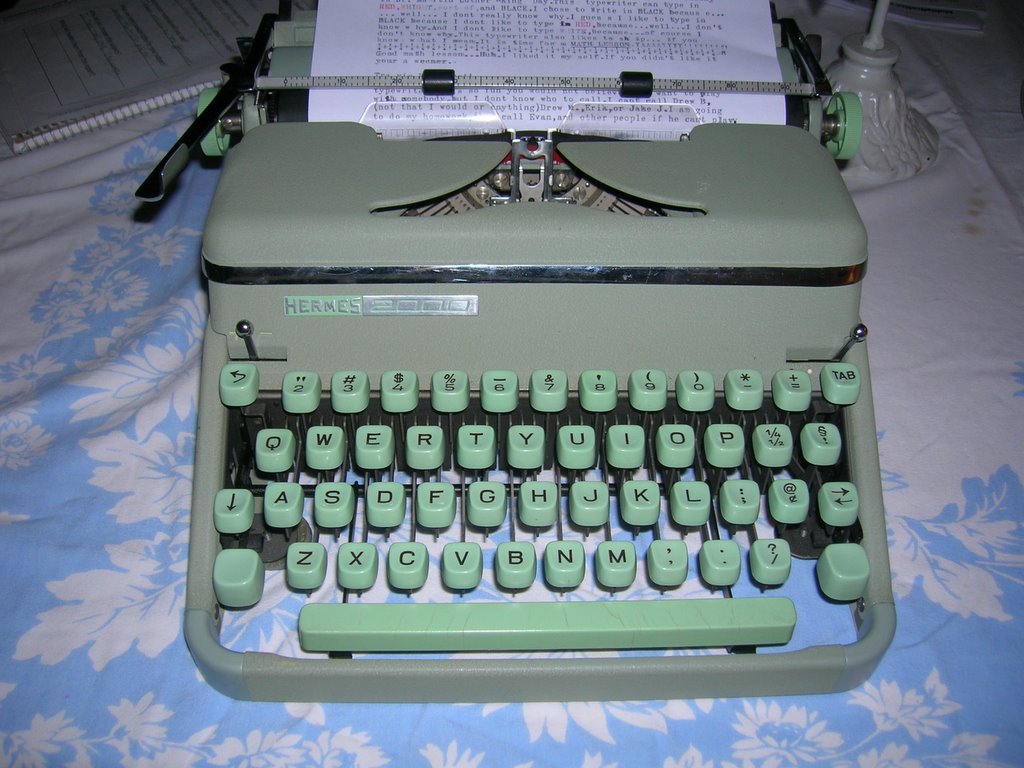
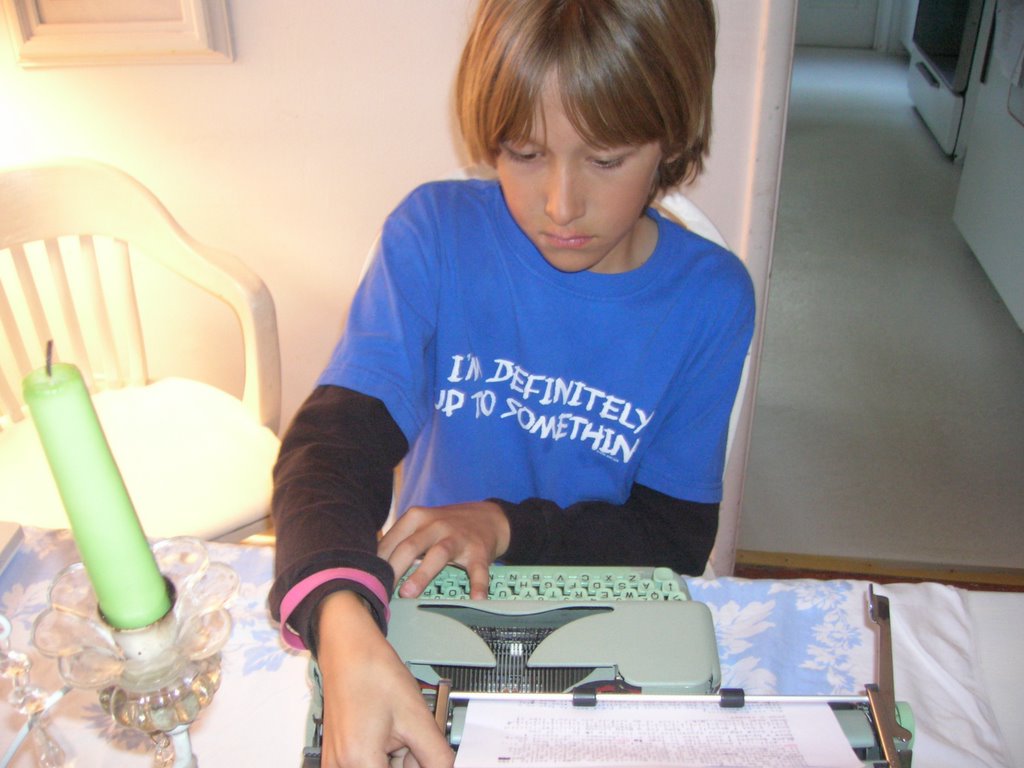


Isn't it lovely? I love it!!!
I did a piece on the Beat Hotel, in Desert Hot Springs (www.dhsbeathotel.com) where there's a manual typewriter in every room and I began salivating for a manual. It's been years.
I love the sound, the look, everything. Of course it's slower, it's rustic, but that could be a good thing.
When Shelby Foote said he used a dip pen because it slowed him down, that resonated with me. I love fountain pens, too.
And last night, on the Golden Globe Awards, thanks to Elle Brooks (I wasn't watching; she was), I learned that Larry McMurtry thanked his Hermes 3000 for 30 years of words. (McMurtry only uses typewriters.)
Travis also loves the typewriter and has been writing up a storm since I got it two days ago.
He says, "I like it more than a computer because ... I don't know... you press the keys harder than a computer. I really don't know why. It's just more fun."
Monday, January 16, 2006
A few million dollars or the respect of fellow writers?
Personally, I'd take the respect of fellow writers over the money. Then again, I've never been that driven by acquiring money--obviously--and what's money going to do for you when your writing community thinks you stink?
Okay, so he tried to sell it as fiction but the publisher said, Well, you say this is a memoir with a bit of embellishing? Let's make it a memoir, then--it'll sell better, so he does, he takes their advice, which is not always the best, admittedly, he gets sucked in, and then lookit.
At some point, you just have to stand your ground. Just say no, right?
But he's sold more books as a result of this fiasco, which I find repugnant. It figures. Our culture is currently so very celebrity-driven. Designer cars, designer clothes, designer books.
Eek!
Okay, so he tried to sell it as fiction but the publisher said, Well, you say this is a memoir with a bit of embellishing? Let's make it a memoir, then--it'll sell better, so he does, he takes their advice, which is not always the best, admittedly, he gets sucked in, and then lookit.
At some point, you just have to stand your ground. Just say no, right?
But he's sold more books as a result of this fiasco, which I find repugnant. It figures. Our culture is currently so very celebrity-driven. Designer cars, designer clothes, designer books.
Eek!
Saturday, January 14, 2006
Scathing piece in the L.A. Times
Yes, I'm interested. Isn't everyone?
Some anonymous someone wrote and said that he/her (said person didn't want to reveal who they were) found it interesting that I've spent the week writing about people I don't care about.
I found that really interesting--and odd.
Aren't all writers interested in matters of ethics in publishing? Aren't you interested in whether what Frey did was considered unethical by the folks in publishing? By readers and other writers? And aren't you interested and curious at the power that Oprah wields?
I am.
And so I write about it. I care about ethics in publishing and I care about how all this will shake down.
The other day I asked a friend--a well-published author, in fact--if she'd been following the Frey fiasco. She said she really hadn't been but from what she ascertained, The Smoking Gun was just trying to start trouble. This was her opinion after reading headlines.
Headlines. We read headlines and we skim.
I suppose I'll hear from that anonymous someone who will tell me again how curious they are that I'm still writing about this topic I care nothing about. I just hope he/her/it says who they are this time, so we can have a dialogue. This is part of the problem, you know--so many of us are afraid to say who we are, express our opinions.
It's easier to remain silent, to not make waves.
Okay, now I must retrieve the L.A. Times from the sidewalk. SFAmylou emailed and said there's an article about Frey. Talk to you later...
I found that really interesting--and odd.
Aren't all writers interested in matters of ethics in publishing? Aren't you interested in whether what Frey did was considered unethical by the folks in publishing? By readers and other writers? And aren't you interested and curious at the power that Oprah wields?
I am.
And so I write about it. I care about ethics in publishing and I care about how all this will shake down.
The other day I asked a friend--a well-published author, in fact--if she'd been following the Frey fiasco. She said she really hadn't been but from what she ascertained, The Smoking Gun was just trying to start trouble. This was her opinion after reading headlines.
Headlines. We read headlines and we skim.
I suppose I'll hear from that anonymous someone who will tell me again how curious they are that I'm still writing about this topic I care nothing about. I just hope he/her/it says who they are this time, so we can have a dialogue. This is part of the problem, you know--so many of us are afraid to say who we are, express our opinions.
It's easier to remain silent, to not make waves.
Okay, now I must retrieve the L.A. Times from the sidewalk. SFAmylou emailed and said there's an article about Frey. Talk to you later...
Friday, January 13, 2006
Oprah determines what you read?
I have never ever read a book because Oprah recommended it. Of course all authors want to be on Oprah, but do authors read what she recommends? I doubt it. Matter of fact, I was attracted to Franzen's The Corrections when he declined being an Oprah pick. That intrigued me, and I loved the book.
But what is that, reading a book because Oprah picked it for her book club? What happened to wandering the bookstore looking for a book, or reading reviews, or listening to your friends talking about their books? Now, if you have no friends that read, then you're going to need Oprah. Or if you don't read reviews or you don't wander the bookstore.
She says if a book resonates, that makes it true? Oh Dear. Now we have to define the word "true."
But what is that, reading a book because Oprah picked it for her book club? What happened to wandering the bookstore looking for a book, or reading reviews, or listening to your friends talking about their books? Now, if you have no friends that read, then you're going to need Oprah. Or if you don't read reviews or you don't wander the bookstore.
She says if a book resonates, that makes it true? Oh Dear. Now we have to define the word "true."
Thursday, January 12, 2006
Publishers Weekly on Frey
Here's what Publishers Weekly and others have to say about Frey. (On Maud Newton's blog, scan down a bit. She has lots of links.
And please, somebody, tell me: Why does everyone care so very much what Oprah thinks and why does she have such influence over what people read? I mean, I know why authors love her, but the reading public, why???
And please, somebody, tell me: Why does everyone care so very much what Oprah thinks and why does she have such influence over what people read? I mean, I know why authors love her, but the reading public, why???
Wednesday, January 11, 2006
And more about the memoir form and Frey
Edward Wyatt, in today's New York Times says, "Memoir is a personal history whose aim is to illuminate, by way of example, events and issues of broader social consequence," said a statement issued by Doubleday and Anchor Books, the divisions of Random House Inc. that published the book in hardcover and paperback, respectively. "By definition, it is highly personal. In the case of Mr. Frey, we decided A Million Little Pieces was his story, told in his own way, and he represented to us that his version of events was true to his recollections. "Recent accusations against him notwithstanding, the power of the overall reading experience is such that the book remains a deeply inspiring and redemptive story for millions of readers." As far as the charges, which were made by the Smoking Gun Web site, "This is not a matter that we deem necessary for us to investigate," said Alison Rich, a spokeswoman for Doubleday and Anchor Books.
***
Publisher's Lunch reports: "Consumers posting on Oprah Winfrey's Book Club message board indicate that Random House is providing refunds to buyers of A MILLION LITTLE PIECES who call their customer service line to complain in the wake of the unanswered charges made by The Smoking Gun earlier this week. One correspondent posts: 'Tell them you wanted fact not fiction.... They are very nice and will tell you how to return the book for a full refund...'
***
Frey's publisher has made more money on this book than perhaps any book ever. I wonder what their position would be if the book had been minor, had there been no Oprah involved. Any guesses? Or am I just being a tad cynical? And how will this effect the memoir form, writers are wondering.
***
Publisher's Lunch reports: "Consumers posting on Oprah Winfrey's Book Club message board indicate that Random House is providing refunds to buyers of A MILLION LITTLE PIECES who call their customer service line to complain in the wake of the unanswered charges made by The Smoking Gun earlier this week. One correspondent posts: 'Tell them you wanted fact not fiction.... They are very nice and will tell you how to return the book for a full refund...'
***
Frey's publisher has made more money on this book than perhaps any book ever. I wonder what their position would be if the book had been minor, had there been no Oprah involved. Any guesses? Or am I just being a tad cynical? And how will this effect the memoir form, writers are wondering.
And more....
Well, that rumor isn't true; Random House says they won't refund your money for the book. You should return it to your bookstore and they'll do it.
Still....
If you liked the book, why wouldn't you just keep it?
Did you see James on Larry King? Maybe he just got caught up. Kind of like a freewriting, when you do all one sentence, how the sentence starts carrying you along with it, picking up speed, and you're letting it rip, letting the words pour out and you don't even know where they came from.
Maybe that's what happened.
As he said to Larry, it's only a few pages--something like 20 out of 400-something--that are in question. Should those 20 pages serve to ream the guy? Would anyone want to ream him if his book were failing instead of wildly succeeding? Was he being whiny, talking out of the side of his mouth? Once a lying addict, always a lying addict??
I dunno....
Larry did seem to go pretty soft on the guy. Barbara Walters would have made him cry. (Does she even still do interviews?)
Here's a transcript of the show. Oprah called in. Scan to almost the end of the transcript.
You're all so quiet out there. What do you think?
Still....
If you liked the book, why wouldn't you just keep it?
Did you see James on Larry King? Maybe he just got caught up. Kind of like a freewriting, when you do all one sentence, how the sentence starts carrying you along with it, picking up speed, and you're letting it rip, letting the words pour out and you don't even know where they came from.
Maybe that's what happened.
As he said to Larry, it's only a few pages--something like 20 out of 400-something--that are in question. Should those 20 pages serve to ream the guy? Would anyone want to ream him if his book were failing instead of wildly succeeding? Was he being whiny, talking out of the side of his mouth? Once a lying addict, always a lying addict??
I dunno....
Larry did seem to go pretty soft on the guy. Barbara Walters would have made him cry. (Does she even still do interviews?)
Here's a transcript of the show. Oprah called in. Scan to almost the end of the transcript.
You're all so quiet out there. What do you think?
Tuesday, January 10, 2006
More on James Frey
Here's more in the The New York Times on James Frey.
And if you want to listen to my interview with James, click here.
Is memoir different from journalism? Do you get to make things up in memoir? These are the questions, among others, that I hear these days.
In memoir, it's agreed that you can make some things up: dialogue you didn't actually write down but sort of remember, or want to approximate. Summary--instead of listing event after event. In other words, if you've had five marriages you might sum them up instead of reeling out each one. Didn't Mary Karr in The Liar's Club embellish beyond the beyond? When I heard that, I didn't want to read her book even more. I want to know that a memoir is basically true. Embellishments are okay. Lies aren't. Fabrications aren't.
And if someone says, "Is this all true?" and you say yes, it had better be true. Otherwise, you say, "I embellished, for the sake of the writing." If someone says, "Were you in jail for such and such?" you had better have been in jail for such and such. And don't say you expunged records, for whatever reason.
If you have a thought on all this, let it rip.
And if you want to listen to my interview with James, click here.
Is memoir different from journalism? Do you get to make things up in memoir? These are the questions, among others, that I hear these days.
In memoir, it's agreed that you can make some things up: dialogue you didn't actually write down but sort of remember, or want to approximate. Summary--instead of listing event after event. In other words, if you've had five marriages you might sum them up instead of reeling out each one. Didn't Mary Karr in The Liar's Club embellish beyond the beyond? When I heard that, I didn't want to read her book even more. I want to know that a memoir is basically true. Embellishments are okay. Lies aren't. Fabrications aren't.
And if someone says, "Is this all true?" and you say yes, it had better be true. Otherwise, you say, "I embellished, for the sake of the writing." If someone says, "Were you in jail for such and such?" you had better have been in jail for such and such. And don't say you expunged records, for whatever reason.
If you have a thought on all this, let it rip.
Monday, January 09, 2006
James Frey
Oh, dear. Right now I'd hate to be in James Frey's shoes. It will be interesting to see how this pans out. The man is bright, though. When he was on my show, he was smart and witty and compassionate. He sounded honest. Wouldn't he figure that any lies would be uncovered at some point? I don't get it. Oy vey.
Monday, January 02, 2006
When the power goes out in Southern California....
....if you have a laptop, or a notebook, you can still write.
We're in the squall here, a few blocks from the beach in Orange County, and when the power went out, the laptop stayed on and I kept working. But then Travis got up and I heard sirens and decided I should shower and get dressed, just in case. In case of what, I don't know. So I did. Made some calls to find out info about the outage. There was none, except for across town Debra's power came back on. Waited some more. No power. So I went outside with a flat pillow on my head to prevent my hair from soaking (of course the umbrellas are in Bry's car and Travis' poncho went bye-bye long ago--no rain, who needs a poncho!). So I'm out there with a flat pillow designed in browns and oranges and blues, and yellow rubber gloves, and I'm moving wood that's still dry from our woodpile that's--where else?--in the rain to a place under the eaves that's not getting rained on, and I'm out there for 15 minutes, doing this, feeling like we'll at least have heat for a while if the power stays off. I come in, wash my hands, and a few minutes later the power comes back on. Of course!
Hope you're staying dry and safe, wherever you are.
We're in the squall here, a few blocks from the beach in Orange County, and when the power went out, the laptop stayed on and I kept working. But then Travis got up and I heard sirens and decided I should shower and get dressed, just in case. In case of what, I don't know. So I did. Made some calls to find out info about the outage. There was none, except for across town Debra's power came back on. Waited some more. No power. So I went outside with a flat pillow on my head to prevent my hair from soaking (of course the umbrellas are in Bry's car and Travis' poncho went bye-bye long ago--no rain, who needs a poncho!). So I'm out there with a flat pillow designed in browns and oranges and blues, and yellow rubber gloves, and I'm moving wood that's still dry from our woodpile that's--where else?--in the rain to a place under the eaves that's not getting rained on, and I'm out there for 15 minutes, doing this, feeling like we'll at least have heat for a while if the power stays off. I come in, wash my hands, and a few minutes later the power comes back on. Of course!
Hope you're staying dry and safe, wherever you are.
Saturday, December 31, 2005
Keeping track, having fun
A writer who read my Writer's Digest article wrote to me with questions. I thought some of you might benefit, as well, from the answers.
How do you keep track of all the notes and pieces of paper and such? she asked.
Keeping track...well, I used to just have a box I threw everything in, all the notes and pieces of paper and cocktail napkins. Then I started carrying notebooks with me wherever I went—the Moleskines I so lovingly discuss and a reporter’s notebook—and now I make notes in them, instead of on shards of paper. That helps. I have filing systems I never refer to, that I really should purge (it being the new year, and all).
I'm paid to write, but it doesn't often feel like fun. How do you keep it fun?
Fun. Freewriting makes it fun for me, and if I have a bit of that in my life, then I’m okay. And writing fiction makes it fun. Something to look forward to. I love writing in my Moleskines (they cast a spell, I swear) and if I can mix up fun with work, I’m okay. I, too, labor over deadlines. I have two deadlines right now for articles for PAGES magazine. Freewriting in my Moleskines keeps the spark alive. In the past, when my interest has flagged, inspirational writing books helped get that spark going again.
How do you know when you have an idea that will sustain you for 200 pages and keep the reader turning the page?
As for ideas that keep nipping at your heels and how to make them long, well, some ideas are teensy and some aren’t. For me, I ponder: Will I be interested in this topic years from now? Since that’s how long it can take to write a book. There are some projects I began as book proposals that I thought I would stay with, and then didn’t. Others—like my book, PEN ON FIRE—kept me long after I thought they would. I've written novels that I later abandoned because I just wasn't interested enough in to revise and do what it takes to sell them. If you’re fascinated with your idea, that’s the main thing, and the main way to keep readers turning the page. The author Chris Bohjalian said when he's involved in a book project, he will abandon it even at page 150 if he's bored with it, because if he’s bored, his readers will be bored.
Platform: when do you know if your platform is big enough?
Good question! I can say that a regional platform can be appealing, and if you’re writing a book that connects to your regional platform, it may be enough. Yet, if your platform is, say, cooking, and you’re doing a book on connecting with adoptive parents, I would think your platform will mean little. If you know an agent, I’d ask her/him. If you don’t know any, I’d find a conference (of which there are a ton—the ASJA conference is in April in NYC—www.asja.org--and is great at making contacts with editors and agents. Take a meeting and ask them. They are great at being blunt and will tell you how it is.
....
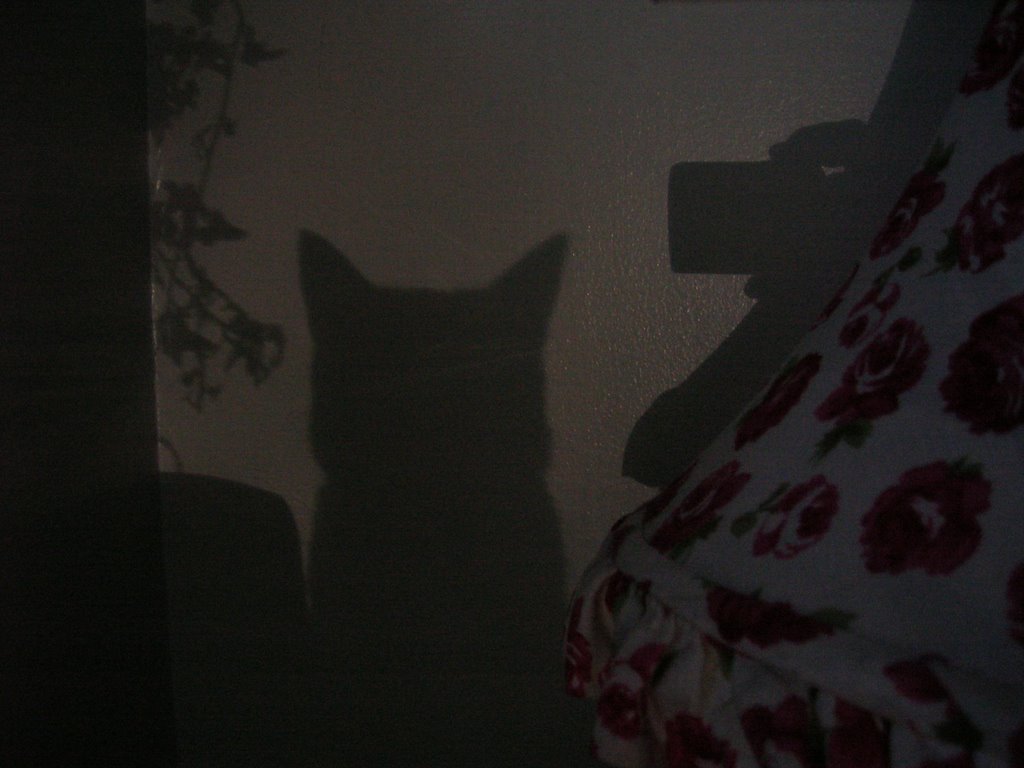
Now, visuals help writing,help break up long blocks of text, yes? So here is what I saw one day high on the wall adjacent to where I work. The sun through the window created such gorgeous shadows.
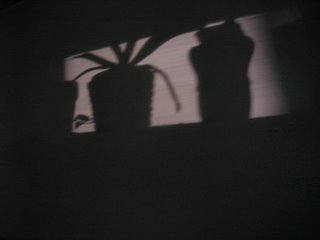
Have a great New Year, full of creative energy, great ideas and lots of stamina to keep your butt in the chair!
How do you keep track of all the notes and pieces of paper and such? she asked.
Keeping track...well, I used to just have a box I threw everything in, all the notes and pieces of paper and cocktail napkins. Then I started carrying notebooks with me wherever I went—the Moleskines I so lovingly discuss and a reporter’s notebook—and now I make notes in them, instead of on shards of paper. That helps. I have filing systems I never refer to, that I really should purge (it being the new year, and all).
I'm paid to write, but it doesn't often feel like fun. How do you keep it fun?
Fun. Freewriting makes it fun for me, and if I have a bit of that in my life, then I’m okay. And writing fiction makes it fun. Something to look forward to. I love writing in my Moleskines (they cast a spell, I swear) and if I can mix up fun with work, I’m okay. I, too, labor over deadlines. I have two deadlines right now for articles for PAGES magazine. Freewriting in my Moleskines keeps the spark alive. In the past, when my interest has flagged, inspirational writing books helped get that spark going again.
How do you know when you have an idea that will sustain you for 200 pages and keep the reader turning the page?
As for ideas that keep nipping at your heels and how to make them long, well, some ideas are teensy and some aren’t. For me, I ponder: Will I be interested in this topic years from now? Since that’s how long it can take to write a book. There are some projects I began as book proposals that I thought I would stay with, and then didn’t. Others—like my book, PEN ON FIRE—kept me long after I thought they would. I've written novels that I later abandoned because I just wasn't interested enough in to revise and do what it takes to sell them. If you’re fascinated with your idea, that’s the main thing, and the main way to keep readers turning the page. The author Chris Bohjalian said when he's involved in a book project, he will abandon it even at page 150 if he's bored with it, because if he’s bored, his readers will be bored.
Platform: when do you know if your platform is big enough?
Good question! I can say that a regional platform can be appealing, and if you’re writing a book that connects to your regional platform, it may be enough. Yet, if your platform is, say, cooking, and you’re doing a book on connecting with adoptive parents, I would think your platform will mean little. If you know an agent, I’d ask her/him. If you don’t know any, I’d find a conference (of which there are a ton—the ASJA conference is in April in NYC—www.asja.org--and is great at making contacts with editors and agents. Take a meeting and ask them. They are great at being blunt and will tell you how it is.
....
Now, visuals help writing,help break up long blocks of text, yes? So here is what I saw one day high on the wall adjacent to where I work. The sun through the window created such gorgeous shadows.

Have a great New Year, full of creative energy, great ideas and lots of stamina to keep your butt in the chair!
Monday, December 26, 2005
Poetry
I'm writing my poetry lecture for my Gotham online class and came across this page on Pulitzer prize winning poet Gwendolyn Brooks. I admire Brooks so much.
Thursday, December 22, 2005
Pet peeves
Does anyone else have pet peeves and hate to discuss them? Right now I've got two, and I've just got to discuss them because They Are Everywhere.
The first is cell phones in cars. Now, okay, driving down the freeway or on a street not absolutely clogged with cars and people, and you're bored, and you gotta talk to someone, so you make a call. I try to avoid it, personally. If I'm alone, I'd rather listen to a book on tape or CD (right now I'm listening to The Namesake by Jhumpa Lahiri) than hang on the phone in the car. If my son is in the car, or my husband, hanging on the phone is just plain rude and I wouldn't do it.
But on the skinny streets of my town, when I see women and men in Mercedes and trucks or SUVs, especially, hogging up the street, turning corners, or backing up--yes! backing up or making u-eees--I want to scream. Sometimes I do, in fact, scream.
The other thing that's been driving me a little nuts is e-mailed Christmas cards. Now, sometimes, it's someone's birthday and you've forgotten to send them a card or you don't have their address and you e-mail a card. I've done it. Sure, why not? But when I receive an e-mailed Christmas card, I'm sorry but I tend to hit delete. (The exception this season was the one I received from Kim Dower, the sweetest book publicist ever. Her artist-husband created a cute cartoon and I printed it out.) And when I'm one on a list of about a million who've also been mailed said e-mailed card, I'm offended. It's almost worst than no card at all.
Technology can be a wonderful thing, but it can also bring out the obnoxiousness that we've all got buried within us, don't you think?
Thanks for letting me rant.
The first is cell phones in cars. Now, okay, driving down the freeway or on a street not absolutely clogged with cars and people, and you're bored, and you gotta talk to someone, so you make a call. I try to avoid it, personally. If I'm alone, I'd rather listen to a book on tape or CD (right now I'm listening to The Namesake by Jhumpa Lahiri) than hang on the phone in the car. If my son is in the car, or my husband, hanging on the phone is just plain rude and I wouldn't do it.
But on the skinny streets of my town, when I see women and men in Mercedes and trucks or SUVs, especially, hogging up the street, turning corners, or backing up--yes! backing up or making u-eees--I want to scream. Sometimes I do, in fact, scream.
The other thing that's been driving me a little nuts is e-mailed Christmas cards. Now, sometimes, it's someone's birthday and you've forgotten to send them a card or you don't have their address and you e-mail a card. I've done it. Sure, why not? But when I receive an e-mailed Christmas card, I'm sorry but I tend to hit delete. (The exception this season was the one I received from Kim Dower, the sweetest book publicist ever. Her artist-husband created a cute cartoon and I printed it out.) And when I'm one on a list of about a million who've also been mailed said e-mailed card, I'm offended. It's almost worst than no card at all.
Technology can be a wonderful thing, but it can also bring out the obnoxiousness that we've all got buried within us, don't you think?
Thanks for letting me rant.
Tuesday, December 20, 2005
All you need is one yes to send you on your way
Here's the online link to my article in the January 2006 issue of Writer's Digest on getting Pen on Fire published.
Sunday, December 18, 2005
Lest anyone think they are too old to publish....
...this just in from Publisher's Lunch:
Fifty-nine-year-old Paul Torday's debut Salmon Fishing in the Yemen, the story of a middle-aged scientist and his involvement with what initially looks like an impossible project: to introduce salmon into the Yemen, to Helen Garnons-Williams at Weidenfeld & Nicolson, at auction, for publication in February 2007, in a two-book deal, by Mark Stanton at Jenny Brown Associates (world).
katie.white@orionbooks.co.uk
It is interesting why Torday's age was printed. Maybe meant as an encouraging word?
Visit www.publisherslunch.com
Fifty-nine-year-old Paul Torday's debut Salmon Fishing in the Yemen, the story of a middle-aged scientist and his involvement with what initially looks like an impossible project: to introduce salmon into the Yemen, to Helen Garnons-Williams at Weidenfeld & Nicolson, at auction, for publication in February 2007, in a two-book deal, by Mark Stanton at Jenny Brown Associates (world).
katie.white@orionbooks.co.uk
It is interesting why Torday's age was printed. Maybe meant as an encouraging word?
Visit www.publisherslunch.com
Thursday, December 08, 2005
In love with Anita Shreve
There are a few authors whose books I pretty much love, without question. Everything they write, I love. I'm promiscuous that way. Chris Bohjalian (not a surprise to anyone who has read my book. T. Jefferson Parker. Now I've a new one: Anita Shreve.
I just finished Fortune's Rocks, an astounding book with much complexity (sounds like something she'd say, or something the judges would say on Iron Chef).
Prior to that, I read Seaglass, which I also loved, and prior to that, The Pilot's Wife. Yes, I loved that too.
When I started Seaglass, I learned that Shreve intended it to be one of three books in a trilogy, but not your usual trilogy. What all three books have in common is the house the main character lives in, a wonderful, rambling beach cottage in New Hampshire. They were written out of order, too.
And now I'm reading A Wedding in December. I just love Shreve's writing.
Are there authors whose work you pretty much love, no matter what they write?
I just finished Fortune's Rocks, an astounding book with much complexity (sounds like something she'd say, or something the judges would say on Iron Chef).
Prior to that, I read Seaglass, which I also loved, and prior to that, The Pilot's Wife. Yes, I loved that too.
When I started Seaglass, I learned that Shreve intended it to be one of three books in a trilogy, but not your usual trilogy. What all three books have in common is the house the main character lives in, a wonderful, rambling beach cottage in New Hampshire. They were written out of order, too.
And now I'm reading A Wedding in December. I just love Shreve's writing.
Are there authors whose work you pretty much love, no matter what they write?
Wednesday, December 07, 2005
Sunday, December 04, 2005
Hooray for notebooks and candles
After I delivered Travis and Alex to their birthday party gig in Redondo Beach--yes, the Green Room, Trav's classic rock band, had their second paying gig yesterday; today they play at Gina's Pizza at the Corona del Mar Christmas walk (for tips)--and on the way home stopped at Pudgy Beads in Long Beach (a glorious vintage bead store with wonderful owners), bought a few things, then drove home, cleaned up a bit (always cleaning up a bit, it seems), lighted the candles I had bought at Ikea on the way to Redondo, and sat on the sofa with my Clairefontaine notebook and Waterman fountain pen (indigo ink).
My iBook G4, which I love, tends to make me a little too perfectionistic, when it comes to first drafts of fiction. It's so easy to delete. With the notebook, I just write. I don't care about being perfect. I can cross out, but I can't delete, and for me, this is a good thing. So I set the timer and sat and wrote and by the time I was done, the room was dark, lit only by candlelight.
This morning at 6:15, Rosie, our six-month-old cat, jumped on the bed and woke me. I tried, for a minute, to go back to sleep, but the house was quiet, bamboo wind chimes by the front door were clacking tastily, so I got up, straightened up a bit (see ... always straightening.....) and sat down with the notebook and pen and wrote a couple pages.
This got me thinking about tools, again. I still love sitting with paper and pen, getting comfortable, and writing. The laptop is good for nonfiction first drafts, though not fiction. Wish I'd remember that when I'm trying to write at the laptop and nothing's coming out.
My iBook G4, which I love, tends to make me a little too perfectionistic, when it comes to first drafts of fiction. It's so easy to delete. With the notebook, I just write. I don't care about being perfect. I can cross out, but I can't delete, and for me, this is a good thing. So I set the timer and sat and wrote and by the time I was done, the room was dark, lit only by candlelight.
This morning at 6:15, Rosie, our six-month-old cat, jumped on the bed and woke me. I tried, for a minute, to go back to sleep, but the house was quiet, bamboo wind chimes by the front door were clacking tastily, so I got up, straightened up a bit (see ... always straightening.....) and sat down with the notebook and pen and wrote a couple pages.
This got me thinking about tools, again. I still love sitting with paper and pen, getting comfortable, and writing. The laptop is good for nonfiction first drafts, though not fiction. Wish I'd remember that when I'm trying to write at the laptop and nothing's coming out.
Friday, December 02, 2005
Squid and the Whale
Debra and Michelle and I went to see this movie tonight. Jeff Daniels is a pompous, no longer successful novelist. His wife is more successful than he. It's downhill from there. An intense movie. And an anti-divorce film, if there ever was one. If you and your spouse are on the fence about splitting up and you have kids, see this film. You will decide you are being whiny and work a little harder to stay together, for the kids, anyway. Laura Linney was great; what else has she been in? I can't place her.
Thursday, December 01, 2005
Thursday
It's going to rain. The sky is overcast, damp. I like rain. But I want it to pour and then be done with--at least until after Sunday when my 11-year-old's band plays at Gina's Pizza at the Corona del Mar Christmas walk. That's the one day a year this town is like New York. The streets are packed. There's one long traffic jam. I'm a back East girl at heart, still, and I love it.
But I don't feel like writing.
Still, I work on The ASJA Monthly, which I edit. But I don't feel like writing--doing my own writing, that is. So I pull on my purple boots, wrap my clapotis around my shoulders and head out with the list for Mother's Market.
I go to the library and check out a book on CD (The Bean Trees by Barbara Kingsolver, which I read years and years ago, and loved). I am so addicted to books on tape or CD. You can listen when you walk, when you clean, when you knit. They help me have more patience with books. If the book starts slow, I don't mind so much. But I do find that certain readers are irritating. I checked out Don DeLillo's Underworld, which I only got to page 400 in (it's an 800-page book) and figured I'd listen to the rest on tape, but the narrator sounded like that digitalized voice you hear when the library calls you to leave a message that your book has come in and is on hold (my friend, Allison, does a perfect rendition of the voice), so I couldn't listen. And the narrator for Middlesex wasn't right either--not for me, so I turned the book in. I did love the narrator for Little Earthquakes, though, and loved the book, too.
Then I go to Mother's Market and down a wheatgrass juice and a Brain Power smoothie, figuring the combo should turbo charge my bloodstream, shop a little, and on the way home, stop at a little store, Paris to the Moon, where I read there was a section entirely devoted to Mother Mary, one of my idols. The store is all glittery and small. There's a pink area, a black and white area, a kids' nook with tin crowns from Mexico, and lots of vintage Christmas tree ornaments and snowglobes.
Onward to home, with goods and groceries. I clean up a little. Swiffer. Iron a red and white vintage tablecloth and spread it out on the table, in preparation for tonight, for Writers Block Party, my every other week group of talented students. Actually, all of people in my private groups, those current and departed, are talented, and it's a pleasure reading their work. My class at UC-Extension is a group of stellar women, bright and funny.
I still don't want to write, though, so I eat lunch: rice with soymilk and maple syrup. I know, I know... But I'm a vegetarian and Italian and like to eat a little differently.
I check in on my Gotham online class. Post a message on the blackboard.
Soon I will go pick Travis up at school. I have to prepare for my show, and my class. Maybe stop by Barnes & Noble and buy a new Moleskine notebook.
I don't think this will be a writing day for me.
But I don't feel like writing.
Still, I work on The ASJA Monthly, which I edit. But I don't feel like writing--doing my own writing, that is. So I pull on my purple boots, wrap my clapotis around my shoulders and head out with the list for Mother's Market.
I go to the library and check out a book on CD (The Bean Trees by Barbara Kingsolver, which I read years and years ago, and loved). I am so addicted to books on tape or CD. You can listen when you walk, when you clean, when you knit. They help me have more patience with books. If the book starts slow, I don't mind so much. But I do find that certain readers are irritating. I checked out Don DeLillo's Underworld, which I only got to page 400 in (it's an 800-page book) and figured I'd listen to the rest on tape, but the narrator sounded like that digitalized voice you hear when the library calls you to leave a message that your book has come in and is on hold (my friend, Allison, does a perfect rendition of the voice), so I couldn't listen. And the narrator for Middlesex wasn't right either--not for me, so I turned the book in. I did love the narrator for Little Earthquakes, though, and loved the book, too.
Then I go to Mother's Market and down a wheatgrass juice and a Brain Power smoothie, figuring the combo should turbo charge my bloodstream, shop a little, and on the way home, stop at a little store, Paris to the Moon, where I read there was a section entirely devoted to Mother Mary, one of my idols. The store is all glittery and small. There's a pink area, a black and white area, a kids' nook with tin crowns from Mexico, and lots of vintage Christmas tree ornaments and snowglobes.
Onward to home, with goods and groceries. I clean up a little. Swiffer. Iron a red and white vintage tablecloth and spread it out on the table, in preparation for tonight, for Writers Block Party, my every other week group of talented students. Actually, all of people in my private groups, those current and departed, are talented, and it's a pleasure reading their work. My class at UC-Extension is a group of stellar women, bright and funny.
I still don't want to write, though, so I eat lunch: rice with soymilk and maple syrup. I know, I know... But I'm a vegetarian and Italian and like to eat a little differently.
I check in on my Gotham online class. Post a message on the blackboard.
Soon I will go pick Travis up at school. I have to prepare for my show, and my class. Maybe stop by Barnes & Noble and buy a new Moleskine notebook.
I don't think this will be a writing day for me.
Thursday, November 17, 2005
More on workshopping
Being a Libra, I of course see both sides of a situation and can see virtue in each side. (Actually, I tend to see more sides that are there.....!) I do feel people do the best they can and sometimes they just reach a limit.
Thing is, the teacher in me wants them to push beyond their limits, and becomes disappointed when they don't, or can't. The writer in me--which is a bigger part of me; it was there first, before the teacher--has little patience for the thinned skinned approach. I have been through a ton of workshopping and have brought stuff that stunk and have been the recipient of criticism that hurt. I guess I kept going because I made the commitment and am loyal to my commitments--to a fault, some would say. I used to think, some day I will come here and they will love what I bring. That day came.
I know this: That day would not have come had I quit because of my feelings that they just didn't get what I was trying to do.
Currently reading: Map of the World by Jane Hamilton.
I didn't pay much attention to this book when it became a bestseller a few years back. Partly it was because the book is difficult--a child drowns. When my son was smaller, children getting hurt in books was too too much. But what an incredible book. Such wonderful writing and character development. We can all learn a thing or three from this book.
Thing is, the teacher in me wants them to push beyond their limits, and becomes disappointed when they don't, or can't. The writer in me--which is a bigger part of me; it was there first, before the teacher--has little patience for the thinned skinned approach. I have been through a ton of workshopping and have brought stuff that stunk and have been the recipient of criticism that hurt. I guess I kept going because I made the commitment and am loyal to my commitments--to a fault, some would say. I used to think, some day I will come here and they will love what I bring. That day came.
I know this: That day would not have come had I quit because of my feelings that they just didn't get what I was trying to do.
Currently reading: Map of the World by Jane Hamilton.
I didn't pay much attention to this book when it became a bestseller a few years back. Partly it was because the book is difficult--a child drowns. When my son was smaller, children getting hurt in books was too too much. But what an incredible book. Such wonderful writing and character development. We can all learn a thing or three from this book.
Tuesday, November 15, 2005
Silencing the voices
“If you hear a voice within you say ‘you cannot paint,’ then by all means paint, and that voice will be silenced.” Van Gogh said this and one of my Gotham students posted it on our classroom board. I love it. It so applies to writing. Only by writing do all those voices that say you can't or shouldn't or why bother go away. At least for a time.
I received a bunch of emails referring to my blog post on workshopping. One person said I was unfair and unprofessional to have that sort of attitude, that maybe I didn't have all the details.
I knew it would be controversial, that blog.
But here's the thing--sometimes there are reasons someone withdraws from a workshop that have nothing to do with critiquing and being thin-skinned or fearful and have everything to do with income or family obligations or time. I'm not talking about those people. I was really talking about students who havetold me that others don't get their work and that's why they're leaving. There have been only a few over the years. But this happens in all workshops and so I was also talking in general, to also say, when you feel others are not getting what you're trying to do, to examine that response of yours. Sometimes our feelings are hurt. Sometimes we pour ourselves onto the page and when we get a ho-hum response, it's painful. So, to make sure you're not leaving a workshop because the response isn't what you'd hope.
Other times I've seen writers receive wonderful feedback, only the writer focuses on that bit of criticism that makes them feel bad and turns it all into sour stuff. Sometimes most others "got it," but maybe someone didn't and that's what the disgruntled writer is focused on.
I dunno.
What I do know is that writing silences all those voices.
I received a bunch of emails referring to my blog post on workshopping. One person said I was unfair and unprofessional to have that sort of attitude, that maybe I didn't have all the details.
I knew it would be controversial, that blog.
But here's the thing--sometimes there are reasons someone withdraws from a workshop that have nothing to do with critiquing and being thin-skinned or fearful and have everything to do with income or family obligations or time. I'm not talking about those people. I was really talking about students who havetold me that others don't get their work and that's why they're leaving. There have been only a few over the years. But this happens in all workshops and so I was also talking in general, to also say, when you feel others are not getting what you're trying to do, to examine that response of yours. Sometimes our feelings are hurt. Sometimes we pour ourselves onto the page and when we get a ho-hum response, it's painful. So, to make sure you're not leaving a workshop because the response isn't what you'd hope.
Other times I've seen writers receive wonderful feedback, only the writer focuses on that bit of criticism that makes them feel bad and turns it all into sour stuff. Sometimes most others "got it," but maybe someone didn't and that's what the disgruntled writer is focused on.
I dunno.
What I do know is that writing silences all those voices.
Monday, November 14, 2005
TC Boyle in the Sacto Bee
TC Boyle in the Sacramento Bee talking about literature...that it's mostly entertaining.
Click here
You may have to register to see it (I did, but it only took a moment). Here's an excerpt:
"People are put off by me because I'm so productive and such a good performer," says Boyle, 53, who will appear Wednesday evening at the Crest Theatre in a talk sponsored by California Lectures. "They think it's not proper for a writer. But I don't agree. Anybody can do whatever he wants, as long as the work backs him up."
And this...
"That said, it takes work. If you have the ability and devote your entire life to it and you're very lucky, you may get an audience and be a productive artist. It's really difficult in our society to be an artist. There's a lot of competition and nobody really cares. So, why not enjoy it and have fun?"
Click here
You may have to register to see it (I did, but it only took a moment). Here's an excerpt:
"People are put off by me because I'm so productive and such a good performer," says Boyle, 53, who will appear Wednesday evening at the Crest Theatre in a talk sponsored by California Lectures. "They think it's not proper for a writer. But I don't agree. Anybody can do whatever he wants, as long as the work backs him up."
And this...
"That said, it takes work. If you have the ability and devote your entire life to it and you're very lucky, you may get an audience and be a productive artist. It's really difficult in our society to be an artist. There's a lot of competition and nobody really cares. So, why not enjoy it and have fun?"
Friday, November 11, 2005
workshopping your writing
A former student and current friend asked me to blog on something controversial, so he could comment. So I sat for a minute, took a bite of fettucine with chopped basil and tomatoes, and thought. This was a hard one. I've been so controversial at times that I've lost friends over that quality I have that allows me to say more than I intended (or maybe I did intend and just wanted to push and see what would happen? I do like to shake things up, it seems).
So, controversial means (to me) something that might lose a few friends for ya. I really don't want to lose more friends than I already have, but then it came to me. I had just the thing that would be controversial, at least in regards to this friend ( and former student) who wrote asking for controversy.
This is it. It has to do with writing workshops and having a thin skin and encountering a few workshop participants who either don't get your work or get it and are giving you a hard time about it. So you leave. You decide that you've gotten all you need from said workshop and it's time to strike out on your own. At least that's the excuse you give.
When in fact what has happened (most of the time) is that your ego has grown ungainly and is misleading you, as egos tend to do.
So many writers are too thin-skinned for their own good. And it's too bad because I've seen some talented writers decide what they really need is to go it alone, and then falter. They start doing crazy things--or continue to do crazy things that I (or another teacher) told them not to do: they write for no pay because it gives them a deadline (they say) or they decide their book (or story) only needs one more pass, if that, and they start sending it out (prematurely) and it gets rejected and then they badmouth the publishing industry (which, frankly, does deserve it, to a point).
You may be thinking: I have this opinion because I need paying students to help keep me afloat. Wrong. These writers that I see go astray are often the ones I've told I'd let stay in the workshop for free, because I see their need.
This brings me back to that old saw: Why do we think writing is different from learning another art form? That we only need to be writing seriously a year or two and then we're ready to go it alone? That is so wrong.
Most of us need workshops for a loooonnnnnggggg time. Years, actually. We need to hear what other writers--our chosen critiques--have to say. Because just get out there and start dealing with agents and publishers and if your skin is thin from years of seclusion, you will give up the whole dealybob of writing to publish.
Well, my dinner is finished now. I have a piece of basil stuck in my throat. I'm going to get up and pour some more pinot. And I'm going to wait for my friend (former student) to post to this very controversial post and tell me how I'm full of it.
So, controversial means (to me) something that might lose a few friends for ya. I really don't want to lose more friends than I already have, but then it came to me. I had just the thing that would be controversial, at least in regards to this friend ( and former student) who wrote asking for controversy.
This is it. It has to do with writing workshops and having a thin skin and encountering a few workshop participants who either don't get your work or get it and are giving you a hard time about it. So you leave. You decide that you've gotten all you need from said workshop and it's time to strike out on your own. At least that's the excuse you give.
When in fact what has happened (most of the time) is that your ego has grown ungainly and is misleading you, as egos tend to do.
So many writers are too thin-skinned for their own good. And it's too bad because I've seen some talented writers decide what they really need is to go it alone, and then falter. They start doing crazy things--or continue to do crazy things that I (or another teacher) told them not to do: they write for no pay because it gives them a deadline (they say) or they decide their book (or story) only needs one more pass, if that, and they start sending it out (prematurely) and it gets rejected and then they badmouth the publishing industry (which, frankly, does deserve it, to a point).
You may be thinking: I have this opinion because I need paying students to help keep me afloat. Wrong. These writers that I see go astray are often the ones I've told I'd let stay in the workshop for free, because I see their need.
This brings me back to that old saw: Why do we think writing is different from learning another art form? That we only need to be writing seriously a year or two and then we're ready to go it alone? That is so wrong.
Most of us need workshops for a loooonnnnnggggg time. Years, actually. We need to hear what other writers--our chosen critiques--have to say. Because just get out there and start dealing with agents and publishers and if your skin is thin from years of seclusion, you will give up the whole dealybob of writing to publish.
Well, my dinner is finished now. I have a piece of basil stuck in my throat. I'm going to get up and pour some more pinot. And I'm going to wait for my friend (former student) to post to this very controversial post and tell me how I'm full of it.
Wednesday, November 09, 2005
Fear stinks
Is anyone else worrying about the avian flu? You read the papers and soon you're freaking out, looking for Tamiflu, thinking you will stock up.
I hate how the media does that.
Well, next Thursday, November 16 (is that a Thursday?), one of my guests will be Marc Siegel, M.D., author of False Alarm: The Truth About the Epidemic of Fear. Read more about him here. Of course his book is not about fear as concerns writers but writers are also immobilized by fear--fear of not succeeding, fear of discovering that their work stinks, fear that they will never ever write one decent paragraph or story or book.
Speaking of books, my other guest that night will be the new book editor at the Los Angeles Times, David Ulin. He was on before with his book, The Myth of Solid Ground. We'll talk about changes at the book review. I'm happy about David's new post and happy most of his writer friends are women. Maybe this means we'll start seeing more books by women covered by the Book Review--finally!
I hate how the media does that.
Well, next Thursday, November 16 (is that a Thursday?), one of my guests will be Marc Siegel, M.D., author of False Alarm: The Truth About the Epidemic of Fear. Read more about him here. Of course his book is not about fear as concerns writers but writers are also immobilized by fear--fear of not succeeding, fear of discovering that their work stinks, fear that they will never ever write one decent paragraph or story or book.
Speaking of books, my other guest that night will be the new book editor at the Los Angeles Times, David Ulin. He was on before with his book, The Myth of Solid Ground. We'll talk about changes at the book review. I'm happy about David's new post and happy most of his writer friends are women. Maybe this means we'll start seeing more books by women covered by the Book Review--finally!
Thursday, October 27, 2005
More on blogging
In my January 29, 2005 blog on, well, blogging, I talked about whether blogging takes time away from your writing. One of my blog visitors wrote to me recently and asked me to go more into blogs, so here goes.
Now that I have had this blog for nine months, I have a few more things to say about blogs and why I think they are a good thing. And how I avoid having my blog take time away from writing.
First off, I blog irregularly--as you know, if you've been checking in here. Once, twice a week at most. I know some bloggers who post long blogs almost daily and while I like to read their blogs, I can't personally keep this up. It would take time away from writing, for sure.
But here's the thing....I have tracking software that allows me to see where most of the activity is, in regards to my web site and what I have seen is that this blog seems to generate the most hits.
I started my blog because my editor at Harcourt thought it would be a great way to keep my Web site fresh, without having to revise the web site itself. When you have a web site, you need to give folks a reason to return. This blog seems to do that. Of course now and then we add features to the web site--there's the TV show I did with Barry Kibrick, on my site, and I've begun archiving radio shows. And soon I will start posting chapters on my web site that didn't make it into Pen on Fire.
There you have it--my three cents on why to blog and how to not let it rob time from your writing. (Other things, frankly, have the ability to take time from my writing more than blogging does....!)
Hopefully this answers your questions....!
Now that I have had this blog for nine months, I have a few more things to say about blogs and why I think they are a good thing. And how I avoid having my blog take time away from writing.
First off, I blog irregularly--as you know, if you've been checking in here. Once, twice a week at most. I know some bloggers who post long blogs almost daily and while I like to read their blogs, I can't personally keep this up. It would take time away from writing, for sure.
But here's the thing....I have tracking software that allows me to see where most of the activity is, in regards to my web site and what I have seen is that this blog seems to generate the most hits.
I started my blog because my editor at Harcourt thought it would be a great way to keep my Web site fresh, without having to revise the web site itself. When you have a web site, you need to give folks a reason to return. This blog seems to do that. Of course now and then we add features to the web site--there's the TV show I did with Barry Kibrick, on my site, and I've begun archiving radio shows. And soon I will start posting chapters on my web site that didn't make it into Pen on Fire.
There you have it--my three cents on why to blog and how to not let it rob time from your writing. (Other things, frankly, have the ability to take time from my writing more than blogging does....!)
Hopefully this answers your questions....!
Why it's trouble posting comments
First I want to tell you why you cannot leave anonymous comments anymore: Because I was receiving so many frivolous comments--not rude, just Web site promos and, well, yukky spam.
So I decided to only accept comments from registered users. I apologize for the hassle, but, frankly, not a lot of people, I find, comment anyway, or they write to me personally, and I just grew tired of spending time tossing comments into the trash.
That said, I would love to hear your comments! I hope you'll take the time to register with Blogger.com if you haven't already.
More soon.....
So I decided to only accept comments from registered users. I apologize for the hassle, but, frankly, not a lot of people, I find, comment anyway, or they write to me personally, and I just grew tired of spending time tossing comments into the trash.
That said, I would love to hear your comments! I hope you'll take the time to register with Blogger.com if you haven't already.
More soon.....
Sunday, October 16, 2005
Archive is up--finally!
We finally have four radio shows archived on my Web site, thanks to Rob Roy and Dave Mosso. And more will be coming in the future. One is with literary agent John Ware, another is with narrative nonfiction author Judy Blunt and novelist Robert Stone, and the third is Ron Carlson, short story writer.
Go here and click on the right side of the screen where it says "audio archive."
Yay!
Go here and click on the right side of the screen where it says "audio archive."
Yay!
Wednesday, October 12, 2005
When you need to get your butt out of the chair
Usually it's a fight to make yourself sit long enough to get some writing done, but sometimes you just need to get up and shake out those muscles--something writers are lax about.
I don't know many writers who like to exercise. In my Southern California neighborhood, I certainly know a fair number of people who like to exercise, who go to the gym or work out with a trainer or run, and love it. I always look at these people with a bit of amazement. That anyone would love to exercise is beyond me. It's an admirable trait, one that I don't possess.
Maybe it's genetic. No one in my family has been an exerciser. My Aunt Teresa used to walk a ton (which may be why she lived to be in her late 80s, for the most part all healthy years).
But I went for my annual the other week and my doctor ran blood tests--the usual ones--and they came back pretty okay except for my cholesterol, which was a bit elevated. Not much, but enough for me to remember my mother had high cholesterol and my grandmother had some strokes, and maybe it was time to pay attention to such things.
I worked on my diet a bit, which is not all that bad; I gave up meat more than 20 years ago. So I cut out some butter, some cheese, ice cream. But exercise was the thing I really needed to work on. I walk now and then, but when I had a dog I walked a ton. No longer.
A friend told me about a Pilates DVD--Gaiam's Pilates for Weight Loss. The narrator doesn't baby talk to you and the beachy setting is gorgeous. So I started doing the 30 minute workout.
Then I made another discovery, something that is so motivating, to this writer, anyway: Books on tape (or CD). Now it's fun to go on Long Walks, because I get to listen to a book. It makes me want to walk longer, take the long route, circle the block to get to the end of a chapter. I listened to Anne Tyler's A Patchwork Planet and John LaCarre's The Constant Gardener this way, and now I'm listening to Ian McEwan's Saturday.
So if you have trouble getting out of the chair, stock up on some books on tape, lace on those tennis shoes, and take to the streets. Not only will you be healthier, you'll have more energy for writing. (I sound like a regular cheerleader, but I swear, I was never one in high school....)
I don't know many writers who like to exercise. In my Southern California neighborhood, I certainly know a fair number of people who like to exercise, who go to the gym or work out with a trainer or run, and love it. I always look at these people with a bit of amazement. That anyone would love to exercise is beyond me. It's an admirable trait, one that I don't possess.
Maybe it's genetic. No one in my family has been an exerciser. My Aunt Teresa used to walk a ton (which may be why she lived to be in her late 80s, for the most part all healthy years).
But I went for my annual the other week and my doctor ran blood tests--the usual ones--and they came back pretty okay except for my cholesterol, which was a bit elevated. Not much, but enough for me to remember my mother had high cholesterol and my grandmother had some strokes, and maybe it was time to pay attention to such things.
I worked on my diet a bit, which is not all that bad; I gave up meat more than 20 years ago. So I cut out some butter, some cheese, ice cream. But exercise was the thing I really needed to work on. I walk now and then, but when I had a dog I walked a ton. No longer.
A friend told me about a Pilates DVD--Gaiam's Pilates for Weight Loss. The narrator doesn't baby talk to you and the beachy setting is gorgeous. So I started doing the 30 minute workout.
Then I made another discovery, something that is so motivating, to this writer, anyway: Books on tape (or CD). Now it's fun to go on Long Walks, because I get to listen to a book. It makes me want to walk longer, take the long route, circle the block to get to the end of a chapter. I listened to Anne Tyler's A Patchwork Planet and John LaCarre's The Constant Gardener this way, and now I'm listening to Ian McEwan's Saturday.
So if you have trouble getting out of the chair, stock up on some books on tape, lace on those tennis shoes, and take to the streets. Not only will you be healthier, you'll have more energy for writing. (I sound like a regular cheerleader, but I swear, I was never one in high school....)
Wednesday, October 05, 2005
I'm not ignoring you...
I really do mean to post more here but lately, I'm just about as busy as I can stand--all with things I choose to do and enjoy doing, but still. There are limits. I just haven't found mine.
Working to finish a book proposal (tweaking takes forever but is necessary) for my agent. Working on fiction. Teaching two online classes, one class at UC-Irvine extension, two private workshops--one weekly, one biweekly. My radio show. My job editing The ASJA Monthly.
Of course there's my son and my husband, the cats and the fish. There are the trips to Toyota to get maintenance for the car, trips to the acupunturist to get maintenance for me, the markets, the library and such. I can imagine if I watched TV, I'd really have no time at all.
And so my blog suffers. I'm sorry! I love blogs. Here is one I check out daily: click here to go there. And more I like: Aunt Violet's rant, The Tranquilo Traveler, and The Yarn Harlot. I could list a ton more blogs. Once you start, there's no end, seeing how there's a zillion blogs being published right this very second.
If you have a writing-related blog, post it in comments; I'd like to check it out.
Working to finish a book proposal (tweaking takes forever but is necessary) for my agent. Working on fiction. Teaching two online classes, one class at UC-Irvine extension, two private workshops--one weekly, one biweekly. My radio show. My job editing The ASJA Monthly.
Of course there's my son and my husband, the cats and the fish. There are the trips to Toyota to get maintenance for the car, trips to the acupunturist to get maintenance for me, the markets, the library and such. I can imagine if I watched TV, I'd really have no time at all.
And so my blog suffers. I'm sorry! I love blogs. Here is one I check out daily: click here to go there. And more I like: Aunt Violet's rant, The Tranquilo Traveler, and The Yarn Harlot. I could list a ton more blogs. Once you start, there's no end, seeing how there's a zillion blogs being published right this very second.
If you have a writing-related blog, post it in comments; I'd like to check it out.
Saturday, September 24, 2005
NYC literary agent Jeff Kleinman
I first learned of Jeff Kleinman at the 2005 ASJA annual conference, where he was a panelist. Then, a couple of months ago, he was a guest on my show. Last week I wrote to Jeff and asked him if he'd be interested in doing a Q&A and he was. Here you go:
BDB: I happen to care for my agent very much but agents, in general, it seems agents have a bad rap. Why?
JK: See how clueless I am--I didn't even know we have a bad rap. You probably shouldn't talk to me--I'm an agent and* a lawyer, so I guess my place is somewhere near the 8th or 9th Circle of Hell.
I can imagine, though, that we have a bad rap for a couple of reasons. First, writers have put us up on pedestals, so we (or some of us) believe that we're particularly special, so some of us are arrogant, difficult people to work with. Second, because there are a lot of unpublished (and not very good) writers in the world, they can't get an agent to represent them--but a lot of times, as I said, the projects aren't quite ready to go, yet. I don't know if there are other reasons that we're hated--it sure
would be intriguing to learn why!
BDB: What does being an agent do for you?
JK: Gets me free books, sometimes, from publishers.
BDB: You're funny. Okay, then, what sort of material do you handle?
JK: Nonfiction: especially narrative nonfiction with a historical bent, but also memoir, health, parenting, aging, nature, pets, how-to, nature, science, politics, military, espionage, equestrian, biography. Fiction: very well-written, character-driven novels; some suspense, thrillers; otherwise mainstream commercial and literary fiction. No: children's, romance, mysteries, westerns, poetry, or screenplays, novels about serial killers, suicide, or children in peril (kidnapped, killed, raped, etc.).
BDB: How do you think your clients would finish the following sentences: On a good day, Jeff __________
JK: ... wears a tie.
BDB: On a bad day, he _______
JK: ... wears a tie.
BDB: What is one myth writers entertain about agents?
JK: That *all* of us lead rich, glamorous, successful lives, jetsetting with all the Beautiful People and dining out hourly at impressive, fancy restaurants. I think only Kristen Nelson lives that life.
BDB: What do writers need to know about agents?
JK: Their favorite foods and home addresses. NO--I was joking. NOT home addresses.
BDB: What do you listen to, and when?
JK: NPR, pretty frequently. Otherwise lots and lots of audio books.
BDB: And what do you read on your own time?
JK: I don't have my "own" time, I guess--I read books that I've been wanting to read because the industry's been talking about them, for one reason or another.
BDB: How can people find you?
JK: www.GraybillandEnglish.com/jmk
BDB: I happen to care for my agent very much but agents, in general, it seems agents have a bad rap. Why?
JK: See how clueless I am--I didn't even know we have a bad rap. You probably shouldn't talk to me--I'm an agent and* a lawyer, so I guess my place is somewhere near the 8th or 9th Circle of Hell.
I can imagine, though, that we have a bad rap for a couple of reasons. First, writers have put us up on pedestals, so we (or some of us) believe that we're particularly special, so some of us are arrogant, difficult people to work with. Second, because there are a lot of unpublished (and not very good) writers in the world, they can't get an agent to represent them--but a lot of times, as I said, the projects aren't quite ready to go, yet. I don't know if there are other reasons that we're hated--it sure
would be intriguing to learn why!
BDB: What does being an agent do for you?
JK: Gets me free books, sometimes, from publishers.
BDB: You're funny. Okay, then, what sort of material do you handle?
JK: Nonfiction: especially narrative nonfiction with a historical bent, but also memoir, health, parenting, aging, nature, pets, how-to, nature, science, politics, military, espionage, equestrian, biography. Fiction: very well-written, character-driven novels; some suspense, thrillers; otherwise mainstream commercial and literary fiction. No: children's, romance, mysteries, westerns, poetry, or screenplays, novels about serial killers, suicide, or children in peril (kidnapped, killed, raped, etc.).
BDB: How do you think your clients would finish the following sentences: On a good day, Jeff __________
JK: ... wears a tie.
BDB: On a bad day, he _______
JK: ... wears a tie.
BDB: What is one myth writers entertain about agents?
JK: That *all* of us lead rich, glamorous, successful lives, jetsetting with all the Beautiful People and dining out hourly at impressive, fancy restaurants. I think only Kristen Nelson lives that life.
BDB: What do writers need to know about agents?
JK: Their favorite foods and home addresses. NO--I was joking. NOT home addresses.
BDB: What do you listen to, and when?
JK: NPR, pretty frequently. Otherwise lots and lots of audio books.
BDB: And what do you read on your own time?
JK: I don't have my "own" time, I guess--I read books that I've been wanting to read because the industry's been talking about them, for one reason or another.
BDB: How can people find you?
JK: www.GraybillandEnglish.com/jmk
Wednesday, September 21, 2005
Staying in the chair... Installment 2
Several things I've found: If you make yourself wait till a certain time, like at the top of the hour, to check your e-mail, this works--for a time...and especially first thing in the morning. As the day wears on, it's harder to do.
If you put off going online, or even turning on your computer, it's much easier to stay off line. Ha! It's like eating sugar...if I don't have any at all, I can stay away. But one sweet and the day is wrecked.
Freewriting helps. When I'm in the midst of freewriting, checking my e-mail is the last thing I want to do because I am caught up, in the midst of words swirling about and through me, out the tip of my pen. I'd be insane to want to think about e-mail when all that's happening.
When you're working on something you love, you don't tend to want to check e-mail, either, or surf around, checking out blogs. Today I worked on fiction in the morning, and a book proposal in the afternoon, and I must say, getting caught up in the work at hand makes e-mail less compelling. But you have to force yourself to dive into the work--at least I do.
It's like walking: I am reluctant to hit the pavement, and then when I do, I get caught up in the rhythm of moving down the sidewalk or street and there's nowhere else I'd rather be. But getting out there is the hard part.
If you put off going online, or even turning on your computer, it's much easier to stay off line. Ha! It's like eating sugar...if I don't have any at all, I can stay away. But one sweet and the day is wrecked.
Freewriting helps. When I'm in the midst of freewriting, checking my e-mail is the last thing I want to do because I am caught up, in the midst of words swirling about and through me, out the tip of my pen. I'd be insane to want to think about e-mail when all that's happening.
When you're working on something you love, you don't tend to want to check e-mail, either, or surf around, checking out blogs. Today I worked on fiction in the morning, and a book proposal in the afternoon, and I must say, getting caught up in the work at hand makes e-mail less compelling. But you have to force yourself to dive into the work--at least I do.
It's like walking: I am reluctant to hit the pavement, and then when I do, I get caught up in the rhythm of moving down the sidewalk or street and there's nowhere else I'd rather be. But getting out there is the hard part.
Tuesday, September 13, 2005
Staying in the chair...and off the Internet
A comment by Patry to my last blog posting had to do with it's one thing to get your butt in the chair, it's another to stay off the Internet. Did I ever write about that? she asked.
I feel a little like Gandhi when he was asked by a concerned mother to tell her son to stop eating sugar. Gandhi said to give him two weeks. First he had to give up sugar, then he could tell her son not to eat it.
Dennis Palumbo (Writing from the Inside Out) said the Internet is death to writers and yes, uh-huh, for sure, it is. It is to me.
I seem to get work done anyway, despite the sucking action the Web has on me. I think I got more done before. Or did I just waste time differently??
I have, on occasion, used e-mail to get writing done. In Pen on Fire, I have a chapter on it. When you email, you tend to use your natural voice and so email can be a great way to find that voice. Of course once you find that voice, then what? Then you segue into a project or something you want to write, or you freewrite.
Everything in moderation, right? But it's hard to stay moderate when your computer is online, all the time.
I like going to cafes that don't work with my wireless because then I get work done without giving email or the Web another thought. And I swear I'm going to work that day every day--and then I don't.
I especially like going away without my computer. But how often do I go away?
Palumbo says that writers he works with in his practice will do that, work where they don't have internet access.
Let me say, right here and now, that I'm going to see about that, resisting the pull of the Internet. Then I can be true about how I did it.
I feel a little like Gandhi when he was asked by a concerned mother to tell her son to stop eating sugar. Gandhi said to give him two weeks. First he had to give up sugar, then he could tell her son not to eat it.
Dennis Palumbo (Writing from the Inside Out) said the Internet is death to writers and yes, uh-huh, for sure, it is. It is to me.
I seem to get work done anyway, despite the sucking action the Web has on me. I think I got more done before. Or did I just waste time differently??
I have, on occasion, used e-mail to get writing done. In Pen on Fire, I have a chapter on it. When you email, you tend to use your natural voice and so email can be a great way to find that voice. Of course once you find that voice, then what? Then you segue into a project or something you want to write, or you freewrite.
Everything in moderation, right? But it's hard to stay moderate when your computer is online, all the time.
I like going to cafes that don't work with my wireless because then I get work done without giving email or the Web another thought. And I swear I'm going to work that day every day--and then I don't.
I especially like going away without my computer. But how often do I go away?
Palumbo says that writers he works with in his practice will do that, work where they don't have internet access.
Let me say, right here and now, that I'm going to see about that, resisting the pull of the Internet. Then I can be true about how I did it.
Thursday, September 01, 2005
Starting a writers' group
In Pen on Fire there's a chapter on critique groups that's pretty lengthy and informative, but I just received an email regarding tips for running critique groups so here's a few things to get you started:
* Meet the same place, same time, every week or every other week. (Once a month just isn't enough.) If you change places and times, it will become so confusing and people will start showing up the wrong day and wrong time at the wrong place, and soon everyone will quit.
* Someone needs to be in charge. This is why critiquing classes are good, because there's someone in charge: the instructor. Someone has to be the bad guy or girl, set the rules, man (or wo-man) the timer.
* Speaking of the timer....generally you will have three readers a night. They should send their work out a few days in advance of the meeting so everyone can read their work before coming to workshop. If you have a group of seven to ten people, give everyone two minutes to critique and at the end, two minutes to the writer to respond. The writer should not talk during the critique, nor should anyone else talk while the person critiquing has the floor. When the timer goes off, the person speaking should wrap it up.
* Screen people who want to join. This might mean a committee of three or so people read their work and also know their personality and how they'll fit in the group. You know that cliche....one bad apple..... Writing you want to read is as important as personality, and personality is as important as the writing quality. A stellar writer with a lousy attitude will ruin the group.
* I wouldn't recommend just having an open group. You need the same people meeting regularly, which forms a bond and creates trust. If you meet at a bookstore, most likely you'll have to let anyone into the group who wants to be in. Better to meet at someone's house or find a room in a library or bank. Or get a restaurant to give you a room during the evening where you can buy food and hang out for two hours discussing and eating....
I hope this is helpful. I wrote a story for Poets & Writers some years back about the Fictionaires, a writers group I belonged to for a time. I'll see if I can find it and post it on my Web site.
* Meet the same place, same time, every week or every other week. (Once a month just isn't enough.) If you change places and times, it will become so confusing and people will start showing up the wrong day and wrong time at the wrong place, and soon everyone will quit.
* Someone needs to be in charge. This is why critiquing classes are good, because there's someone in charge: the instructor. Someone has to be the bad guy or girl, set the rules, man (or wo-man) the timer.
* Speaking of the timer....generally you will have three readers a night. They should send their work out a few days in advance of the meeting so everyone can read their work before coming to workshop. If you have a group of seven to ten people, give everyone two minutes to critique and at the end, two minutes to the writer to respond. The writer should not talk during the critique, nor should anyone else talk while the person critiquing has the floor. When the timer goes off, the person speaking should wrap it up.
* Screen people who want to join. This might mean a committee of three or so people read their work and also know their personality and how they'll fit in the group. You know that cliche....one bad apple..... Writing you want to read is as important as personality, and personality is as important as the writing quality. A stellar writer with a lousy attitude will ruin the group.
* I wouldn't recommend just having an open group. You need the same people meeting regularly, which forms a bond and creates trust. If you meet at a bookstore, most likely you'll have to let anyone into the group who wants to be in. Better to meet at someone's house or find a room in a library or bank. Or get a restaurant to give you a room during the evening where you can buy food and hang out for two hours discussing and eating....
I hope this is helpful. I wrote a story for Poets & Writers some years back about the Fictionaires, a writers group I belonged to for a time. I'll see if I can find it and post it on my Web site.
Wednesday, August 31, 2005
Next week in Santa Monica, CA...
A comment to the last post was, "If only they'd just sit their butt in the chair and write...."
Well, next week, Wednesday, Sept. 7, at 7:30 p.m., I'll be at the Barnes & Noble in Santa Monica doing a talk called, "How to Keep Your Butt in the Chair When the Rest of You Wants to Get Up."
Yes, so much of writing is staying in the chair.
Well, next week, Wednesday, Sept. 7, at 7:30 p.m., I'll be at the Barnes & Noble in Santa Monica doing a talk called, "How to Keep Your Butt in the Chair When the Rest of You Wants to Get Up."
Yes, so much of writing is staying in the chair.
Wednesday, August 17, 2005
Sweet and sour smell of success
Check out this article by Dennis Palumbo, author of Writing from the Inside Out: "Psychotherapy in LA LA Land" in the Psychotherapy Networker, July/August 2005.
Monday, August 15, 2005
Trouble with querying
I've been meaning to answer Wendy's question of a couple weeks ago. She asked, "In early June, I sent to queries to parenting magazines and I haven't yet heard back from either magazine. How long should I wait before following up? Any advice for how to follow up?"
First off, I don't know how your query went, Wendy--e-mail or snail mail? If you're new to the parenting magazines, did you include clips? Often if you're a new writer or new to a magazine, they want clips. And how many queries went out? And did you include a SASE?
It's notoriously hard to break into the parenting magazines, or any major magazine. To answer your question, it's time to follow up. Send a postcard--unless they like to be contacted via e-mail, then email the editor you queried. Unfortunately, many editors feel no need to respond to writers with whom they have no relationship.
If you respond to the questions above, perhaps I will be more helpful.
First off, I don't know how your query went, Wendy--e-mail or snail mail? If you're new to the parenting magazines, did you include clips? Often if you're a new writer or new to a magazine, they want clips. And how many queries went out? And did you include a SASE?
It's notoriously hard to break into the parenting magazines, or any major magazine. To answer your question, it's time to follow up. Send a postcard--unless they like to be contacted via e-mail, then email the editor you queried. Unfortunately, many editors feel no need to respond to writers with whom they have no relationship.
If you respond to the questions above, perhaps I will be more helpful.
Thursday, August 04, 2005
Kevin Smokler, author of Bookmark Now
Kevin Smoker, author of Bookmark Now: Writing in Unreaderly Times, was on my show a couple of years ago talking about blogs and Web sites. He'll be back on, on August 25. I recently asked him some questions:
BDB: What was the genesis for Bookmark Now: Writing in Unreaderly
Times?
KS: Complete frustration with how books and reading were portrayed online, in the media and the world at large. I was 26, in the wrong graduate program and looking for something to dedicate my passions to. I loved books, reading, contemporary authors and fiction and was eager to find others my age who felt the same way, who were as addicted to Salon, NPR and This American Life as I was. I think it was a Sunday afternoon when I was doing searches online for "contemporary authors," "gen X. book lovers" or something like that and found a site called "Book Radio" (it's no longer around). I clicked on it excitedly and was met with yet another sweater-clad, tea-party discussion of books as if being a reader was the same as being a Limoge Box Collector. I remember jumping out of my chair and yelling, "Books are not stuffed animals! They are sexy, they are fun, they are relevant, godamn it!". I think it started there.
BDB: How did you go about choosing the essays/essayists included in the book?
KS: I had a dream list of authors before I began the project, some of whom came through and others who didn't. Others I had known and admired for some time. A few were recommended to me by authors who had already committed. A few more were repped by the same agency as me.
BDB: I don't have the book yet, so I'm speaking blindly, but from what I read about the book, it seems what you're saying is that all the hubbub about people not reading as much is just plain wrong, that people are reading more than ever. This true?
KS: I don't if people are reading more or not, but accepting that is the case, moaning about the evil effects of the Internet and television and that kids these days don't have any appreciation for intellectual rigor is not the solution. It's precisely this fear of cultural change that my grandparents laid into my parents about rock n' roll, that their grandparents laid on the younger generation about jazz. And it makes us all look like ostriches with our heads in the sand.
That said, 90 percent of the non-readers would like to but give two reasons why they don't: No time and they don't know what is good. That these folks want to read but feel lost, intimidated, too busy to, is a giant vault of wasted potential for all us us who depend on readers for our survival. That includes me.
BDB: Was it an easy book to sell?
KS: Fairly. I think it took my agent about three months. I don't know how that compares with other first-time authors.
BDB: Any discoveries along the way, things you learned by doing the book that surprised you?
KS: Editing an anthology requires more tack and diplomacy than this Jewish/Leo/eldest child was born with. But when you're dealing with 25 writers with their own styles, temperaments, and creative processes, you learn to be gentle. I didn't expect I would have to be but in retrospect I'm glad I did.
Second, I grew up real fast while on book tour this summer. I was pretty convinced of how glamorous and exciting it would be and kept saying "More! More!" to my publicist. I was completely unprepared for how exhausting it would feel visiting 10 cities in 8 weeks, in telling an events manager in Portland that it sure feels great to be in Seattle because I didn't remember where I woke up that morning. That isn't glamorous at all. The only way it feels even slightly manageable is to be as humble about the process as possible, to say that it is your job each evening to be of service to to your book, to those who publish and believe in you and to the readers who support you. I learned quickly that if my first thought each day was, "Give me what's mine!", I would spend the whole summer unappreciative of publishing a book. And really, how many first books do you get?
BDB: What are you reading right now?
KS: I just finished Bel Canto by Anne Patchett which I've been trying to get to for about two years, and Can't Stop Won't Stop by Jeff Change, an excellent political and cultural history of hip-hop music. Right now, I'm reading A Complicated Kindess by Mariam Toews, which was recommended to me while on tour, I May Not Get There With You, Michael Eric Dyson's biography of Martin Luther King and Nathaniel West's Day of the Locust for a classics book club I'm in.
BDB: I want to talk for a minute about blogs. When you last came on my show, you said it was never too early to create a web presence. Will you elaborate?
KS: Sure. for the generation of readers coming up now and pretty much all the ones afterward, they get most of their information online. So if you don't represent yourself and your work in that space, to future readers it doesn't exit. It's also a generation raised on high levels of access to information about creative people ("Inside the Actor's Studio," DVD commentaries). So for any writer looking to have a long career, they have prepare for this inevitability. And that means having the most complete information about you and your work available and nicely organized on the Internet. Your page at Amazon or your publisher's Web site is not enough because then someone else is controlling the information and can do with it as they see fit. Having your own Web site under its own domain name enables you not only to retain control of the essential information about you and your work but also lets your readers communicate with you and provides a place for their enthusiasm to land. What is your biggest fan to do if you don't have a Web site other than wait 3 years for next book to come out? Have a Web site and they can sign up for your mailing list, get info about when you'll be in their city, send their friends to it. It creates a fan culture around your work.
BDB: So creating a blog, and not a Web site, would be fine?
KS: A blog is a kind of Web site, one that is frequently updated with links and commentary in reverse chronological order. I don't think it's necessary for most authors to blog unless they have something to say that frequently. However some, like Gayle Brandeis, Nelson George and Danyel Smith just do it because they have fun blogging and they are interesting people. But the most important parts of an author's Web site are the bio, book information, links to online booksellers, events calendar and a mailing list. A blog is nice but not essential.
BDB: Are there too many blogs?
KS: No. There is too little education about how to find the good ones.
BDB: What should I have asked you but didn't?
KS: "What are you doing next?" I'm currently in the middle of the proposal for my second book which will be an oral history of ordinary people answering this question, "What Book Changed your Life?" and playing around with several article and radio ideas. I'm also looking forward to several weeks at home with my girlfriend, my cat and a stack of unread books.
Visit Kevin's Web site.
BDB: What was the genesis for Bookmark Now: Writing in Unreaderly
Times?
KS: Complete frustration with how books and reading were portrayed online, in the media and the world at large. I was 26, in the wrong graduate program and looking for something to dedicate my passions to. I loved books, reading, contemporary authors and fiction and was eager to find others my age who felt the same way, who were as addicted to Salon, NPR and This American Life as I was. I think it was a Sunday afternoon when I was doing searches online for "contemporary authors," "gen X. book lovers" or something like that and found a site called "Book Radio" (it's no longer around). I clicked on it excitedly and was met with yet another sweater-clad, tea-party discussion of books as if being a reader was the same as being a Limoge Box Collector. I remember jumping out of my chair and yelling, "Books are not stuffed animals! They are sexy, they are fun, they are relevant, godamn it!". I think it started there.
BDB: How did you go about choosing the essays/essayists included in the book?
KS: I had a dream list of authors before I began the project, some of whom came through and others who didn't. Others I had known and admired for some time. A few were recommended to me by authors who had already committed. A few more were repped by the same agency as me.
BDB: I don't have the book yet, so I'm speaking blindly, but from what I read about the book, it seems what you're saying is that all the hubbub about people not reading as much is just plain wrong, that people are reading more than ever. This true?
KS: I don't if people are reading more or not, but accepting that is the case, moaning about the evil effects of the Internet and television and that kids these days don't have any appreciation for intellectual rigor is not the solution. It's precisely this fear of cultural change that my grandparents laid into my parents about rock n' roll, that their grandparents laid on the younger generation about jazz. And it makes us all look like ostriches with our heads in the sand.
That said, 90 percent of the non-readers would like to but give two reasons why they don't: No time and they don't know what is good. That these folks want to read but feel lost, intimidated, too busy to, is a giant vault of wasted potential for all us us who depend on readers for our survival. That includes me.
BDB: Was it an easy book to sell?
KS: Fairly. I think it took my agent about three months. I don't know how that compares with other first-time authors.
BDB: Any discoveries along the way, things you learned by doing the book that surprised you?
KS: Editing an anthology requires more tack and diplomacy than this Jewish/Leo/eldest child was born with. But when you're dealing with 25 writers with their own styles, temperaments, and creative processes, you learn to be gentle. I didn't expect I would have to be but in retrospect I'm glad I did.
Second, I grew up real fast while on book tour this summer. I was pretty convinced of how glamorous and exciting it would be and kept saying "More! More!" to my publicist. I was completely unprepared for how exhausting it would feel visiting 10 cities in 8 weeks, in telling an events manager in Portland that it sure feels great to be in Seattle because I didn't remember where I woke up that morning. That isn't glamorous at all. The only way it feels even slightly manageable is to be as humble about the process as possible, to say that it is your job each evening to be of service to to your book, to those who publish and believe in you and to the readers who support you. I learned quickly that if my first thought each day was, "Give me what's mine!", I would spend the whole summer unappreciative of publishing a book. And really, how many first books do you get?
BDB: What are you reading right now?
KS: I just finished Bel Canto by Anne Patchett which I've been trying to get to for about two years, and Can't Stop Won't Stop by Jeff Change, an excellent political and cultural history of hip-hop music. Right now, I'm reading A Complicated Kindess by Mariam Toews, which was recommended to me while on tour, I May Not Get There With You, Michael Eric Dyson's biography of Martin Luther King and Nathaniel West's Day of the Locust for a classics book club I'm in.
BDB: I want to talk for a minute about blogs. When you last came on my show, you said it was never too early to create a web presence. Will you elaborate?
KS: Sure. for the generation of readers coming up now and pretty much all the ones afterward, they get most of their information online. So if you don't represent yourself and your work in that space, to future readers it doesn't exit. It's also a generation raised on high levels of access to information about creative people ("Inside the Actor's Studio," DVD commentaries). So for any writer looking to have a long career, they have prepare for this inevitability. And that means having the most complete information about you and your work available and nicely organized on the Internet. Your page at Amazon or your publisher's Web site is not enough because then someone else is controlling the information and can do with it as they see fit. Having your own Web site under its own domain name enables you not only to retain control of the essential information about you and your work but also lets your readers communicate with you and provides a place for their enthusiasm to land. What is your biggest fan to do if you don't have a Web site other than wait 3 years for next book to come out? Have a Web site and they can sign up for your mailing list, get info about when you'll be in their city, send their friends to it. It creates a fan culture around your work.
BDB: So creating a blog, and not a Web site, would be fine?
KS: A blog is a kind of Web site, one that is frequently updated with links and commentary in reverse chronological order. I don't think it's necessary for most authors to blog unless they have something to say that frequently. However some, like Gayle Brandeis, Nelson George and Danyel Smith just do it because they have fun blogging and they are interesting people. But the most important parts of an author's Web site are the bio, book information, links to online booksellers, events calendar and a mailing list. A blog is nice but not essential.
BDB: Are there too many blogs?
KS: No. There is too little education about how to find the good ones.
BDB: What should I have asked you but didn't?
KS: "What are you doing next?" I'm currently in the middle of the proposal for my second book which will be an oral history of ordinary people answering this question, "What Book Changed your Life?" and playing around with several article and radio ideas. I'm also looking forward to several weeks at home with my girlfriend, my cat and a stack of unread books.
Visit Kevin's Web site.
Monday, August 01, 2005
Marilyn Elise Powell Berns 1931-2005
This post isn't about writing. Not exactly.
I went to Marilyn Berns' funeral today. She was the mother of my good friend, the artist Leslie Berns Richman. I last saw Marilyn and her husband Norm when they came to my book launching party at Book Soup. I lived with Leslie in San Francisco in the late '70s and we've been friends ever since, though since '81, at least, we've lived in different locales.
Her mother Marilyn died last week. She had lung cancer that progressed into her liver. Her passing was rather quick. She had two daughters, Lisa and Leslie, and was married to Norm.
I was moved by the talks everyone gave in remembrance of Marilyn. Over and over people said how Marilyn was generous and loving, and quick to tell you if you weren't doing your best. Marilyn is the sister of Colin Powell, former secretary of state. While I was moved by everyone's talks, I was most moved by what Colin said.
He talked about how they grew up in a Bronx, New York, tenement with their parents, Luther and Ariel. Colin said Marilyn always pushed him to do his best and while she got into a good college--Buffalo State Teachers College--the one of her choice, he kept getting turned down by colleges. But he kept trying, and ended up going to City College. His sister went to college and so he had to, too. I found that moving--here was one of the most respected politicians in recent history, and he was saying it was his sister who made him want to do better, who prompted him to go to college and do all he could.
She was his sister, and she was a teacher. Marilyn was an effective teacher. That same quality, wanting the people she knew and loved to do their best, carried over to her students. Marilyn was charismatic and had an infectious laugh. She was self-assured and she wanted her students to have confidence in themselves, too. I've been thinking about that, about teaching and how you help a student believe in him or herself when that belief in self is lacking. Should a teacher never take no for an answer, when a student says, "I just can't do that," or does a good teacher persist?
I almost quit high school but there were a few teachers who wouldn't let me. Who knew I could do better, if only they could find the key. And they did.
I wish Marilyn were here to discuss teaching (too often it takes someone passing to remember what we meant to do with that person, what we meant to talk about) and if you ever take no for an answer. Yet, I imagine she would have said, No. You never take no for an answer. You always expect more and hope for more. And sometimes the best happens.
I went to Marilyn Berns' funeral today. She was the mother of my good friend, the artist Leslie Berns Richman. I last saw Marilyn and her husband Norm when they came to my book launching party at Book Soup. I lived with Leslie in San Francisco in the late '70s and we've been friends ever since, though since '81, at least, we've lived in different locales.
Her mother Marilyn died last week. She had lung cancer that progressed into her liver. Her passing was rather quick. She had two daughters, Lisa and Leslie, and was married to Norm.
I was moved by the talks everyone gave in remembrance of Marilyn. Over and over people said how Marilyn was generous and loving, and quick to tell you if you weren't doing your best. Marilyn is the sister of Colin Powell, former secretary of state. While I was moved by everyone's talks, I was most moved by what Colin said.
He talked about how they grew up in a Bronx, New York, tenement with their parents, Luther and Ariel. Colin said Marilyn always pushed him to do his best and while she got into a good college--Buffalo State Teachers College--the one of her choice, he kept getting turned down by colleges. But he kept trying, and ended up going to City College. His sister went to college and so he had to, too. I found that moving--here was one of the most respected politicians in recent history, and he was saying it was his sister who made him want to do better, who prompted him to go to college and do all he could.
She was his sister, and she was a teacher. Marilyn was an effective teacher. That same quality, wanting the people she knew and loved to do their best, carried over to her students. Marilyn was charismatic and had an infectious laugh. She was self-assured and she wanted her students to have confidence in themselves, too. I've been thinking about that, about teaching and how you help a student believe in him or herself when that belief in self is lacking. Should a teacher never take no for an answer, when a student says, "I just can't do that," or does a good teacher persist?
I almost quit high school but there were a few teachers who wouldn't let me. Who knew I could do better, if only they could find the key. And they did.
I wish Marilyn were here to discuss teaching (too often it takes someone passing to remember what we meant to do with that person, what we meant to talk about) and if you ever take no for an answer. Yet, I imagine she would have said, No. You never take no for an answer. You always expect more and hope for more. And sometimes the best happens.
Thursday, July 28, 2005
I love Moleskine notebooks
I first corresponded with Armand Frasco, the founder of Moleskinerie.com, just after my Web site went live. I wrote about Moleskines in my book, and later linked my site to his Web site and then he linked to mine. I revisit Moleskinerie often and love it. It's so well done, as well as being a gathering place for Moleskine obsessed users. A few weeks ago there was a wonderful piece in The New York Times Magazine about him and his site.
I asked Armand some questions:
BDB: Can it be that your Moleskinerie site only a year old? In the NYT mag article, the writer (Rob Walker) said you started your blog last year.
AF: Yes, Moleskinerie.com went live on January 12, 2004.
BDB: Are you surprised at all by the attention to your blog?
AF: Yes, the attention constantly amuses me. I never dreamt of being in the New York Times Magazine, etc. With the attention came the expected rise of e-mails and other requests and running the blog has become an almost full-time occupation. Moleskine is a good product that I patronize, am satisfied with and happy to share the good news.
BDB: When did you discover Moleskines?
AF: I bought my first Moleskine about four years ago at a mall in suburban Chicago. I've used different journals before that and still do.
BDB: What do you love about Moleskines?
AF: I love Moleskine notebooks for their sturdy construction and unobtrusive, minimalist look. The paper is excellent for my own use, which is mostly writing and some drawings. As Louis Henri Sullivan said, "Form follows function". That is Moleskine.
BDB: Tell me more about your blog. What was the intention, when you began it?
AF: Honestly, Moleskinerie was started on a whim, on a bright but boring winter day. I searched for Moleskine users online and found hundreds. With a basically underutilized TypePad blogging account I opened Moleskinerie with the intention of connecting with other users from all over the globe.
BDB: What's your intention now? The same?
AF: Since then, Moleskinerie has evolved to become the premier gathering place for Moleskine enthusiasts worldwide. My basic intention of bringing people together remains with the added sense of responsibility for providing a forum of expression for our readers' amazingly diverse creative use of the notebook and the site's continuity.
BDB: Do you write?
AF: Yes I do, for Moleskinerie, of course and for other print publications and online sites. My major interest though is photo
documentaries which I do for organizations and families. I also struggle to keep a personal journal updated.
BDB: What are you reading right now?
AF: I received a copy of Drawing from Life by Jennifer New for my birthday (July 16). This very interesting book gave me a deeper understanding of why people keep journals. A snip: "Like old Shaker chairs grown smooth from supporting so many bodies, or a handmade quilt faded from decades of laundering and human contact, journals are utilitarian objects transformed by repeated and fond use. They hold life in them, which is why we cannot let them go. And yet they are
ubiquitous to the point of invisibility."
BDB: You're now seen as a sort of expert on Moleskines. How does that make you feel?
AF: To paraphrase the Dalai Lama, "I am a simple Moleskine user, nothing more, nothing less."
BDB: Anything else?
AF: Thank you Barbara for giving me this chance to share my thoughts with your many readers. Memories make us what we are and what we will become. Journals and diaries help keep those memories within ready reach (no batteries required) so get out, get a life and write about it!
I asked Armand some questions:
BDB: Can it be that your Moleskinerie site only a year old? In the NYT mag article, the writer (Rob Walker) said you started your blog last year.
AF: Yes, Moleskinerie.com went live on January 12, 2004.
BDB: Are you surprised at all by the attention to your blog?
AF: Yes, the attention constantly amuses me. I never dreamt of being in the New York Times Magazine, etc. With the attention came the expected rise of e-mails and other requests and running the blog has become an almost full-time occupation. Moleskine is a good product that I patronize, am satisfied with and happy to share the good news.
BDB: When did you discover Moleskines?
AF: I bought my first Moleskine about four years ago at a mall in suburban Chicago. I've used different journals before that and still do.
BDB: What do you love about Moleskines?
AF: I love Moleskine notebooks for their sturdy construction and unobtrusive, minimalist look. The paper is excellent for my own use, which is mostly writing and some drawings. As Louis Henri Sullivan said, "Form follows function". That is Moleskine.
BDB: Tell me more about your blog. What was the intention, when you began it?
AF: Honestly, Moleskinerie was started on a whim, on a bright but boring winter day. I searched for Moleskine users online and found hundreds. With a basically underutilized TypePad blogging account I opened Moleskinerie with the intention of connecting with other users from all over the globe.
BDB: What's your intention now? The same?
AF: Since then, Moleskinerie has evolved to become the premier gathering place for Moleskine enthusiasts worldwide. My basic intention of bringing people together remains with the added sense of responsibility for providing a forum of expression for our readers' amazingly diverse creative use of the notebook and the site's continuity.
BDB: Do you write?
AF: Yes I do, for Moleskinerie, of course and for other print publications and online sites. My major interest though is photo
documentaries which I do for organizations and families. I also struggle to keep a personal journal updated.
BDB: What are you reading right now?
AF: I received a copy of Drawing from Life by Jennifer New for my birthday (July 16). This very interesting book gave me a deeper understanding of why people keep journals. A snip: "Like old Shaker chairs grown smooth from supporting so many bodies, or a handmade quilt faded from decades of laundering and human contact, journals are utilitarian objects transformed by repeated and fond use. They hold life in them, which is why we cannot let them go. And yet they are
ubiquitous to the point of invisibility."
BDB: You're now seen as a sort of expert on Moleskines. How does that make you feel?
AF: To paraphrase the Dalai Lama, "I am a simple Moleskine user, nothing more, nothing less."
BDB: Anything else?
AF: Thank you Barbara for giving me this chance to share my thoughts with your many readers. Memories make us what we are and what we will become. Journals and diaries help keep those memories within ready reach (no batteries required) so get out, get a life and write about it!
Tuesday, July 26, 2005
Monday, July 18, 2005
Amy Krouse Rosenthal Q&A
I met Amy Krouse Rosenthal when she was a guest on "Writers on Writing" a couple of months ago to talk about her new book, Encyclopedia of an Ordinary Life.
Here she is, again:
BDB: Does a writer have an obligation to her readers?
AKR: I think the primary obligation a writer has is to herself. If she fulfills this obligation in the truest most thorough way she knows how, then she will have indirectly fulfilled any obligation she might have to her reader.
BDB: What is your writing routine?
AKR: I take the kids to school. Then I practice yoga. Then I come home and do house stuff, get things in order, tend to the business side of my work, you know, return e-mails, phone calls, things like that. And then around 2:00 I pack up my things, grab my laptop, and head over to my favorite coffeehouse to write for about three hours. If I can get three hours in, it’s a good day. That’s pretty much my routine Monday-Thursday. I am not a morning person so I never get up early to write, never. And while I am a night person and love staying up late, I never write at night either. Night is about couch hang time with my husband. When I’m really busy or in the midst of new book I will use the late evening hours to tackle e-mails and tasks like that, but never to write. I’d say 95 percent of my book was written between the hours of 2:00 and 5:00 p.m.—for whatever reason, that’s my "on" mode.
BDB: Do you think your next book will brand you as a certain type of writer?
AKR: Not at the moment, no. But my last two books were about being a mom, so in writing this book, Encyclopedia, I knew I was intentionally and distinctly NOT writing (soley) about motherhood. I love being a mom, and I do often enjoy writing about, but I did not want that to be something that was expected of me. I kinda like writing about a lot of different stuff, so I guess the short answer here is that I’d like to be able to stretch myself and explore all sorts of topics and arenas and generally be brandless.
BDB: Any myths you see new writers entertaining?
AKR: Maybe there's this assumption that someone, a writer, can sort of "whip something up real quick." Sometimes getting one sentence to feel how i want it to feel can take days, or weeks. There's the act of getting the words out, and there's the subsequent act of crafting them. Both are time consuming and demanding, at least for me. But the reality check is this: I love words. I love the alphabet. I even love typing. The act of typing is a happy, comfortable thing for me—my fingers feel at home on a keyboard. So I think that is a strength, feeling tenderly about the tools of this trade. Maybe it’s not so much a strength—because I think “strength” implies that I had some role in it, that I worked to achieve that, to make that happen. I think I was just born with a fondness for words and sentences, and was predisposed to enjoy playing with them. It’s like a toddler who just loves balls, loves holding them, bouncing them, throwing them, is basically obsessed by them. So when that toddler becomes a child, it’s likely that he will be drawn to sports that involve a ball. Wherever there’s a ball is where the child wants to be.
Here she is, again:
BDB: Does a writer have an obligation to her readers?
AKR: I think the primary obligation a writer has is to herself. If she fulfills this obligation in the truest most thorough way she knows how, then she will have indirectly fulfilled any obligation she might have to her reader.
BDB: What is your writing routine?
AKR: I take the kids to school. Then I practice yoga. Then I come home and do house stuff, get things in order, tend to the business side of my work, you know, return e-mails, phone calls, things like that. And then around 2:00 I pack up my things, grab my laptop, and head over to my favorite coffeehouse to write for about three hours. If I can get three hours in, it’s a good day. That’s pretty much my routine Monday-Thursday. I am not a morning person so I never get up early to write, never. And while I am a night person and love staying up late, I never write at night either. Night is about couch hang time with my husband. When I’m really busy or in the midst of new book I will use the late evening hours to tackle e-mails and tasks like that, but never to write. I’d say 95 percent of my book was written between the hours of 2:00 and 5:00 p.m.—for whatever reason, that’s my "on" mode.
BDB: Do you think your next book will brand you as a certain type of writer?
AKR: Not at the moment, no. But my last two books were about being a mom, so in writing this book, Encyclopedia, I knew I was intentionally and distinctly NOT writing (soley) about motherhood. I love being a mom, and I do often enjoy writing about, but I did not want that to be something that was expected of me. I kinda like writing about a lot of different stuff, so I guess the short answer here is that I’d like to be able to stretch myself and explore all sorts of topics and arenas and generally be brandless.
BDB: Any myths you see new writers entertaining?
AKR: Maybe there's this assumption that someone, a writer, can sort of "whip something up real quick." Sometimes getting one sentence to feel how i want it to feel can take days, or weeks. There's the act of getting the words out, and there's the subsequent act of crafting them. Both are time consuming and demanding, at least for me. But the reality check is this: I love words. I love the alphabet. I even love typing. The act of typing is a happy, comfortable thing for me—my fingers feel at home on a keyboard. So I think that is a strength, feeling tenderly about the tools of this trade. Maybe it’s not so much a strength—because I think “strength” implies that I had some role in it, that I worked to achieve that, to make that happen. I think I was just born with a fondness for words and sentences, and was predisposed to enjoy playing with them. It’s like a toddler who just loves balls, loves holding them, bouncing them, throwing them, is basically obsessed by them. So when that toddler becomes a child, it’s likely that he will be drawn to sports that involve a ball. Wherever there’s a ball is where the child wants to be.
Tuesday, July 12, 2005
Roxana Robinson on writing
I've been a fan of Roxana Robinson's for some time. I think I first saw her short stories in the New Yorker and one of my favorite essays of all time, on the writing process, is in the New York Times essay collection, Writers on Writing, Volume I. I came in contact with Roxana when I joined Readerville last year. Then she came on my show last week to talk about her new book, A Perfect Stranger.
Here is Roxana, on writing, and her work:
BDB: A Perfect Stranger is a collection of short stories. Writers are often cautioned against writing short stories because they can be difficult to sell. What do you say to that?
RR: Unfortunately, it's true. They are harder to sell than novels. It's odd, because you'd think that nowadays, when we all seem to have Attention Deficit Disorder, and spend our time rushing around in a state of distraction, that short stories would have more appeal than novels, which are longer, more complex, and have more information to keep track of. But a friend pointed out recently to me that short stories are actually quite similar to poems, in that they are highly focused and highly compressed, and quite demanding for the reader. You can read a novel in small doses, before you go to sleep, and you can rely on the narrative to remind you of who the characters are, and what's going on. But a short story must be read in one sitting, and you must pay careful attention to it the whole time. So maybe the story is too demanding for the reader.
BDB: You also write essays and novels and narrative nonfiction books. Do you prefer one form over another?
RR: I like all the forms that I write in. I use them for different things. I write non-fiction about things that are more abstract and less personal, usually. If I want to write about something personal, I'll switch to fiction, where I have more privacy and more flexibility. People have the notion that the memoir is somehow truer than fiction, but usually in a memoir you must be careful about the facts. So why not use the fictive form, where everything can be subordinated to the emotional truth you are trying to present? When I wrote the biography of Georgia O'Keeffe, it ws a wonderful opportunity to combine all the forms, really. I loved writing about early modernist art, and the emergence of photography, and the world of American art, which satisfied all my art historical tendencies. The story of O'Keeffe herself was a marvelous one, rich and complex and full of action, so in one sense it was as though I was writing a novel in which the characters and the narrative line had already been given to me.
I love the short story form, obviously. It's a very demanding form, very exigent, but very powerful, and I like it for delivering a certain kind of emotional moment.
The novel--which I also enjoy--is a much looser form, much more forgiving, capacious and generous. It takes on your form as you write it. If you write a novel over too many years, you find yourself disagreeing with your earlier self, as your thoughts appear in the beginning. You can stuff anything into the form, anything you're thinking about right then, there's room for it.
BDB: What are you working on now?
RR: I've just finished writing the Foreword to a collection of early stories by F. Scott Fitzgerald, published by Modern Library, which I much enjoyed. It's always wonderful to reread work by a great writer, because each time you read it you're at a different stage of your own life, and your responses are new.
I've also written an essay for an anthology which will come out in the fall called "The Nuclear (as in Family) Bomb," published by Norton. I'm writing a couple of new essays for other anthologies, too - it seems to be a very popular form. And I'm going to write a blog for the Natural Resources Defense Council, for the last two weeks of this month. It will be about the natural world--about great blue herons, and fox cubs, and rogue storms, and climate change--anything that comes across my horizon. The natural world is a great passion of mine, and was one of the themes of my last novel, "Sweetwater."
And of course I'm working on a new novel, though I can't talk about that until it's finished.
BDB: Why don't you like talking about it till you're finished?
RR: Talking about a novel--or any fiction I'm working on--before it's finished is a dangerous move. Most novelists I know have found this to be true. If you talk about something before you've written it, somehow it vanishes from the arena where the two of you exist. Somehow its living presence dissipates, it seeps out and evaporates into the air, so that when you next try to work on it, this priceless, fascinating, vigorous presence it has become lifeless and empty, nothing you can make anything from at all. For a similar reason, I don't show my work until it's entirely finished. Until it's whole and complete, it's in a malleable state, and at that time anyone's comment has too much weight, too much power, to risk my learning it. I need to finish the work in my own mind, for myself, before I expose it to anyone else's gaze, or opinion.
BDB: When you write, are you looking to affect the reader in some way?
RR: Hmm. I don't really think about the reader--unless it's that I feel I am the reader, myself. What I'm trying to do is present something in a way that will be both clear and powerful for the reader to experience. I want to engage the reader both emotionally and intellectually, to lead them through some sort of questioning process, some exploration that I myself am going through. I don't usually write about something unless I feel very strongly about it myself, so I want it to mean something powerful to the reader as well.
BDB: Who do you read?
RR: I'm an omnivore. I like books about dogs and about nature. I read AliceMunro and Ann Beattie. The last book I read was The Gate, a memoir by Francois Bizot, a French anthropologist who was captured by the Khmer Rouge in Cambodia. Right now I'm reading Mary Gordon's new novel, Pearl, which I like very much. I'm working my way through Proust--I recently finished Sodom and Gomorrah, but it will take me some time to tackle the next volume.I read more books by women than by men, partly because our sympathies are often more in alignment, and partly out of solidarity. More books by men are published, reviewed and given prizes than books by women, despite the fact that more women read literary fiction than men. So I try to redress the balance a bit.
BDB: How do you know when an idea is to be a novel or an essay or a short story?
RR: The dynamics, for me, are very different. A short story presents itself to me as a very powerful moment. It can be
something I've experienced myself, something I've watched, or something I've heard about, but that moment is the core of the story. I write toward it, trying to create characters and a narrative that will make the moment as powerful for you, the reader, as it was for me. When the moment finally arrives, something else always happens--a shift occurs, a change. But the
moment is still the core of the story.
What happens with a novel, though, is completely different.
A novel appears, rather dimly and obscurely, as a set of characters and a conflict. Once I know the characters well enough, they carry out the narrative, working their way through the conflict. It means that, since I know the characters, I have some sense of what they'll do, but I don't have control of them. So I don't know exactly what's going to happen; I certainly
don't have a plot outline beforehand.
It means that I know less about what will happen in a novel than in a story.
BDB: Advice for writers?
RR: Oh, write, write, write. For yourself. Forget about publishers and agents and the market. Write about whatever you need to write about. Write about the things that trouble you, things that make you feel ashamed, things that make you weep with rage, or cry with laughter. Write about the things that are the most important in your own secret life. The reason to write is to try to explain the world to yourself, and if you do it well enough, you'll find that you explain it to other people too. But do it first for yourself. And good luck.
Roxana's Web site is here .
Here is Roxana, on writing, and her work:
BDB: A Perfect Stranger is a collection of short stories. Writers are often cautioned against writing short stories because they can be difficult to sell. What do you say to that?
RR: Unfortunately, it's true. They are harder to sell than novels. It's odd, because you'd think that nowadays, when we all seem to have Attention Deficit Disorder, and spend our time rushing around in a state of distraction, that short stories would have more appeal than novels, which are longer, more complex, and have more information to keep track of. But a friend pointed out recently to me that short stories are actually quite similar to poems, in that they are highly focused and highly compressed, and quite demanding for the reader. You can read a novel in small doses, before you go to sleep, and you can rely on the narrative to remind you of who the characters are, and what's going on. But a short story must be read in one sitting, and you must pay careful attention to it the whole time. So maybe the story is too demanding for the reader.
BDB: You also write essays and novels and narrative nonfiction books. Do you prefer one form over another?
RR: I like all the forms that I write in. I use them for different things. I write non-fiction about things that are more abstract and less personal, usually. If I want to write about something personal, I'll switch to fiction, where I have more privacy and more flexibility. People have the notion that the memoir is somehow truer than fiction, but usually in a memoir you must be careful about the facts. So why not use the fictive form, where everything can be subordinated to the emotional truth you are trying to present? When I wrote the biography of Georgia O'Keeffe, it ws a wonderful opportunity to combine all the forms, really. I loved writing about early modernist art, and the emergence of photography, and the world of American art, which satisfied all my art historical tendencies. The story of O'Keeffe herself was a marvelous one, rich and complex and full of action, so in one sense it was as though I was writing a novel in which the characters and the narrative line had already been given to me.
I love the short story form, obviously. It's a very demanding form, very exigent, but very powerful, and I like it for delivering a certain kind of emotional moment.
The novel--which I also enjoy--is a much looser form, much more forgiving, capacious and generous. It takes on your form as you write it. If you write a novel over too many years, you find yourself disagreeing with your earlier self, as your thoughts appear in the beginning. You can stuff anything into the form, anything you're thinking about right then, there's room for it.
BDB: What are you working on now?
RR: I've just finished writing the Foreword to a collection of early stories by F. Scott Fitzgerald, published by Modern Library, which I much enjoyed. It's always wonderful to reread work by a great writer, because each time you read it you're at a different stage of your own life, and your responses are new.
I've also written an essay for an anthology which will come out in the fall called "The Nuclear (as in Family) Bomb," published by Norton. I'm writing a couple of new essays for other anthologies, too - it seems to be a very popular form. And I'm going to write a blog for the Natural Resources Defense Council, for the last two weeks of this month. It will be about the natural world--about great blue herons, and fox cubs, and rogue storms, and climate change--anything that comes across my horizon. The natural world is a great passion of mine, and was one of the themes of my last novel, "Sweetwater."
And of course I'm working on a new novel, though I can't talk about that until it's finished.
BDB: Why don't you like talking about it till you're finished?
RR: Talking about a novel--or any fiction I'm working on--before it's finished is a dangerous move. Most novelists I know have found this to be true. If you talk about something before you've written it, somehow it vanishes from the arena where the two of you exist. Somehow its living presence dissipates, it seeps out and evaporates into the air, so that when you next try to work on it, this priceless, fascinating, vigorous presence it has become lifeless and empty, nothing you can make anything from at all. For a similar reason, I don't show my work until it's entirely finished. Until it's whole and complete, it's in a malleable state, and at that time anyone's comment has too much weight, too much power, to risk my learning it. I need to finish the work in my own mind, for myself, before I expose it to anyone else's gaze, or opinion.
BDB: When you write, are you looking to affect the reader in some way?
RR: Hmm. I don't really think about the reader--unless it's that I feel I am the reader, myself. What I'm trying to do is present something in a way that will be both clear and powerful for the reader to experience. I want to engage the reader both emotionally and intellectually, to lead them through some sort of questioning process, some exploration that I myself am going through. I don't usually write about something unless I feel very strongly about it myself, so I want it to mean something powerful to the reader as well.
BDB: Who do you read?
RR: I'm an omnivore. I like books about dogs and about nature. I read AliceMunro and Ann Beattie. The last book I read was The Gate, a memoir by Francois Bizot, a French anthropologist who was captured by the Khmer Rouge in Cambodia. Right now I'm reading Mary Gordon's new novel, Pearl, which I like very much. I'm working my way through Proust--I recently finished Sodom and Gomorrah, but it will take me some time to tackle the next volume.I read more books by women than by men, partly because our sympathies are often more in alignment, and partly out of solidarity. More books by men are published, reviewed and given prizes than books by women, despite the fact that more women read literary fiction than men. So I try to redress the balance a bit.
BDB: How do you know when an idea is to be a novel or an essay or a short story?
RR: The dynamics, for me, are very different. A short story presents itself to me as a very powerful moment. It can be
something I've experienced myself, something I've watched, or something I've heard about, but that moment is the core of the story. I write toward it, trying to create characters and a narrative that will make the moment as powerful for you, the reader, as it was for me. When the moment finally arrives, something else always happens--a shift occurs, a change. But the
moment is still the core of the story.
What happens with a novel, though, is completely different.
A novel appears, rather dimly and obscurely, as a set of characters and a conflict. Once I know the characters well enough, they carry out the narrative, working their way through the conflict. It means that, since I know the characters, I have some sense of what they'll do, but I don't have control of them. So I don't know exactly what's going to happen; I certainly
don't have a plot outline beforehand.
It means that I know less about what will happen in a novel than in a story.
BDB: Advice for writers?
RR: Oh, write, write, write. For yourself. Forget about publishers and agents and the market. Write about whatever you need to write about. Write about the things that trouble you, things that make you feel ashamed, things that make you weep with rage, or cry with laughter. Write about the things that are the most important in your own secret life. The reason to write is to try to explain the world to yourself, and if you do it well enough, you'll find that you explain it to other people too. But do it first for yourself. And good luck.
Roxana's Web site is here .
Thursday, July 07, 2005
A few things Shelby Foote said
I watched a three-hour interview with Shelby Foote on Book TV this weekend. The interview was shot a couple of years ago at Foote's home in Memphis, TN. I wrote down a few things he said and wanted to share them with you:
He writes with a fountain pen that he dips. Why? "Because it makes me take my time," he said. "I don't want anything mechanical coming between me and the page."
He was asked about his philosophy of the sentence. He said that using different lengths of sentences is more important than we know.
He also read Remembrance of Things Past by Marcel Proust nine times, which is what influenced the way he thinks about sentences.
And he quoted George Lucas: "Talent is always a writer's deviation."
Shelby Foote died last week. He was in his late 80s.
He writes with a fountain pen that he dips. Why? "Because it makes me take my time," he said. "I don't want anything mechanical coming between me and the page."
He was asked about his philosophy of the sentence. He said that using different lengths of sentences is more important than we know.
He also read Remembrance of Things Past by Marcel Proust nine times, which is what influenced the way he thinks about sentences.
And he quoted George Lucas: "Talent is always a writer's deviation."
Shelby Foote died last week. He was in his late 80s.
Monday, July 04, 2005
Warning: This is about nothing
It's been a couple of weeks since I posted anything, so lest you feel I've abandoned my blogging post, I wanted to post a little something, say hello, and tell you I've not gone anywhere. In the next couple of weeks, I'll be posting Q&As by authors, so there will be fun new stuff soon.
But it's the fourth of July and today will find us at my sister-in-law's home on a cul de sac in Costa Mesa, CA, where there will be a water slide, bounce house, cotton candy machine, and a dunking booth. Travis is looking forward to the dunking booth. He can't wait to be dunked. Ho-kay..... Me, I'll watch. Never been dunked, never want to be dunked.
First, though, I need to work on my novel. I will be thinking about it all day if I don't. It's 7:37 a.m. The house is quiet. Brian didn't get home from a gig in Temecula until one a.m. or so, so he'll be out for a while. Travis will be asleep for a while more, too; he was up watching the "Miami Animal Police" and the cooking channel until late (his two favorite stations are the Food Network--especially "Iron Chefs"--and Animal Planet).
So right now I'm going to leave you and go to my fictional world. Are y'all getting any writing done today?
But it's the fourth of July and today will find us at my sister-in-law's home on a cul de sac in Costa Mesa, CA, where there will be a water slide, bounce house, cotton candy machine, and a dunking booth. Travis is looking forward to the dunking booth. He can't wait to be dunked. Ho-kay..... Me, I'll watch. Never been dunked, never want to be dunked.
First, though, I need to work on my novel. I will be thinking about it all day if I don't. It's 7:37 a.m. The house is quiet. Brian didn't get home from a gig in Temecula until one a.m. or so, so he'll be out for a while. Travis will be asleep for a while more, too; he was up watching the "Miami Animal Police" and the cooking channel until late (his two favorite stations are the Food Network--especially "Iron Chefs"--and Animal Planet).
So right now I'm going to leave you and go to my fictional world. Are y'all getting any writing done today?
Subscribe to:
Posts (Atom)


 Posts
Posts

