What is your earliest musical memory? Is there a song that stands out from when you were sixteen? Who were you with? What were you doing? What about when you were twenty-one? Thirty-three? Forty-six? What played at your wedding or when your child was born? For fifteen minutes, write down these musical memories.
Experiment. Play different types of music and write. Write to silence as well. How does what you listen to—or not listen to—affect what you write?
Put on music you like, set the timer for fifteen minutes and write whatever comes through. Don’t try to make it into something else. Not yet, anyway. Let the music take you and your writing with it, and see what happens.
Work with similes, too. Set the timer for fifteen minutes and start with what you hear right now. What does what you hear remind you of? What does the rain sound like to you? What do tires moving past your house sound like? the whistle of the teakettle? Pay attention to sounds as you sit and write, as you walk, as you do what you do, and bring those sounds into your writing.
Monday, November 20, 2006

Sunday, November 12, 2006
Don't buy new books
This isn't my advice, but AOL's advice, yesterday, on their home page, I'm told. This is such lousy advice. Anyone who doesn't know the publishing biz may not think this is bad advice, may in fact think it good advice. Yet, how could anyone not know that an author makes no money on used books. Buying used books counts in no way toward an author eventually getting royalties.
A couple of weeks ago a friend--bless her heart--told me she found my book online at a great price. I was speechless. She thought I'd be happy and I could see she truly did not know that I'd much rather her paid a little bit more for a new book at that same online store.
So listen....if you want to keep the publishing industry alive, buy new books. Go into bookstores--indies, chains, even online--and buy new books. Only buy used books if the book you want is out of print or way out of your budget. It's sort of like poetry; so many people are budding poets but they never buy poetry books and the poetry market is rolling in the dust.
A couple of weeks ago a friend--bless her heart--told me she found my book online at a great price. I was speechless. She thought I'd be happy and I could see she truly did not know that I'd much rather her paid a little bit more for a new book at that same online store.
So listen....if you want to keep the publishing industry alive, buy new books. Go into bookstores--indies, chains, even online--and buy new books. Only buy used books if the book you want is out of print or way out of your budget. It's sort of like poetry; so many people are budding poets but they never buy poetry books and the poetry market is rolling in the dust.
Saturday, November 11, 2006
Stranger than Fiction
Go see this movie if you haven't already. It's wonderful. This is a writer's movie. Great acting, moving, inventive. That's all I'm going to say. No spoilers here. Just go see it so we can talk.
Monday, November 06, 2006
Start with a photograph
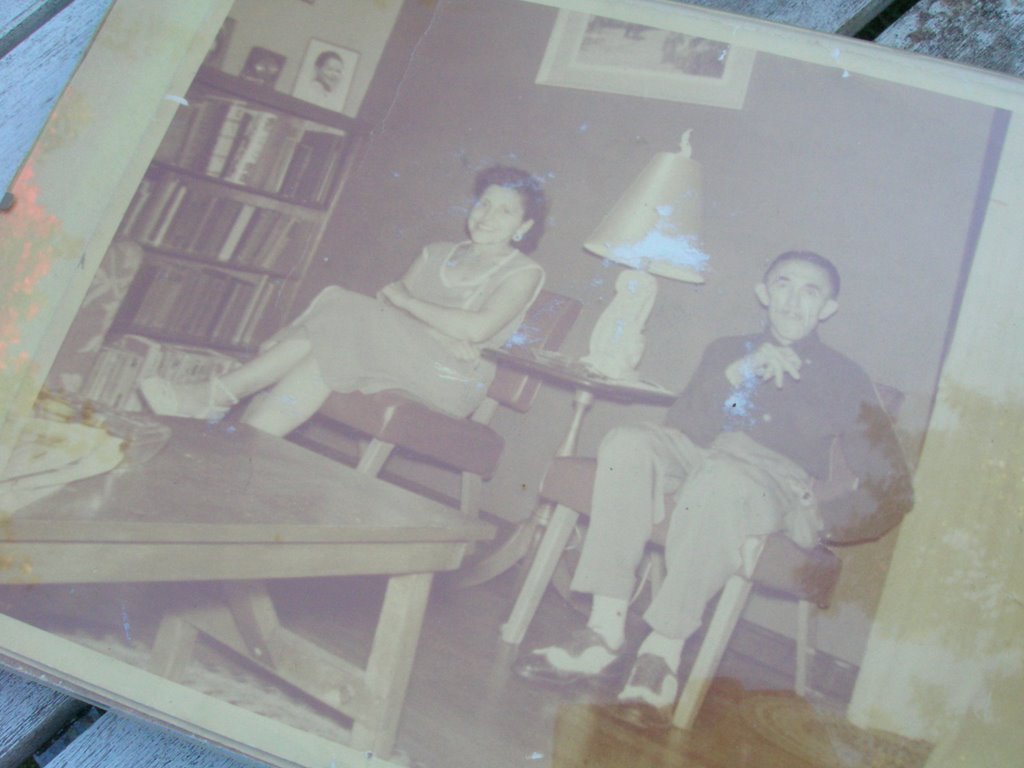
It's an exercise I often give to my students, to start with a photo--preferably an old photo--and see what it sparks.
This is an early photograph of my parents. I hadn’t planned on writing the poem below, but this photograph--along with another photo of my mother, years later--inspired me. This is what I wrote:
Fading Pictures
In the photograph, Mom and Dad sit on naugahyde
chairs. Mom wears that wide smile, now mine,
that she hates so much because her gums show. Dad
glimmers like a secret that yearns to be told
and squeezes a cigaret between two erect fingers.
A gold-framed photo of my brother
sits on the table between them.
I have not yet arrived.
They seemed so happy then, before Dad spent
his money on women. Before my brother
grew too old for his dreams. Before I married
beneath an ancient oak tree, sure that I would save
my children from the earth by having none.
Dad is long passed and Mom is far gone. Encased
in her tract home with an upstairs she never
uses. She boils chicken wings for her
Pomeranian that spins as it barks.
In the latest picture of Mom, she sits at her
kitchen table. Clutching a cigarette, she gazes
through the blinds at the barren winter landscape.
Empty chairs surround her table and I have to look
away from this already fading Kodak color.
The sadness in her eyes, the brittleness
of her crooked index finger. I cannot help
but wonder where the woman is who once tempted
any man who came near, who embarrassed
this daughter with her sexiness. Mom’s diamond
pendant, now mine, stuck in her cleavage. Men
just could not look away. With my small chest,
I cannot offer any place in which to wedge
that stone.
...................................................................
I ended up sending this to a local literary contest a bunch of years ago. The poem was a winner and was printed in Poetry Flash, a Bay Area literary journal.
Tuesday, October 31, 2006
Happy halloween!
Everyone reading this dresses up tonight, right, and goes trick or treating? Or stays home to treat the tricksters--in costume?
Halloween has always been one of my favorite holidays. When I was a kid, I convinced my mother that we had to begin three days early so we could visit all the houses in our somewhat rural neighborhood. I had three costumes, one for each night. Rather than stocking up on candy, I just wanted to be able to celebrate for longer than just one day.
Three nights prior to Halloween, my mother would drive me to the far reaches of the neighborhood. A typical scenario went like this:
I knock on a door. The light goes on and someone answers. They see me, alone, in costume, at their doorstep.
"Trick or treat!" I say, and hold out my bag.
The homeowner (nobody rented back then, not in our neighborhood) looks confused. "Is it Halloween?" he or she says.
"I begin early so I can visit everyone," I say.
"Oh...well....let me see what I can find." Inevitably, they throw change or a piece of fruit into my bag. Few are ready, yet, with candy.
...
My mother had no idea, and I suppose I didn't either, that trick or treating was only done on Halloween. My mother was raised with eight siblings by parents who were from Italy, who never even learned English, and couldn't have known the ins and outs of the American custom of Halloween.
These days I only dress up on the 31st, instead of two and three days prior, and so does Bry. We accompany Travis trick or treating. My costume tonight: a plastic surgeon. I bought an emergency room doctor's costume and plastic wrap to wrap about my body, here and there.
Should you dress up but stay home, try writing while in costume. See how it affects your writing. Or become the character you are dressed up as and write from that character's point of view.
Boo!
Halloween has always been one of my favorite holidays. When I was a kid, I convinced my mother that we had to begin three days early so we could visit all the houses in our somewhat rural neighborhood. I had three costumes, one for each night. Rather than stocking up on candy, I just wanted to be able to celebrate for longer than just one day.
Three nights prior to Halloween, my mother would drive me to the far reaches of the neighborhood. A typical scenario went like this:
I knock on a door. The light goes on and someone answers. They see me, alone, in costume, at their doorstep.
"Trick or treat!" I say, and hold out my bag.
The homeowner (nobody rented back then, not in our neighborhood) looks confused. "Is it Halloween?" he or she says.
"I begin early so I can visit everyone," I say.
"Oh...well....let me see what I can find." Inevitably, they throw change or a piece of fruit into my bag. Few are ready, yet, with candy.
...
My mother had no idea, and I suppose I didn't either, that trick or treating was only done on Halloween. My mother was raised with eight siblings by parents who were from Italy, who never even learned English, and couldn't have known the ins and outs of the American custom of Halloween.
These days I only dress up on the 31st, instead of two and three days prior, and so does Bry. We accompany Travis trick or treating. My costume tonight: a plastic surgeon. I bought an emergency room doctor's costume and plastic wrap to wrap about my body, here and there.
Should you dress up but stay home, try writing while in costume. See how it affects your writing. Or become the character you are dressed up as and write from that character's point of view.
Boo!
Wednesday, October 25, 2006
Richard Ford in today's New York Times
Richard Ford talks about his new book, The Lay of the Land in this New York Times story.
Also...I've been thinking a lot about why authors live where they live and how you find writers in certain areas more than in other areas.
For instance, where I live, in Orange County, California, there are few authors. UC-Irvine is here, with the MFA program that most writers would kill to get into and when they don't, no matter how talented they are, it scars them for years, it seems. But when writers graduate from UCI, most leave the area. They go to Los Angeles, Northern California or far away. Is it just the cost of real estate in these parts, or is it something else?
A friend from ASJA said there are some 500 writers, agents and editors who belong to a group in Montclair, NJ, who get together and do events. 500? There was a piece in the New York Times a while ago about how Brooklyn is overrun with writers.
I've been wanting to leave the O.C. for some time, but I doubt it's for the same reasons that other writers don't stay.
Just mulling.....if you have any thoughts, let them fly. I want to hear.
Also...I've been thinking a lot about why authors live where they live and how you find writers in certain areas more than in other areas.
For instance, where I live, in Orange County, California, there are few authors. UC-Irvine is here, with the MFA program that most writers would kill to get into and when they don't, no matter how talented they are, it scars them for years, it seems. But when writers graduate from UCI, most leave the area. They go to Los Angeles, Northern California or far away. Is it just the cost of real estate in these parts, or is it something else?
A friend from ASJA said there are some 500 writers, agents and editors who belong to a group in Montclair, NJ, who get together and do events. 500? There was a piece in the New York Times a while ago about how Brooklyn is overrun with writers.
I've been wanting to leave the O.C. for some time, but I doubt it's for the same reasons that other writers don't stay.
Just mulling.....if you have any thoughts, let them fly. I want to hear.
Friday, October 20, 2006
What I see from where I sit
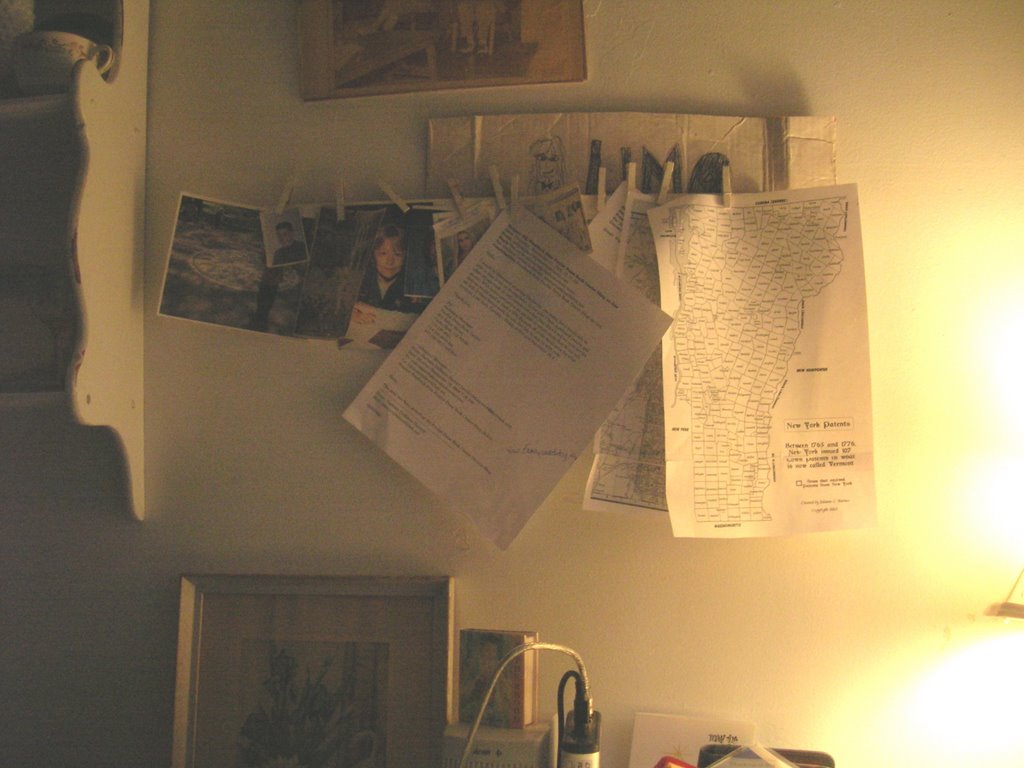
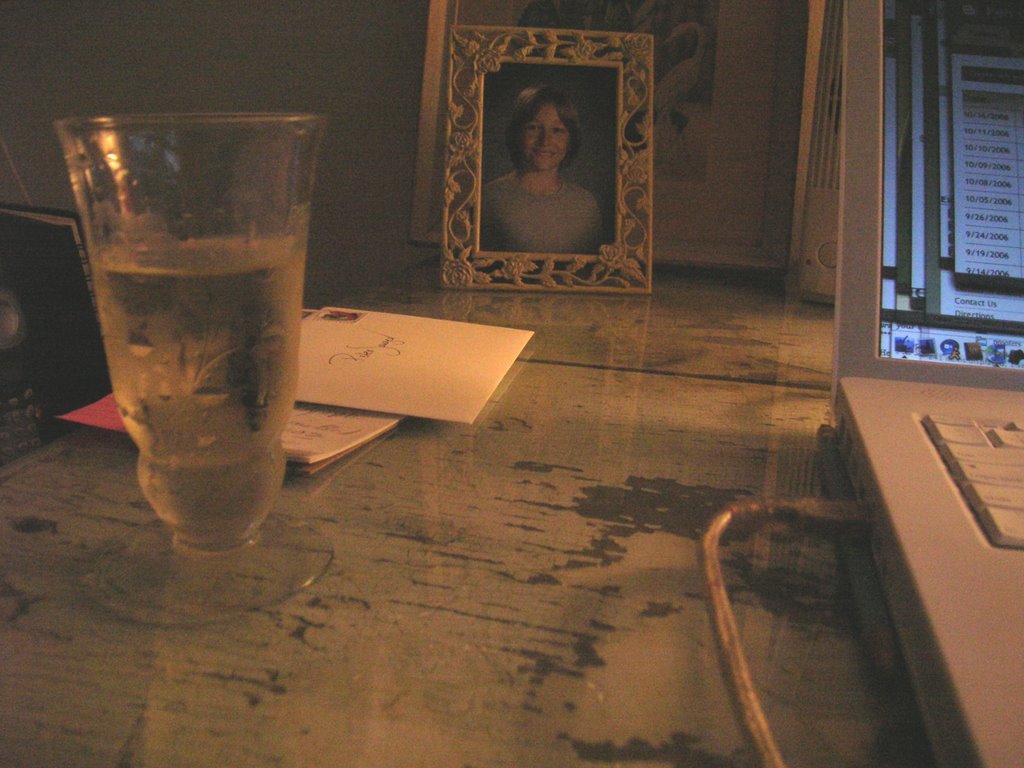
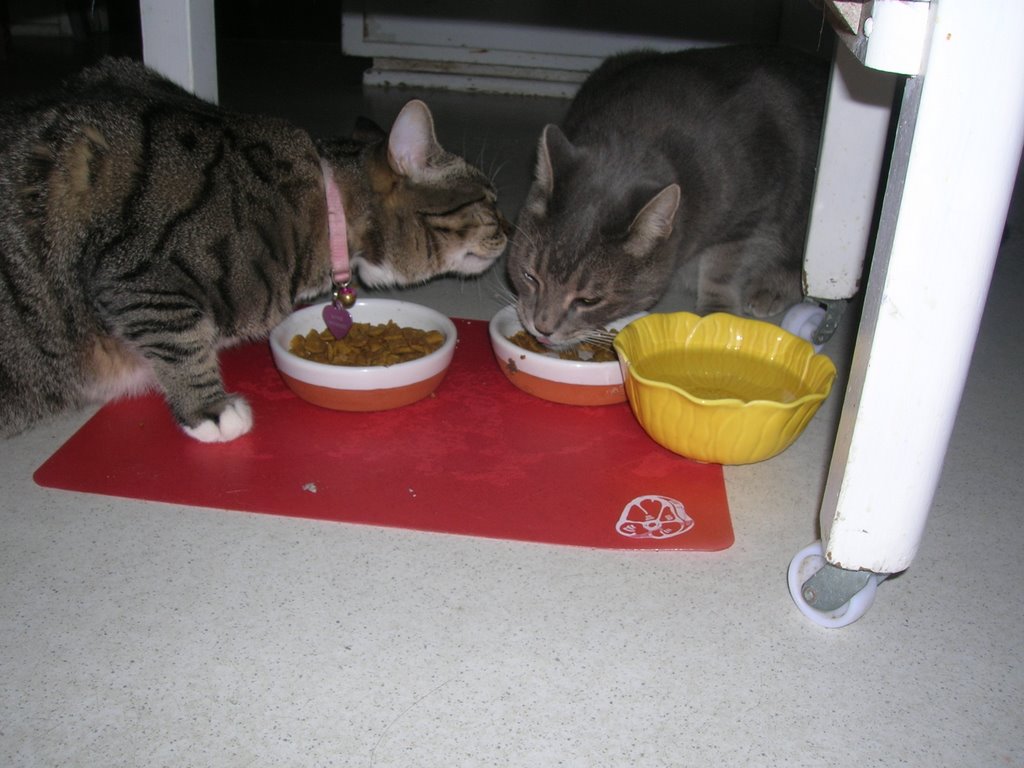
A map of Vermont hangs above my desk. (One is behind it, too.)
A glass of wine, a framed photograph of Travis.
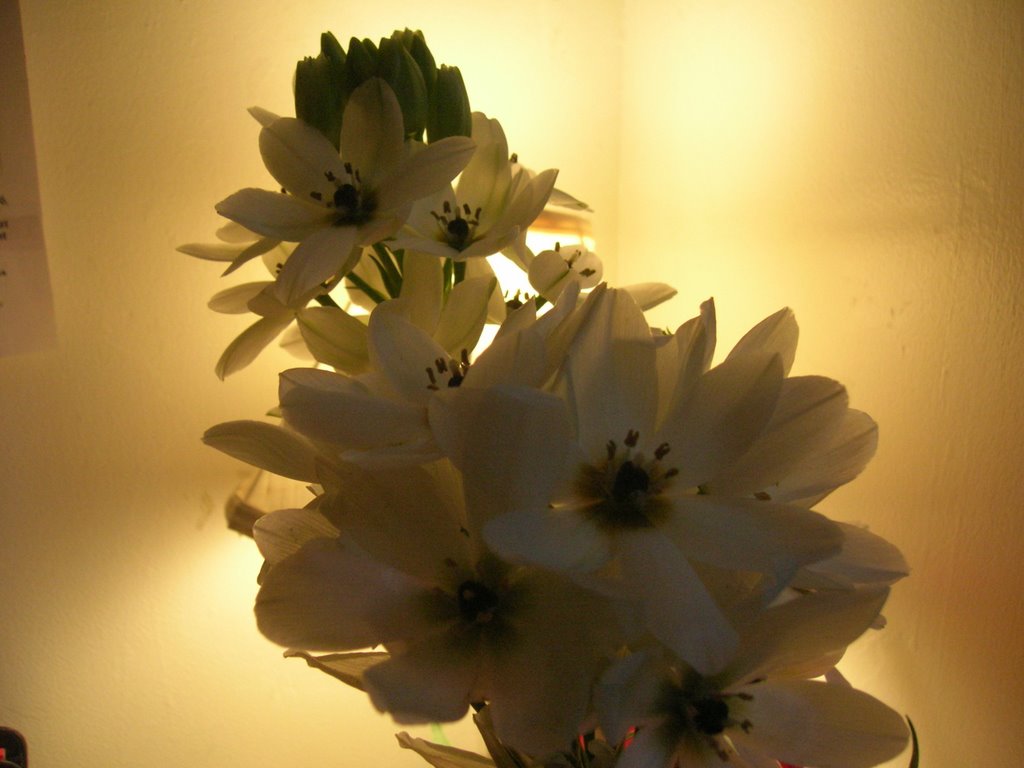
A birthday plant from Elle.
Our cats, doing what they do best.
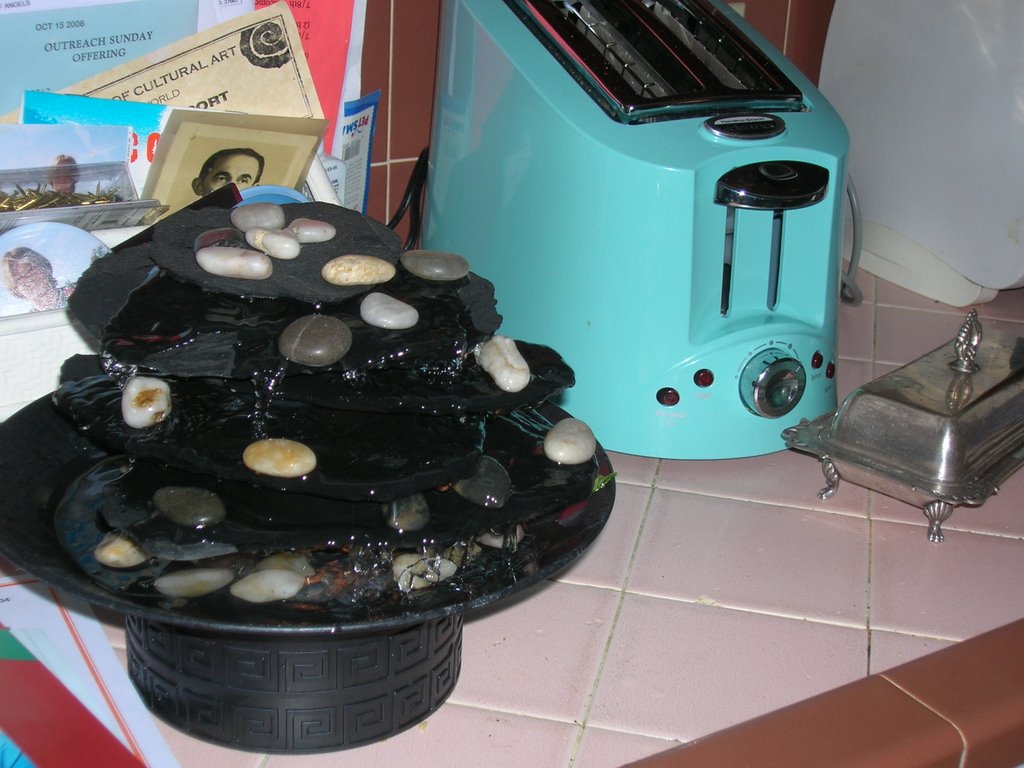
The mini-waterfall we bought at Ace Hardware that constantly runs and whispers to me that what I long for is the sound of a creek just outside my window. The aqua toaster burns toast but reminds me of a different time. So we keep it.
I want to see what is on and around your desk, what you see from where you sit. If you have a blog, take some pictures and post a link.
Monday, October 16, 2006
Raining cats and dogs

Wednesday, October 11, 2006
Anne Tyler's Digging to America
You know how when you read a book that you love, you are elated and then when it's over, you're sort of depressed, because you think there will never be another book that you'll love as much--and then there is, and you're elated all over again?
I'm reading Anne Tyler's newest novel and I will say, I love it as much as I loved Accidental Tourist, which was not only a great book, but a great movie adaptation.
This book also interests me because I sense Tyler infusing the book with her life, and I'm always interested in how we translate bits of our lives into fiction.
(Actually, I'm listening to it on CD, with Blair Brown--Days and Nights of Molly Dodd, with the wonder David Strathairn--doing a stellar job reading.)
What are you reading that you love?
I'm reading Anne Tyler's newest novel and I will say, I love it as much as I loved Accidental Tourist, which was not only a great book, but a great movie adaptation.
This book also interests me because I sense Tyler infusing the book with her life, and I'm always interested in how we translate bits of our lives into fiction.
(Actually, I'm listening to it on CD, with Blair Brown--Days and Nights of Molly Dodd, with the wonder David Strathairn--doing a stellar job reading.)
What are you reading that you love?
Tuesday, October 10, 2006
Life simulates art ....
...or TV, in any case. Ever see the Showtime TV show, Weeds? More specifically, the intro in which a line of SUVs (Range Rovers, I think) are exiting subdivision? I saw this this morning, the Corona del Mar version, that is.
I went for a walk and on my way home I was coming down the alley and at opposite ends of the alley, black SUVs were pulling out of their garages at the same exact moment, same angle, everything. Then they passed one another. One guy was on a cell phone. Of course.
Remember that old Animals' song with the lines: We gotta get out of this place / If its the last thing we ever do / We gotta get out of this place / 'Cause girl, there's a better life / For me and you ...
Uh, yeah.....the song is very much on my mind. The show is interesting, but I don't want to be living it.
I went for a walk and on my way home I was coming down the alley and at opposite ends of the alley, black SUVs were pulling out of their garages at the same exact moment, same angle, everything. Then they passed one another. One guy was on a cell phone. Of course.
Remember that old Animals' song with the lines: We gotta get out of this place / If its the last thing we ever do / We gotta get out of this place / 'Cause girl, there's a better life / For me and you ...
Uh, yeah.....the song is very much on my mind. The show is interesting, but I don't want to be living it.
Monday, October 09, 2006
Stayin' alive, stayin' alive...
In today's Los Angeles Times, there's a story about how independent bookstores that want to stay alive pretty much need to do more than just sell books. They need to sell food, hold performances, form membership programs, and hire employees who can talk books--imagine!
Interestingly, the piece also talks about how there's been a turnaround, that indie bookstores are opening at a rate of "60, 70, 80 stores" each year.
Sounds great to me.
What do you think about bookstores needing to take on additional roles, other than just selling books?
Interestingly, the piece also talks about how there's been a turnaround, that indie bookstores are opening at a rate of "60, 70, 80 stores" each year.
Sounds great to me.
What do you think about bookstores needing to take on additional roles, other than just selling books?
Sunday, October 08, 2006
When you no longer care so much.....
....it happens. Or seems to. Your story, essay, book sells. The other night Melissa Bank came on my show and talked about how she worked on The Girl's Guide to Hunting and Fishing for 10 years and endured a ton of rejections and it wasn't until she had given up, until she just didn't care anymore, in a deep way, about being published, that her book sold. She was as committed to writing as ever--it was what she did--but she no longer had that deep, longing need to be published. Everyone who has been published and who hasn't been published, but wants to be, knows what this is. It's horrible.
I was at that point with Pen on Fire, too. I had been making jewelry and my web designer was putting together a web site because I was no longer banking on getting a book out there. We were thinking of moving back to Vermont and planned a trip to New England right after I sent my proposal off to my agent. Not long after we returned to California, with thoughts to move and with my designer putting together a web site, my book went to auction and sold.
When we are feeling needy for anything, whatever that thing is, it seems to elude us. When you're not in a relationship, and you just have to have a relationship, there are no relationships to be had. It's when you say, Screw it, I'm through with men/women, that someone seems to magically appear.
I was at that point with Pen on Fire, too. I had been making jewelry and my web designer was putting together a web site because I was no longer banking on getting a book out there. We were thinking of moving back to Vermont and planned a trip to New England right after I sent my proposal off to my agent. Not long after we returned to California, with thoughts to move and with my designer putting together a web site, my book went to auction and sold.
When we are feeling needy for anything, whatever that thing is, it seems to elude us. When you're not in a relationship, and you just have to have a relationship, there are no relationships to be had. It's when you say, Screw it, I'm through with men/women, that someone seems to magically appear.
Thursday, October 05, 2006
Books to help you along the way

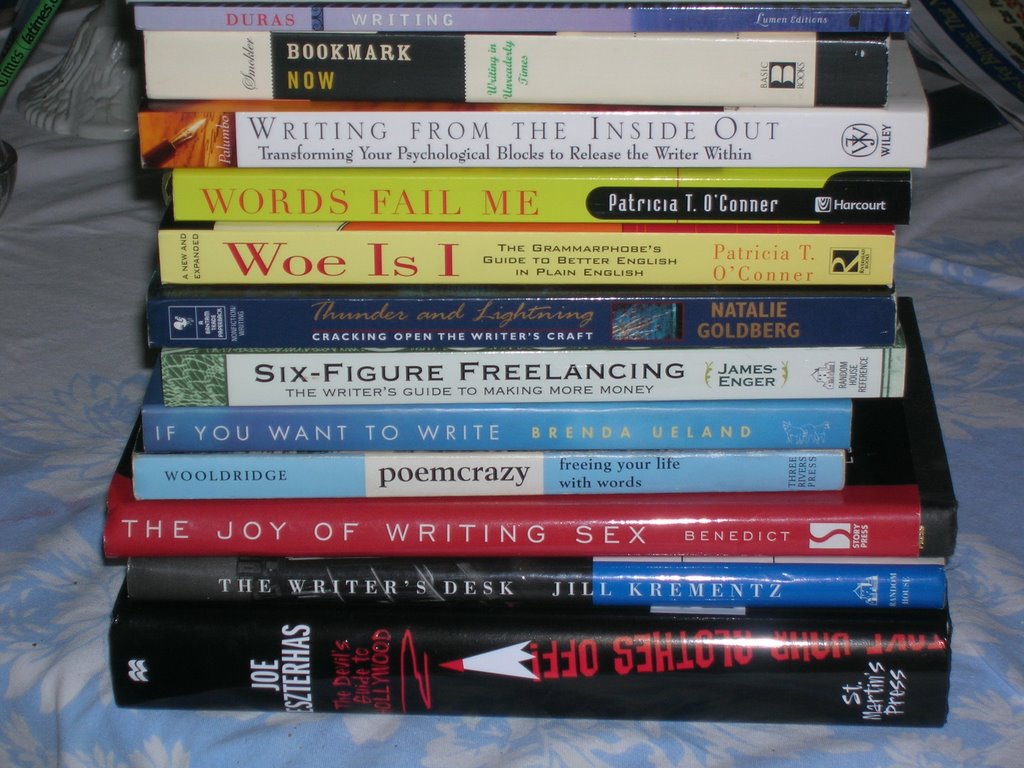
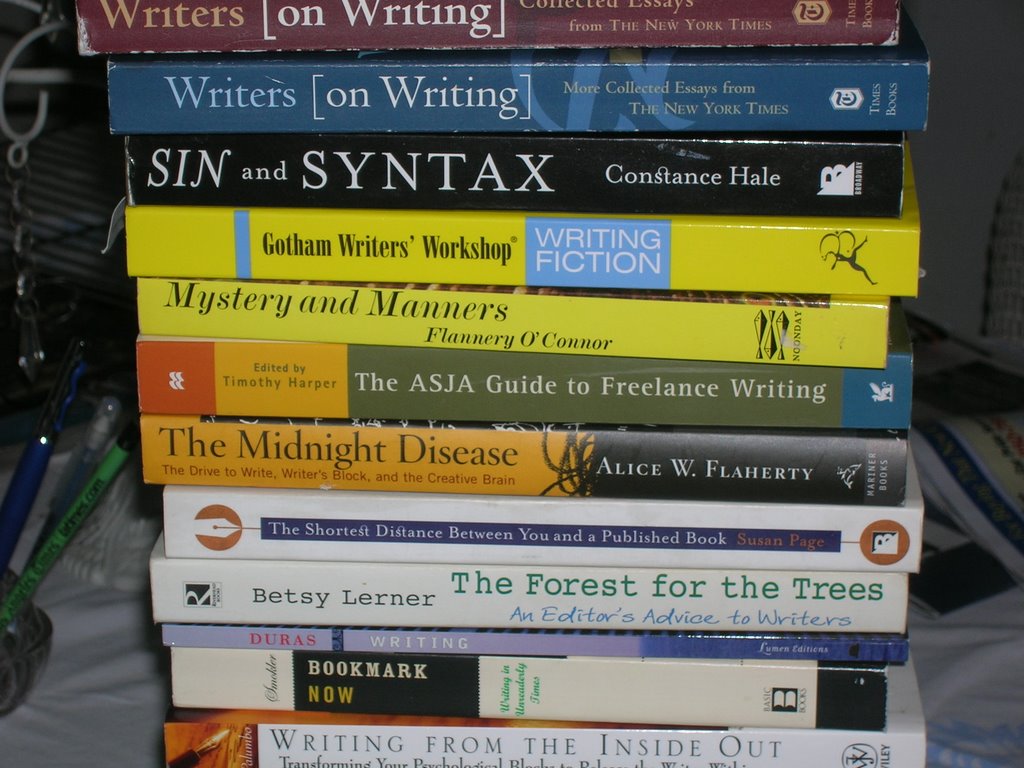
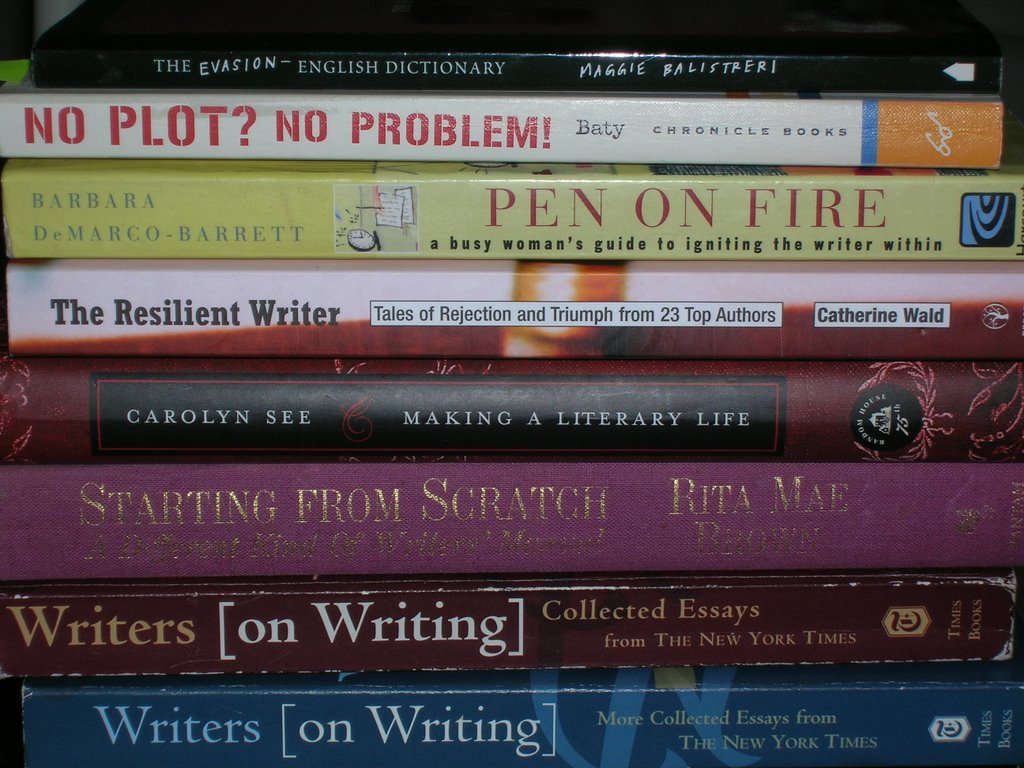
I just heard from a writer who was dealing with a rejection and the discouragement it brings. And I thought, as writers, we so need to keep the faith. Of course hearing authors' tales of woe and ultimate success help. So do writing books. So here's my short list on writing books that will help you keep the faith. And help you with craft and all that, too.
Actually, here's a picture of them. First, an almost toppling stack, then closeups so you can see titles. I regularly recommend all of these titles.
Tuesday, September 26, 2006
On short story collections
Kathryn A. posted a question in the comment area of Sunday's blog on lengths. She wants to know about short story collections, what does "full length" collection mean.
I would think it means that the publisher is looking to publish book length collections of short stories. So if your stories are a page long, then you'd probably need at least 200 stories to make up a collection and if they were 50 pages long (too long!), then you'd need at least four.
What I hear over and over from agents and authors of short story collections is that unless most of the stories that make up your collection have been published in prominent literary journals and magazines, it will be almost impossible to find a publisher. Even well-known short story writers are encouraged (prodded) by their agents and editors to write novels.
Nothing's impossible, though. And if a short story writer is what you are, then that's what you have to do.
Work to get them placed in respected journals: Tin House, Granta, Glimmer Train, Zoetrope, Ploughshares, New Yorker, etcetera etcetera. A story in Pig Farmers Quarterly just won't impress.
Does this help, K.?
I would think it means that the publisher is looking to publish book length collections of short stories. So if your stories are a page long, then you'd probably need at least 200 stories to make up a collection and if they were 50 pages long (too long!), then you'd need at least four.
What I hear over and over from agents and authors of short story collections is that unless most of the stories that make up your collection have been published in prominent literary journals and magazines, it will be almost impossible to find a publisher. Even well-known short story writers are encouraged (prodded) by their agents and editors to write novels.
Nothing's impossible, though. And if a short story writer is what you are, then that's what you have to do.
Work to get them placed in respected journals: Tin House, Granta, Glimmer Train, Zoetrope, Ploughshares, New Yorker, etcetera etcetera. A story in Pig Farmers Quarterly just won't impress.
Does this help, K.?
Sunday, September 24, 2006
Going to great lengths--or not
A former student who now lives in Hawaii wrote to me and asked me about the word lengths of short stories, novellas and novels.
The last short story I wrote when I was at Goddard College ran 9,000 words. LONG. My instuctor, the novelist Kathryn Davis, never talked about word lengths. She was more interested in the art of the story, and in craft, and figured a story would run as long or short as it needed to. I, of course, had no idea that it would be considered too long, though I did end up placing it in a literary journal. Short stories run typically 1,500 - 3,000 words, with some as short as 250 words. Amy Hempel has some very short stories--a couple of paragraphs--and there are anthologies called Flash Fiction and Sudden Fiction with these very short shorts. I also always say, whatever works...works. If you are writing a story that is running long, let it. Let it be what it is going to be. From writing that long short story, I came to realize I was more interested in book length pieces.
A novella, even more difficult to place than a short story, said the wonderful short story writer Antonya Nelson when she came on my show, and tend to run around 20,000 words to 40,000 words give or take a few thou.
Novels usually begin at 50,000 words and go to 100,000. For first novels, to go longer than that, I hear, is taking your life into your own hands. At 50,000 words, picture Brave New World, picture Animal Farm.
But again, if it works, it works, no matter the length.
The last short story I wrote when I was at Goddard College ran 9,000 words. LONG. My instuctor, the novelist Kathryn Davis, never talked about word lengths. She was more interested in the art of the story, and in craft, and figured a story would run as long or short as it needed to. I, of course, had no idea that it would be considered too long, though I did end up placing it in a literary journal. Short stories run typically 1,500 - 3,000 words, with some as short as 250 words. Amy Hempel has some very short stories--a couple of paragraphs--and there are anthologies called Flash Fiction and Sudden Fiction with these very short shorts. I also always say, whatever works...works. If you are writing a story that is running long, let it. Let it be what it is going to be. From writing that long short story, I came to realize I was more interested in book length pieces.
A novella, even more difficult to place than a short story, said the wonderful short story writer Antonya Nelson when she came on my show, and tend to run around 20,000 words to 40,000 words give or take a few thou.
Novels usually begin at 50,000 words and go to 100,000. For first novels, to go longer than that, I hear, is taking your life into your own hands. At 50,000 words, picture Brave New World, picture Animal Farm.
But again, if it works, it works, no matter the length.
Tuesday, September 19, 2006
Joe Eszterhas and serendipity
I've been hosting, producing and engineering my radio show for something like nine years; truthfully, I've lost track. My son was a toddler when I began--I know that because when he would come with me to the show, I would often hear him clomping and jumping and screaming happily in the lobby and in the hallway. He is 12 now, and when he comes with me he is much calmer, doing homework or reading or skateboarding outside and every so often he looks at me through the window in the door to the studio, checking in, telling me he's there and that everything's fine.
Sometimes I feel overwhelmed with doing the show along with everything else that I do (which is why I've been using my guest host Debbie Keith more and more) but I keep doing it because of the people I meet, most of whom I would not meet otherwise. I've never been the sort of person who emails or calls someone and says, "Hey, I'd love to pick your brain. How about I take you to lunch the next time I'm in town?" It's just not me.
The great thing about my show is I pick who I interview. No one is foisted upon me. And last week I had the good fortune of interviewing Joe Eszterhas, the very successful, rebellious, anti-Hollywood screenwriter. He wrote Basic Instinct, Flashdance, Music Box and Jagged Edge. I met him through his daughter Suzanne Perryman who had written to me after she read my book and started listening to my show. At some point she said she was his daughter and would I be interested in having him on my show when his new book came out?
Serendipity is a wonderful thing. OF COURSE I WOULD BE INTERESTED, I told her. I'd admired the guy for years and years, his independent spirit and ability to not become a part of the Hollywood clique while becoming immensely successful.
The interview is now in the archive and you can listen to it at http://writersonwriting.blogspot.com.
As an afterthought, I must say that this blog post was inspired by another PA host at KUCI, T.R. Black. After my interview with Joe, T.R. wrote and said, "I especially enjoyed (all of your interviews are good) your conversation with Joe Eszterhas on Thursday. I have always liked his screenwriting and find him a compelling character. In that I see over 200 films per year in theatres, I have seen nearly all of the films with which he has been involved (sans Big Shots). I too, think The Music Box is his best effort. It is complimented by an A-list cast featuring a strong performance by Jessica Lange. He has been written about in the LA Times on many occasions, and featured o television and radio, as well. But, I thought you evoked some original answers and really had a special rapport with him. Very illuminating."
Sometimes I feel overwhelmed with doing the show along with everything else that I do (which is why I've been using my guest host Debbie Keith more and more) but I keep doing it because of the people I meet, most of whom I would not meet otherwise. I've never been the sort of person who emails or calls someone and says, "Hey, I'd love to pick your brain. How about I take you to lunch the next time I'm in town?" It's just not me.
The great thing about my show is I pick who I interview. No one is foisted upon me. And last week I had the good fortune of interviewing Joe Eszterhas, the very successful, rebellious, anti-Hollywood screenwriter. He wrote Basic Instinct, Flashdance, Music Box and Jagged Edge. I met him through his daughter Suzanne Perryman who had written to me after she read my book and started listening to my show. At some point she said she was his daughter and would I be interested in having him on my show when his new book came out?
Serendipity is a wonderful thing. OF COURSE I WOULD BE INTERESTED, I told her. I'd admired the guy for years and years, his independent spirit and ability to not become a part of the Hollywood clique while becoming immensely successful.
The interview is now in the archive and you can listen to it at http://writersonwriting.blogspot.com.
As an afterthought, I must say that this blog post was inspired by another PA host at KUCI, T.R. Black. After my interview with Joe, T.R. wrote and said, "I especially enjoyed (all of your interviews are good) your conversation with Joe Eszterhas on Thursday. I have always liked his screenwriting and find him a compelling character. In that I see over 200 films per year in theatres, I have seen nearly all of the films with which he has been involved (sans Big Shots). I too, think The Music Box is his best effort. It is complimented by an A-list cast featuring a strong performance by Jessica Lange. He has been written about in the LA Times on many occasions, and featured o television and radio, as well. But, I thought you evoked some original answers and really had a special rapport with him. Very illuminating."
Thursday, September 14, 2006
Beware contests
Sigh...yet another contest for unpublished novelists has been announced. Lest you think I am recommending this contest, I am not. I'm cautioning you about this contest and all contests that charge reading fees.
The very wonderful short story writer Ron Carlson (and contest judge) said that contests do one thing: They get you out of bed.
But they do little else. Because they get you and every other aspiring writer out of bed to write, the competition is fierce. So you send off your story or your chapters with your fee and you wait and hope and wait.
Many contests don't even have to award the prize if the readers feel that no one qualifies.
Listen, it's hard to publish fiction, but it's still possible. Look at all the novels coming out, all the short stories. You do need a combo of great writing and sheer good luck. Doesn't hurt if you have some great publication credits or a famous writer who knows and loves you.
But contests, they make you feel like something is happening when nothing necessarily is.
If you insist on submitting to contests, though, search out the good ones. Look on the acknowledgment pages of novels for the names of contests that the author is thanking. And then make sure your story or novel exerpt (or entire novel) is stellar--as stellar as you can possibly make it. Those first paragraphs/pages mean so much.
The very wonderful short story writer Ron Carlson (and contest judge) said that contests do one thing: They get you out of bed.
But they do little else. Because they get you and every other aspiring writer out of bed to write, the competition is fierce. So you send off your story or your chapters with your fee and you wait and hope and wait.
Many contests don't even have to award the prize if the readers feel that no one qualifies.
Listen, it's hard to publish fiction, but it's still possible. Look at all the novels coming out, all the short stories. You do need a combo of great writing and sheer good luck. Doesn't hurt if you have some great publication credits or a famous writer who knows and loves you.
But contests, they make you feel like something is happening when nothing necessarily is.
If you insist on submitting to contests, though, search out the good ones. Look on the acknowledgment pages of novels for the names of contests that the author is thanking. And then make sure your story or novel exerpt (or entire novel) is stellar--as stellar as you can possibly make it. Those first paragraphs/pages mean so much.
Friday, September 08, 2006
Reading phases
Deborah's comment yesterday got me thinking about phases my reading has traversed.
In high school I read a few books of merit, but mostly I read--um--trash. One title was Swing High Sweet Pussycat. I suppose it was romance. Amazon doesn't list it so who knows. Toward the end of high school and in the years between it and college, I read essays (Paul Williams--the writer, not the singer), Jack Kerouac and the Beats, bought Swann's Way by Proust though I never finished it, and tried to read Rod McKuen but it didn't work. I read The Prophet and lots of books about California, especially Haight Ashbury. I wanted to travel to L.A. and do Primal Scream therapy, but I was too young. (Remember Janov?) I read books on gestalt therapy and read Jung.
At Goddard, I discovered Raymond Carver, the poet Stephen Dobyns, Michael Ryan (whom I later came to know), and the magical realists. Borge struck a chord. So did James Baldwin. I loved all of his novels, especially Giovanni's Room. I loved Margaret Atwood's Edible Woman and Surfacing. I admired Virgina Woolf and I believe I wanted to be her, though her writing wasn't my favorite. Henry James' Portrait of a Lady I liked very much.
Later, Terry McMillan's first novel Mama impressed me, and so did Clarence Major's first novel (he's mostly known as a poet), Such was the Season. Joan Didion.
Then writers like Amy Hempel and T. Jefferson Parker (my favorite crime writer) and Don DeLillo came onto the radar screen. And now....now there are too many to mention. I've made lists on my Web site, penonfire.com and at Readerville.com, on my author's page, but they are inconclusive lists because they just keep growing. I just finished Lolly Winston's Happiness Sold Separately and LOVED it.
I hate writing about my favorite books because as soon as I say what one is, another pops up.
What are you reading and how has your reading changed over the years?
In high school I read a few books of merit, but mostly I read--um--trash. One title was Swing High Sweet Pussycat. I suppose it was romance. Amazon doesn't list it so who knows. Toward the end of high school and in the years between it and college, I read essays (Paul Williams--the writer, not the singer), Jack Kerouac and the Beats, bought Swann's Way by Proust though I never finished it, and tried to read Rod McKuen but it didn't work. I read The Prophet and lots of books about California, especially Haight Ashbury. I wanted to travel to L.A. and do Primal Scream therapy, but I was too young. (Remember Janov?) I read books on gestalt therapy and read Jung.
At Goddard, I discovered Raymond Carver, the poet Stephen Dobyns, Michael Ryan (whom I later came to know), and the magical realists. Borge struck a chord. So did James Baldwin. I loved all of his novels, especially Giovanni's Room. I loved Margaret Atwood's Edible Woman and Surfacing. I admired Virgina Woolf and I believe I wanted to be her, though her writing wasn't my favorite. Henry James' Portrait of a Lady I liked very much.
Later, Terry McMillan's first novel Mama impressed me, and so did Clarence Major's first novel (he's mostly known as a poet), Such was the Season. Joan Didion.
Then writers like Amy Hempel and T. Jefferson Parker (my favorite crime writer) and Don DeLillo came onto the radar screen. And now....now there are too many to mention. I've made lists on my Web site, penonfire.com and at Readerville.com, on my author's page, but they are inconclusive lists because they just keep growing. I just finished Lolly Winston's Happiness Sold Separately and LOVED it.
I hate writing about my favorite books because as soon as I say what one is, another pops up.
What are you reading and how has your reading changed over the years?
Wednesday, September 06, 2006
What Hemingway might have to do if he were writing today
My friend Jordie called me yesterday about an op-ed piece in the Los Angeles Times: "What Hemingway didn't have to do." The piece was by Michelle Slatalla who wrote about how authors, these days, must do promotion. Jordie is upset at the state of publishing and wishes things were different, like in the old days, when writers wrote and publishers promoted.
I don't know what to say about this. It depresses him, this state of publishing, Me, I accept it. Doesn't hurt that from '89 to '96 I had a small publicity biz and thought it was fun to get a client's name in the paper or get a reporter to call him/her just because I wrote up a press release and sent it to the paper.
I'm not an extrovert and yet I do find it fun to give talks and teach. I mean, you can only write so much, and then it's time to get off your butt and get out of the house.
Jordie's an extrovert so I doubt this is the problem. Maybe he's too much an extrovert and longs to be able to sit at his desk and muse and write; he's a wonderful writer. But he's disgusted with the publishing biz and I wonder if this discouragement causes him to just not write so much anymore.
I can see it from the publisher's point of view (the problem with being a Libra is you can see things from not just both sides, but multiple sides--from each facet!).
Publishers publish books and need to make money doing so. Publishers aren't exactly big business. So what should they do? If they publish a book and it just sits there, who's fault is it? It's theirs for not promoting it, but isn't it also the writer's fault, for not doing what he/she can do to get it out there? And if no one is buying, who's fault is that? Good books do sell via word of mouth, so a writer can do virtually no PR and if readers love it, it will sell.
It's a complicated issue with no easy solution. There's so much else to take up a reader's time. You're reading this blog, yes? At one time there was no blog and no Internet and so you'd read the paper or--ahem--a book.
On the other hand, maybe you read as many books as you did before the Internet. I do. I just don't watch TV anymore--except, of course, for the Turner Classic Movie channel. Yes, I've seen To Kill a Mockingbird numerous times and I will continue to, so shush.
What do we do, as writers, to support the publishing industry? Buy new books or used books? Borrow books from the library or a friend? This doesn't really support publishing. Or, if you write poetry, do you buy books of poetry? Or look up poems on the Internet? We've got to buy books to keep the machine lubricated.
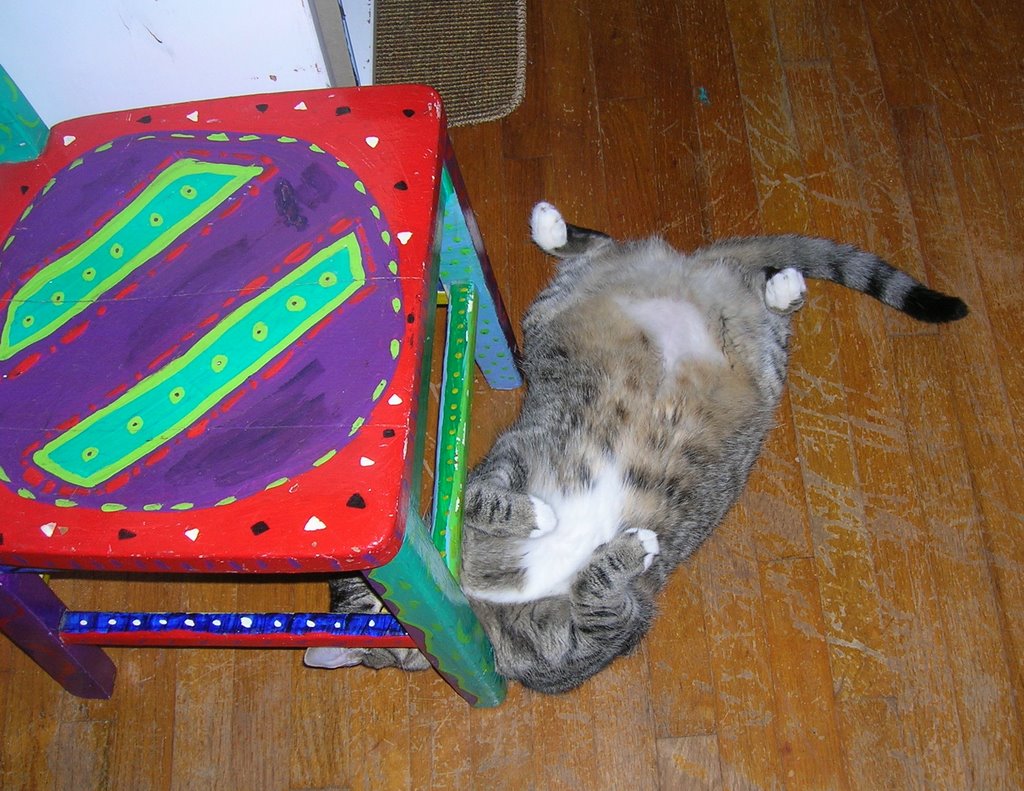
Don't we? Or do we hide out heads under bushel baskets and chairs, like Rosie is doing above? Slatalla came up with a creative way to promote her book--by writing a piece for the L.A. Times. The piece might be construed as complaining or whining about publishing, when in fact she's having fun with it. No?
Friday, September 01, 2006
Books on the mantle in September

The shades of fall--fall back east, that is, or up in the mountains--are back on the mantle. Here in the O.C., a few blocks from the beach, yards and trees glow green. If you want to see evidence of fall, you look to the hills. The South gets hurricanes; Southern California is headed into fire season.
It's Friday afternoon. Travis is at the beach with a friend and his mom. Brian's out doing errands. I just worked on Starletta's Kitchen using the timer; the timer works over and over again, no matter how long you've been writing. Once you set it you just can't turn it off. You've got to write till it goes off on its own.
I bought a paper shredder today. TC Boyle's novel (Talk Talk) and his words on my show--"I shred, and then I burn"--are fresh in my mind. It shreds credit cards, staples, paper. Cross-cut shreds.
Travis is shredding his workbooks from the 6th grade, now that he's veering into 7th.
Subscribe to:
Posts (Atom)


 Posts
Posts

