Once you listen to the podcast of my show with Glen (posted yesterday), finish up with reading here. Questions we didn't have time for on the show.
Was the first graf, and the first chapter, always the beginning? Or did you revise the beginning over and over?
Believe it or not, the answer to both those questions is yes. Intuitively, I knew I had to start The Jack Bank with those many lessons I remember from childhood about Kruger National Park, where we lived, being a paradise. A few years earlier, I’d written an essay—“Kitsch and the Art of Wildlife Painting,” published in The Massachusetts Review in 2004—about how much I hated African paintings, because to me they projected a kind of false idealism about animals I actually found very scary as a young kid. I linked this feeling of falseness to the general sense I had as a boy that something was untrue about the whites-only paradise created by apartheid—smiling black maids, happy gardeners, crime-free streets, and middle-class comfort. I sensed that this general cheerfulness disguised a very deep racial pain, much as I looked at the pictures of leopards lounging in thorn trees and wondered why the butchered warthogs I saw in the real world never made it onto living-room walls.
So if the first chapter was going to be about my earliest memories of physical vulnerability, due to dangerous animals, then the opening scene had to be about the illusion that I was immortal and safe, because I lived in an earthly heaven.
That said, I worked endlessly on all the sentences and paragraphs in that opening, shortening them, pulling out only the most relevant and evocative details, and trying to be true to my recollections.
The title: At what point did you have it (the subtitle as well)?
The title was the first thing I had. On our podcast I talked about the jack bank as a controlling metaphor for the book—the idea that if we invest in violence and cruelty, it earns compound interest. Also, that the book came out of an essay called “The Jack Bank,” which I published in Virginia Quarterly Review. It never seemed to me the book could be called anything else. The memory of that school prefect allowing us to deposit beatings and earn interest on them, and the enthusiasm with which all of us younger boys volunteered to be hurt—this was all just so weird to me, so haunting. To me, it said more about story of coming to terms with apartheid’s violent side, and my own temptation to solve conflicts with violence—than any other recollection in the book.
The subtitle merited a bit more discussion. As we said in the interview, this memoir sits close to the “fiction” end of the journalism-novel continuum. I gave myself permission to make educated guesses about what happened. Written in the present tense, the book reads much like a novel. I briefly talked with my editor as well with the St Martin’s Press lawyers about whether these artistic liberties meant I could no longer call The Jack Bank “memoir.” They agreed that so long as it was a good faith attempt to recreate the past, and as long as I was upfront in my Author’s Note about my artistic methodology, there wasn’t a problem. I really don’t have the faintest doubt that this is my personal story rather than that of a fictional character’s, so I stand by the subtitle.
My editor suggested, “Memoir of a South African Childhood” rather than just “A Memoir,” so as to send a signal to readers about the book’s content.
Re memoir as a form....one editor I spoke with said she thought memoir was replacing the novel as the most popular genre, that as a culture we are so into reality everything, the memoir is the written form of reality shows. What do you think about this?
There may be a grain of truth in the idea. The novel rose to prominence with the bourgeois nuclear family. Before the eighteenth and nineteenth centuries, almost everyone in Europe would have known all about their neighbors’ lives, as a result of living on top of them in a crowded village. Street chitchat and evenings around the hearth with family and friends would have provided more stories, which is to say more knowledge of how to deal with life. But as more people moved into large, middle class, private houses, they needed different forms of storytelling. The novel allowed them to live vicariously, and thus learn how to cope with life, while preserving their and other middle-class people’s privacy.
The big change came, I think, not with Survivor and Jersey Shore, but in the 1960s and 70s, with feminism, Black liberation, and gay liberation. Suddenly, privacy wasn’t a source of freedom, power, and privilege anymore. It provided a screen for women and children to be abused in the home. It provided a way for society to hold LGBT people in contempt while still enjoying our talents—if your hairdresser is in the closet, you don’t have to grant him any rights. Ordinary people came to believe the personal was political and should therefore be given voice. In popular culture, this eventually led to reality TV; in universities, among other things it fed the growth of creative writing programs. Community, as an alternative to isolated suburban family, made something of a comeback—remember hippy communes and women’s consciousness-raising groups?
I write out of that intellectual tradition of 60’s style activism—in the book I talk about my years in feminist, socialist, anti-apartheid, and gay activist circles. Hence my statement in my Author’s Note that I continue to believe in memoir as a social act, because if no one is willing to break the protective veil of silence over individual lives, how will we ever learn from each other? But it’s important to distinguish literary memoir from Big Brother 8. The memoirist digs deeper, and tells her story with more artistry, than the housemates talking about kitchen crumbs or bedroom shenanigans.
Also, novels and memoirs are always going to provide different pleasures to readers. With memoir comes testimony—someone saying this is an honest attempt to be real. But with novel comes the extraordinary joy of seeing an author’s imagination ranging free. That satisfaction will never be redundant.
Were there memoirs you found inspirational or informative as you were writing yours?
So many! Clearly, my main influences were the more novelistic memoirs. Angela Ashes made me want to write in a filtered child’s voice, where the language and perception is simultaneously that of a young person’s and that of an adult looking back and shaping what the child sees. The Glass Castle showed me what could be done with a brilliant but subtle overarching metaphor.
J.M. Coetzee’s memoir, Boyhood, resonated both in subject matter—he writes about many of the same things I do, like English-Afrikaans tension and the masochistic pleasure white South African boys took in corporal punishment—and in style. I loved the way he wrote his whole story in third person, present tense. I almost did the same, except that as a first time author I didn’t think I could get away with third person. I did use the present tense. Both formal choices—third person and present tense—are signals to readers that the author is giving himself permission to re-imagine the past.
I didn’t like all of the Afro-pessimism in Rian Malan’s My Traitor’s Heart, but it would disingenuous of me to pretend that memoir didn’t deeply influence my vision of South African culture—both black and white—as being soaked in extraordinary violence, as a result of our strange history.
I read and re-read Vivian Gornick, George Orwell, and Natalia Ginzburg to inspire me to write with the clarity that I think is my literary aesthetic. Fierce Attachments was my model of a “movement memoir” that never became preachy or didactic. Ginzburg’s classic essay, “He and I,” about the ups and downs of an intimate relationship, was the inspiration for my chapter about Afrikaners. The chapter title, “Them and Me,” is a nod to Ginzburg.
I love memoirs with poetry and collage in them, like Ondaatje’s Running in the Family and Nick Flynn’s Another Bullshit Night in Suck City. Books that make fun of the genre help me keep my feet on the ground. I think of Dave Eggers’s A Heartbreaking Work of Staggering Genius and, even better, Lauren Slater’s Lying. The latter is a true heartbreaking (and hilarious) work of staggering genius! You can’t read it and take yourself completely seriously; she reminds us that the act of self-characterization on the page is inevitably a kind of lie or at least oversimplification.
Structure: You had so many topics in your book. Was it a challenge knowing what to keep and what to leave out, and how did you decide how much ink to give each?
There was no system. It was intuitive. In my head I was trying to tell a story rather than explore topics, so I addressed topics only to the extent that this felt relevant to my central question, which was: “What did it mean to me to grow up in a culture with an abusive streak?”
My editor asked for more about faith and about religion, and I agreed with her, so in the final draft I added the section in chapter 7 about losing my Catholicism in comparative religion class. This narrative does “talk” to the main story in the chapter, where my friend Aubrey is teaching me to take risks that my previous Catholic faith might not have permitted.
What was harder than leaving out topics was leaving out sub-narratives. At moments I felt as if I was lying to readers, but really, all I was doing was keeping the book manageable. For instance, in the second chapter, Kobus van der Walt and I had had a history together. We’d played together, got along and then annoyed each other—so when he prevents me from entering the hall to see what the Afrikaner Nationalist youth group is doing, there are more emotional layers than I let on to readers. But I couldn’t figure out how to discuss all this without hopelessly slowing down—and distracting from—the story I was trying to tell in the chapter, so I focused only on the cultural dimension, the fact that this was another way I couldn’t be Afrikaans. Without making ruthless cuts like this, I don’t think it’s possible to write a coherent autobiographical narrative.
Agents and editors constantly talk about voice, in terms of memoir, that voice is—if not everything, it’s a LOT of why they’re attracted to certain memoirs and not attracted to others. Do you think voice makes a difference whether a memoir will be compelling, or will it always be the big story, the dramatic story, that’s the most compelling?
Yes--voice, voice, voice, that’s what matters—not the big story!
Look, I’m not going to pretend some inherent drama doesn’t help. As a memoirist I don’t regret my material--the lions outside my tent when I was ten years old, the proximity to a notorious serial killer, and so on. But as I think I said on the podcast, I feel it’s my voice—a function of hard literary labor—that makes these recollections emotionally compelling. As mere anecdotes they might be entertaining, but not memorable. What deepens them is an adult narrator looking back and trying to figure out what they meant.
Some of the memoirists and essayists I most admire—E.B. White, Natalia Ginzburg, Vivian Gornick, Gretel Ehrlich, Philip Lopate—built whole careers on writing about everyday experiences loaded with meanings that would be easy to miss. Except that these writers noticed. They meditated on these trivial occurrences—a dinner party, a husband getting irritated if his wife puts on a sweater on an evening that he experiences as hot—and reached tremendous feeling. That’s perhaps a memoirist’s most important job—simply to live the examined life.
Thursday, July 28, 2011

Wednesday, July 27, 2011
Memoirist Glen Retief podcast just up
Glen Retief, author of the memoir, The Jack Bank, in conversation with me for the entire hour.
Download audio
(Broadcast date: July 20, 2011)
Download audio
(Broadcast date: July 20, 2011)
Monday, July 25, 2011
Literary attorney Mark Fowler and Dan Duling
Mark Fowler, New York City-based literary attorney, and Dan Duling, playwright and writer for Laguna Beach's Pageant of the Masters talk with Barbara DeMarco-Barrett about writers' legal issues and writing plays and narration for Laguna Beach's Pageant of the Masters.
Download audio
Broadcast date: July 13, 2011.
Download audio
Broadcast date: July 13, 2011.
Saturday, July 23, 2011
Dani Shapiro on writing memoir

Let's talk about structure--again. We've talked about it on the show and in person (when you were here, at the Pen on Fire Salon). The structure of DEVOTION was so compelling with its short chapters spiraling narrative. How did the structure come to you, or did it evolve and surprise you? In other words, had you planned to write a more traditional narrative like SLOW MOTION but it went another way?
When I first started writing DEVOTION I thought the book would have a more traditional structure. I wasn't thinking about SLOW MOTION, per se, but I certainly imagined that that narrative of DEVOTION would unfold in a straightforward manner. But almost immediately, it began breaking up on me. I wrote a small piece, then another, then another. And all the while, I was panicking. I realized that the story was asking to be told in a puzzle-like way, in these pieces, and I didn't know if it could be done. I hadn't read any books that had done it -- which either meant, to my mind, that it couldn't be done, or hadn't been done well. But then, along the way, I read a few books that had had succeeded brilliantly in creating a forceful narrative drive--a compelling story--in these puzzle-like pieces. Annie Dillard's FOR THE TIME BEING was the book that made me think, okay, maybe I can do this. And then, for a while, because I felt I needed more structure within this seemingly loose way of story-telling, I thought I was going to write DEVOTION in seventy-two pieces, because there is a story in the Kabbalah about God having seventy-two names. But this was an intellectual construct rather than an organic idea, and at a certain point, I realized that this self-imposed number, seventy-two, was limiting what I could do. I was writing toward the number seventy-two, holding onto it, rather than simply allowing the narrative to unfold in as many pieces as it needed. And so the book really took off for me when I let go of that artificial construct. It started breaking up into even smaller pieces. I included lists, definitions, brief descriptions that I wouldn't have been able to, otherwise. It was a lesson--one that I learn over and over again--about not imposing ideas from the outside, but rather, allowing structure to develop out of the ideas and narrative of the book, sort of like watching a Polaroid develop. It can only become clear when a writer forges ahead, into the unknown, and then the structure emerges.
Had anyone--an agent, editor--encouraged you to write the memoir using a more traditional structure?
I really didn't show DEVOTION to anyone as I was writing it, other than to my husband, who is my first reader. I find it can be dangerous to get opinions that may have more to do with the marketplace or what people think is selling, while in the midst of the creative process itself. As I said, I was panicking -- but the panic was part of doing the work. I couldn't have written DEVOTION using a more traditional structure, and so I had to go through the struggle of discovering how to tell the story. Outside opinions would have been distracting at best, and quite possibly might have derailed me. That's another thing I've had to learn again and again over the years. To keep the process as internal and private as possible for as long as possible. It's not that the marketplace doesn't matter -- of course it matters, and we all want to sell books! -- but the book can't start there, or there's no hope for it.
In DEVOTION, you found a way to blend your spiritual search, your son's illness, and the struggle with your mother--and more. When you began the book, or prior to beginning, did you know there would be multiple threads weaving throughout?
The multiple threads really ended up emerging from the structure. There was the story of motherhood, of daughterhood, of moving from the city to the country, of my religious upbringing, my spiritual crisis in midlife, my search. I came to think of each of them as a fishing line cast at the beginning of the book, which would then need to be grounded by the end. Each thread needed to have a resolution of sorts. Or to catch a fish, to extend the dubious metaphor even further.
One reason the structure works so well is because each chapter transitions to the next, even if you're writing about a different time and space. How much attention did you pay to transitions?
One of the more challenging but also ultimately very satisfying aspects of working in that way is that I had to wait for the next piece to emerge. I almost never knew where I was going next when I finished a piece. At one point, I referred to the writing of DEVOTION as "death by 102 prose poems." That's what it felt like. The spaces between each piece felt important. I had to breathe, to be patient, to allow the unconscious pattern to emerge. And sometimes I ended up needing to move pieces around so that they fit together more clearly -- but not as often as you'd think. The unconscious has its own coherence, if only we get out of its way.
While memoir is not autobiography, but about a specific time/experience/journey, it can still be difficult knowing what to leave out. Was there a lot you left out? And how did you decide what had to go?
I love this question. What to leave out is at the heart of writing memoir, I think. I'll sometimes meet a writer who is trying to write memoir and is stuck, and that stuckness so often comes out of a feeling that it all needs to go in there, the whole kitchen sink, every story, every year, every memory. And that isn't what memoir is at all. I always try to keep in mind that memoir is an act of story-telling. What is this one story I'm trying to tell? What belongs in this story? I can write other books later about other stories, other aspects of experience or memory. And so what I leave out is dictated by the story I'm trying to tell. There are many aspects of my life that didn't go into DEVOTION, or into SLOW MOTION for that matter, because the books couldn't have supported those other stories. I don't think that's in any way deceitful, or morally questionable, though some readers feel entitled to know everything, and feel somehow cheated if they later find out: oh, she had a half-sister she didn't write about, or, oh, she had a months-long marriage at age eighteen, or whatever. (Those are both real examples.) But I'm not writing autobiography -- I'm writing memoir, and memoir is a story that hews to memory. I never invent anything, ever. But I don't feel like I need to reveal all. It isn't a confession, or a diary.
Dani Shapiro's other recent book's include Black & White (Knopf, 2007) and Family History
(Knopf, 2003). Her short stories and essays have appeared in The New Yorker, Granta, Tin House, Elle, Bookforum, Oprah, Ploughshares, among others, and have been broadcast on National Public Radio. She is a contributing editor at Travel + Leisure and guest editor of Best New American Voices 2010. She lives with her husband and son in Litchfield County, Connecticut.
Wednesday, July 13, 2011
Alethea Black and Robyn Griggs Lawrence
Marrie Stone interviews Alethea Black, author of I Knew You'd Be Lovely, and Robyn Griggs Lawrence, author of Simply Imperfect: Revisiting the Wabi-Sabi House.
Download audio.
(Broadcast date: Jul 6, 2011)
Download audio.
(Broadcast date: Jul 6, 2011)
Monday, July 11, 2011
Tamar Cohen and Jane Smiley
Marrie Stone interviews Tamar Cohen, author of The Mistress's Revenge, and Jane Smiley, author of Private Life.
Download audio.
(Broadcast date: Jun 29, 2011)
Download audio.
(Broadcast date: Jun 29, 2011)
Saturday, July 09, 2011
Susie Bright and Melissa Schroeder
Marrie Stone interviews Susie Bright, author of Big Sex Little Death: A Memoir, and Melissa Schroeder, author of A Little Harmless Obsession.
Download audio.
(Broadcast date: Jun 22, 2011)
Download audio.
(Broadcast date: Jun 22, 2011)
Thursday, July 07, 2011
Our first donation!
A shout out to Ron Alvarez (former NYC cop) who clicked the donation button over on the right side of the screen and sent $$ our way, which I will, in turn, send to our podcast guru Rob Roy. It's because of Rob that the Writers on Writing podcast started up, and it's largely because of him that it functions. When it recently fell off the iTunes radar, Rob put in time to get it going again. So thanks Ron, and thanks again to Rob for all that he does.
Geraldine Brooks and Laura Furman
Marrie Stone interviews Geraldine Brooks, author of Caleb's Crossing, and Laura Furman, author of The Mother Who Stayed.
Download audio.
(Broadcast date: May 18, 2011)
Download audio.
(Broadcast date: May 18, 2011)
Wednesday, July 06, 2011
This morning's show
Join co-host Marrie Stone as she chats with debut author Alethea Black about her short story collection, "I Knew You'd Be Lovely" and Robyn Griggs Lawrence, author of "Simply Imperfect: Revisiting the Wabi-Sabi House."
Tune in this morning, July 6, at 9:00 a.m. (PT) or online at www.kuci.org (or iTunes under college/university radio). Hundreds of past podcasts can be heard at www.penonfire.com.
Tune in this morning, July 6, at 9:00 a.m. (PT) or online at www.kuci.org (or iTunes under college/university radio). Hundreds of past podcasts can be heard at www.penonfire.com.
Tuesday, July 05, 2011
Arielle Eckstut, David Henry Sterry and Arthur Plotnik
Barbara DeMarco-Barrett interviews Arielle Eckstut and David Henry Sterry, co-authors of The Essential Guide to Getting Your Book Published, and Arthur Plotnik, author of Better Than Great: A Plenitudinous Compendium of Wallopingly Fresh Superlatives.
Download audio.
(Broadcast date: Jun 12, 2011)
Download audio.
(Broadcast date: Jun 12, 2011)
Saturday, July 02, 2011
Podcast is back up
Back from Palm Desert. Saturday. Just musin' about, a lil of this, a lil of that. Our podcast is back up on iTunes, thanks to our podcast guru Rob Roy. Here's the link. You can go there and subscribe--or re-subscribe, and when we upload a new show, you'll receive it in your iTunes podcast library.
This is what summer looks like in our teensy yard.

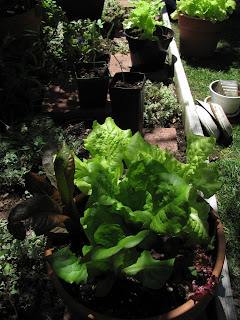
This is what summer looks like in our teensy yard.


Monday, June 27, 2011
Away...finally: Rancho Las Palmas
Rituals figure highly in my life, it seems. Put on a certain CD before I start writing, or change the atmosphere somehow, is the first active ritual that comes to mind.
Our annual trip to the desert is another. It's become a family ritual. Every year for so many years--perhaps even since Travis was in first grade--the first week after school is out, we're desert bound. (Don't worry: Nigel and Rosie have company at the house and are being cared for.)
Where we stay has changed, though. Used to be the Korakia (where Brian and I honeymooned), or The Willows, in Palm Springs, but as Travis got older, we started staying at resorts--mostly for the pool (for him).
The last few years we've come to Rancho Las Palmas. It has everything we need: the pool, a Lazy River, a good view from the room, which is what you see here, and an attentive staff, esp. the undisputed champ of guest services, Connie Orsak. She always makes our time here special. Rancho is also across the street from The River, which has restaurants, movies, and a bookstore. Always need a bookstore nearby... Last night after dinner, we walked over to Borders and I bought the New Yorker "The Talk of the Town: Special Issue."
I also tried to talk to an employee about what I read, that Borders was closing stores and were they closing? But he walked away from me, looking sort of angry, saying it wasn't true. A very strange interaction. Travis was watching, shaking his head. We agreed that he was so defensive, it must be true. This morning I Googled it and yes, Borders across the street at The River is slated (tragically!) to close. I hope another bookstore goes in that space. It just won't be the same, The River without a bookstore! We'll have to drive down the street and dine near Barnes & Noble!


Our annual trip to the desert is another. It's become a family ritual. Every year for so many years--perhaps even since Travis was in first grade--the first week after school is out, we're desert bound. (Don't worry: Nigel and Rosie have company at the house and are being cared for.)
Where we stay has changed, though. Used to be the Korakia (where Brian and I honeymooned), or The Willows, in Palm Springs, but as Travis got older, we started staying at resorts--mostly for the pool (for him).
The last few years we've come to Rancho Las Palmas. It has everything we need: the pool, a Lazy River, a good view from the room, which is what you see here, and an attentive staff, esp. the undisputed champ of guest services, Connie Orsak. She always makes our time here special. Rancho is also across the street from The River, which has restaurants, movies, and a bookstore. Always need a bookstore nearby... Last night after dinner, we walked over to Borders and I bought the New Yorker "The Talk of the Town: Special Issue."
I also tried to talk to an employee about what I read, that Borders was closing stores and were they closing? But he walked away from me, looking sort of angry, saying it wasn't true. A very strange interaction. Travis was watching, shaking his head. We agreed that he was so defensive, it must be true. This morning I Googled it and yes, Borders across the street at The River is slated (tragically!) to close. I hope another bookstore goes in that space. It just won't be the same, The River without a bookstore! We'll have to drive down the street and dine near Barnes & Noble!


Wednesday, June 22, 2011
Save the date: West Hollywood Book Fair
I'll be moderating a memoir panel at the New West Hollywood Book Fair on Sunday, Oct. 2. I hope I see you there.
Tuesday, June 21, 2011
Poetry prize
Any poets out there? Read on....
Submissions sought for $100,000 Kingsley Tufts Poetry Award
Office of University Communications
For Immediate Release
Contact Rod Leveque, Assistant Director, Media Relations (909) 621-8396
June 20, 2011
Submissions sought for $100,000 Kingsley Tufts Poetry Award
CLAREMONT, California — Claremont Graduate University (CGU) is accepting submissions for the 2012 Tufts Poetry Awards. The awards — now in their 20th year — are among the richest and most highly anticipated in the world of poetry.
The winner of the Kingsley Tufts Poetry Award will receive a $100,000 prize. The award is given annually for a book by an emerging poet who has not reached the pinnacle of his or her career.
CGU is also accepting submissions for the Kate Tufts Discovery Award, which carries a prize of $10,000. That award is presented annually for a first book by a poet of genuine promise.
The awards were established in 1992 by Kate Tufts to honor her late husband, poet and writer Kingsley Tufts. Past Kingsley Tufts Poetry Award winners include Robert Wrigley, Tom Sleigh, Linda Gregerson, Matthea Harvey and Yusef Komunyakaa.
Submissions must include eight copies of an eligible book of poetry, a list of previously published work, and a completed entry form. Only books published between Sept. 1, 2010 and Aug. 31, 2011 are eligible.
Entries must be postmarked by Sept. 15, 2011. Winners will be announced in February. The awards will be presented in April.
Send Submissions To:
Kingsley & Kate Tufts Poetry Awards
Claremont Graduate University
160 E. Tenth Street, Harper East B7
Claremont, California 91711-6165
Entry forms and additional information are available at www.cgu.edu/tufts.
About Claremont Graduate University
Founded in 1925, Claremont Graduate University is one of the top graduate schools in the United States. Our nine academic schools conduct leading-edge research and award masters and doctoral degrees in 24 disciplines. Because the world’s problems are not simple nor easily defined, diverse faculty and students research and study across the traditional discipline boundaries to create new and practical solutions for the major problems plaguing our world. A Southern California based graduate school devoted entirely to graduate research and study, CGU boasts a low student-to-faculty ratio.
If you would rather not receive future communications from Claremont Graduate University, let us know by clicking here.
Claremont Graduate University, 150 E. 10th St., Claremont, CA 91711 United States
Submissions sought for $100,000 Kingsley Tufts Poetry Award
Office of University Communications
For Immediate Release
Contact Rod Leveque, Assistant Director, Media Relations (909) 621-8396
June 20, 2011
Submissions sought for $100,000 Kingsley Tufts Poetry Award
CLAREMONT, California — Claremont Graduate University (CGU) is accepting submissions for the 2012 Tufts Poetry Awards. The awards — now in their 20th year — are among the richest and most highly anticipated in the world of poetry.
The winner of the Kingsley Tufts Poetry Award will receive a $100,000 prize. The award is given annually for a book by an emerging poet who has not reached the pinnacle of his or her career.
CGU is also accepting submissions for the Kate Tufts Discovery Award, which carries a prize of $10,000. That award is presented annually for a first book by a poet of genuine promise.
The awards were established in 1992 by Kate Tufts to honor her late husband, poet and writer Kingsley Tufts. Past Kingsley Tufts Poetry Award winners include Robert Wrigley, Tom Sleigh, Linda Gregerson, Matthea Harvey and Yusef Komunyakaa.
Submissions must include eight copies of an eligible book of poetry, a list of previously published work, and a completed entry form. Only books published between Sept. 1, 2010 and Aug. 31, 2011 are eligible.
Entries must be postmarked by Sept. 15, 2011. Winners will be announced in February. The awards will be presented in April.
Send Submissions To:
Kingsley & Kate Tufts Poetry Awards
Claremont Graduate University
160 E. Tenth Street, Harper East B7
Claremont, California 91711-6165
Entry forms and additional information are available at www.cgu.edu/tufts.
About Claremont Graduate University
Founded in 1925, Claremont Graduate University is one of the top graduate schools in the United States. Our nine academic schools conduct leading-edge research and award masters and doctoral degrees in 24 disciplines. Because the world’s problems are not simple nor easily defined, diverse faculty and students research and study across the traditional discipline boundaries to create new and practical solutions for the major problems plaguing our world. A Southern California based graduate school devoted entirely to graduate research and study, CGU boasts a low student-to-faculty ratio.
If you would rather not receive future communications from Claremont Graduate University, let us know by clicking here.
Claremont Graduate University, 150 E. 10th St., Claremont, CA 91711 United States
Monday, June 20, 2011
Music and images
A few weeks ago my son Travis said life would be more interesting if there was a soundtrack to accompany our daily goings ons.
So true.
In my case, soundtracks help the writing to move along. This morning I put on The Godfather soundtrack and got to work on my memoir. It's a trigger and helps to put me in the mindset of the work. It also drowns out (sorta) the sound of the tree trimmers across the street.
I also look at images. When you're working on a memoir, even if you're not including them in the work, images are helpful. Images help you to remember. Here's one such image. My brother and me, at our grandmother's house, long ago.

If you're feeling stuck, try a musical ritual. It helps to play the same music for a particular project. Maybe there are a couple of CDs you like. For me, right now, it's this Godfather soundtrack, and Yo-Yo Ma (in particular, his Bach: Prelude Cello Suite No. 1).
If you have rituals that work for you, share!
So true.
In my case, soundtracks help the writing to move along. This morning I put on The Godfather soundtrack and got to work on my memoir. It's a trigger and helps to put me in the mindset of the work. It also drowns out (sorta) the sound of the tree trimmers across the street.
I also look at images. When you're working on a memoir, even if you're not including them in the work, images are helpful. Images help you to remember. Here's one such image. My brother and me, at our grandmother's house, long ago.

If you're feeling stuck, try a musical ritual. It helps to play the same music for a particular project. Maybe there are a couple of CDs you like. For me, right now, it's this Godfather soundtrack, and Yo-Yo Ma (in particular, his Bach: Prelude Cello Suite No. 1).
If you have rituals that work for you, share!
Saturday, June 18, 2011
Pen on Fire Salon with Aimee Bender and Michael Jaime-Becerra
The Pen on Fire Writers Salon features Barbara DeMarco-Barrett in conversation with Aimee Bender, author of The Particular Sadness of Lemon Cake and Michael Jaime-Becerra, author of This Time Tomorrow.
Download audio.
(Event date: June 2010)
Download audio.
(Event date: June 2010)
Wednesday, June 15, 2011
The view from behind the board
 | |
| Dark and moody in the KUCI studio |
Monday, June 13, 2011
Robert Sabbag and Ander Monson
Barbara DeMarco-Barrett interviews Robert Sabbag, author of Down Around Midnight: A Memoir of Crash and Survival and Ander Monson, author of Vanishing Point: Not a Memoir.
Download audio.
(Broadcast Date: May 19, 2010)
An earlier, incomplete version of this show was posted in 2010.
Download audio.
(Broadcast Date: May 19, 2010)
An earlier, incomplete version of this show was posted in 2010.
Thursday, June 09, 2011
Mira Bartok and Maira Kalman on Writers on Writing
Barbara DeMarco-Barrett interviews Mira Bartok, author of The Memory Palace and Maira Kalman, author/illustrator of In Pursuit of Happiness.
Download audio.
(Broadcast date: March 16, 2011)
Download audio.
(Broadcast date: March 16, 2011)
Monday, June 06, 2011
Catherine Friend and Caitlin Kelly on Writers on Writing
Barbara DeMarco-Barrett interviews Catherine Friend, author of Sheepish: Two Women, Fifty Sheep & Enough Wool to Save the Planet, and Caitlin Kelly, author of Malled: My Untentional Career in Retail.
Download audio.
(Broadcast date: May 11, 2011)
Download audio.
(Broadcast date: May 11, 2011)
Wednesday, May 25, 2011
The Pen on Fire Salon writeup in OC Family
Marcie wrote about last week's salon on the OC Family blog. Here you go: click here.
Monday, May 23, 2011
Wednesday, May 18, 2011
An Evening with fiction writers Katie Arnoldi and Marisa Matarazzo
Last night was another wonderful night at the spectacular SCAPE Gallery in Corona del Mar. The evening renewed my belief that Orange County does indeed want, and need, literary events like this one. We had a full house for these two authors, whom I admire in so many ways. Take a look:


Find more on Katie Arnoldi here and more on Marisa Matarazzo here. If you were in attendance, feel free to post comments below. What did you get out of the evening?
Thanks to Allison Johnson and Travis Barrett for photography.


Find more on Katie Arnoldi here and more on Marisa Matarazzo here. If you were in attendance, feel free to post comments below. What did you get out of the evening?
Thanks to Allison Johnson and Travis Barrett for photography.
Friday, May 13, 2011
My friend, the author, Susan Straight sent this to me. Please read:
May 11, 2011
To: Students in the Creative Writing Department, and all UC Students, Their Families and Faculty
From: Professor Susan Straight
I’ve never written a letter to all the students in our department, or to families and faculty, but this is a critical time for us. In my 23 years of teaching at UCRiverside, I have never felt our educational future so threatened.
The cuts in our state budget will deeply affect classes not only in the Creative Writing Department, but in all departments and on all campuses, this fall. The cuts will affect your education (and my ability to teach you in the way that I know is best) and cannot be accepted.
As a state, California is funding developers, financial institutions, private and public corporations, but it is forcing deep cuts onto the premier public university system in the United States. Money is being taken away from the young people and graduate students of all ages who will keep California alive in the coming years. You, the UC students, along with your fellow students in the Cal State University system and the California Community College system, will be the scientists and researchers who invent and test new technologies for everything from computers to crops; you will become the teachers who pass on knowledge necessary for survival; you will become the doctors, dentists, nurses, pharmacists who will navigate complicated health care futures; and you will become the businesspeople, artists, and yes, the writers the state needs.
In contrast to recent news stories about corruption in government at many levels, what we do here on our ten campuses has been extremely positive for this state. We are truly the future of this large economy. My former students teach people all over the world; they work for magazines and publishers, write books, and work as doctors, lawyers, dentists, ad writers, geologists, entomologists, and research scientists.
But this budget will strip us of faculty, lecturers, TAs, and staff. This means we cannot offer enough classes this fall to ensure that incoming students will likely graduate in four years. (Many of you are already forced to take a fifth year because UC course offerings have been reduced.) It also means that courses which used to have 15 students, and which currently have 30 students, will have 75 students in the fall. Other courses will have 200 students. (In other departments, courses have up to 800 students and more!)
I will go so far as to call it unethical to enroll freshmen students who will not be able to enroll in classes they will need; I will also call unethical the degradation of your education if you are forced to sit in overcrowded classes and not get the individual attention you need from your professors. I love teaching here. I love my students, as many of you know, and everywhere I speak I tell audiences that my students at UCR are the finest in the nation, that you tell stories and write poems and craft essays no other writers in America can. My fellow faculty will attest that you are better than many undergraduate students at Ivy League and private colleges. I’m not flattering you. I’m being truthful. So I want you to write to your Chancellor Timothy White, and your UC President Mark Yudof, and to your state legislators, and let them know how you feel about these cuts, and your education. I want you to pass this letter on to your parents, grandparents, spouses and families, and have them write letters as well, because they are helping you pay for this education, and you deserve better.
You and your families worked hard for years so you could be here. Write your story, tell us what you did before you got here, what your parents did, and what you plan to do with your life with your degree – whatever your major, whatever your career, whether you’ve just arrived or are in graduate school or are working. If you’re in high school and plan to attend a UC, write about your plans. If you’re graduated, let us know what you do.
Professor Michael Jayme suggested this to me, when I felt despair about this budget, and he is a perfect example of our campus excellence. He was my student, many years ago, and now he dedicates most hours of his week to writing comments on your work. We cannot do that if classes are cut and if others are forced to huge enrollments, and if we lose you because of tuition out of reach for most families.
We want to hear your voices. Don’t be silent. Write to your legislators, post on Facebook, write for newspapers, write your stories.
Sincerely,
Professor Susan Straight
UC President Mark Yudof: president@ucop.edu
UCR Chancellor Timothy White: timothy.white@ucr.edu
Senator Bob Dutton: senator.dutton@senator.ca.gov
Rep. Brian Nestande: assemblymember.nestande@assembly.ca.gov
Rep. Jeff Miller: Assemblymember.Miller@assembly.ca.gov
Gov. Jerry Brown: governor.brown@governor.ca.gov
Postscript - Below is a letter sent to faculty by The President of the University of California, Mark Yudof. I agree with him – we need to be sure your voices, and the voices of your families, are heard.
Dear Colleagues, We are at a crucial juncture for the University of California. As you know, the proposed state budget calls for a $500 million cut in university support next year — a cut that will significantly impact our academic and research mission, and our service to the people of California. And there is a real possibility that UC could see an even bigger cut in state funding if California closes the entire $26.6 billion state deficit through budget cuts. An all-cuts budget would be devastating to the university and the students and communities we serve, and put at risk our faculty’s research, a critical driver of future jobs and wealth in California. With so much at stake, I wanted to take a moment to share with you some of our recent efforts to advocate for UC. First, we are telling lawmakers and the people of California that higher education cannot and should not bear an additional burden under an all-cuts budget. Education is simply too important to the future of our state to face further disinvestment. You can view a legislative presentation from Patrick Lenz, vice president of budget and capital resources, here.
Next, UC and its supporters are making themselves heard in Sacramento and around the state. Since February, thousands of UC supporters have written the governor and lawmakers on UC’s behalf. We also have been a constant presence at the Capitol: On UC Day in March, hundreds of alumni joined us in Sacramento for an event highlighting the university’s contributions to the state and its people. In April, students and campus leaders from UC, CSU and the community colleges met with lawmakers to talk about the importance of affordable, accessible education. And over the next few weeks, I and other UC leaders will be attending Senate Budget Committee hearings to give testimony about the short and long-term consequences of cuts to higher education.
Our advocacy is not limited to Sacramento, however. We have been reaching out to the state’s business community, building awareness and support for the vital role UC plays in California’s economy. We are also taking our case directly to the public. In our Stand Up for UC campaign , supporters are using Facebook to post videos and comments about why UC matters to them and their communities. Robert Reich, labor secretary under President Clinton and a professor of public policy at UC Berkeley, is particularly eloquent in describing UC’s important role in creating opportunity and upward mobility for students who come from modest means. You can see his video here.
If you share my passion for the university, if you agree that it represents California’s truest and best idea of itself, please consider joining our advocacy efforts. Send a letter or call your legislators; sign up to become a UC advocate or connect to your campus advocacy network. If you use social media, visit the Stand Up for UC page on Facebook and post a comment or video.
Your active participation can help protect this great institution, and this great state.
With best wishes, I am,
Sincerely yours,
Mark G. Yudof
President
_______________________________________________
May 11, 2011
To: Students in the Creative Writing Department, and all UC Students, Their Families and Faculty
From: Professor Susan Straight
I’ve never written a letter to all the students in our department, or to families and faculty, but this is a critical time for us. In my 23 years of teaching at UCRiverside, I have never felt our educational future so threatened.
The cuts in our state budget will deeply affect classes not only in the Creative Writing Department, but in all departments and on all campuses, this fall. The cuts will affect your education (and my ability to teach you in the way that I know is best) and cannot be accepted.
As a state, California is funding developers, financial institutions, private and public corporations, but it is forcing deep cuts onto the premier public university system in the United States. Money is being taken away from the young people and graduate students of all ages who will keep California alive in the coming years. You, the UC students, along with your fellow students in the Cal State University system and the California Community College system, will be the scientists and researchers who invent and test new technologies for everything from computers to crops; you will become the teachers who pass on knowledge necessary for survival; you will become the doctors, dentists, nurses, pharmacists who will navigate complicated health care futures; and you will become the businesspeople, artists, and yes, the writers the state needs.
In contrast to recent news stories about corruption in government at many levels, what we do here on our ten campuses has been extremely positive for this state. We are truly the future of this large economy. My former students teach people all over the world; they work for magazines and publishers, write books, and work as doctors, lawyers, dentists, ad writers, geologists, entomologists, and research scientists.
But this budget will strip us of faculty, lecturers, TAs, and staff. This means we cannot offer enough classes this fall to ensure that incoming students will likely graduate in four years. (Many of you are already forced to take a fifth year because UC course offerings have been reduced.) It also means that courses which used to have 15 students, and which currently have 30 students, will have 75 students in the fall. Other courses will have 200 students. (In other departments, courses have up to 800 students and more!)
I will go so far as to call it unethical to enroll freshmen students who will not be able to enroll in classes they will need; I will also call unethical the degradation of your education if you are forced to sit in overcrowded classes and not get the individual attention you need from your professors. I love teaching here. I love my students, as many of you know, and everywhere I speak I tell audiences that my students at UCR are the finest in the nation, that you tell stories and write poems and craft essays no other writers in America can. My fellow faculty will attest that you are better than many undergraduate students at Ivy League and private colleges. I’m not flattering you. I’m being truthful. So I want you to write to your Chancellor Timothy White, and your UC President Mark Yudof, and to your state legislators, and let them know how you feel about these cuts, and your education. I want you to pass this letter on to your parents, grandparents, spouses and families, and have them write letters as well, because they are helping you pay for this education, and you deserve better.
You and your families worked hard for years so you could be here. Write your story, tell us what you did before you got here, what your parents did, and what you plan to do with your life with your degree – whatever your major, whatever your career, whether you’ve just arrived or are in graduate school or are working. If you’re in high school and plan to attend a UC, write about your plans. If you’re graduated, let us know what you do.
Professor Michael Jayme suggested this to me, when I felt despair about this budget, and he is a perfect example of our campus excellence. He was my student, many years ago, and now he dedicates most hours of his week to writing comments on your work. We cannot do that if classes are cut and if others are forced to huge enrollments, and if we lose you because of tuition out of reach for most families.
We want to hear your voices. Don’t be silent. Write to your legislators, post on Facebook, write for newspapers, write your stories.
Sincerely,
Professor Susan Straight
UC President Mark Yudof: president@ucop.edu
UCR Chancellor Timothy White: timothy.white@ucr.edu
Senator Bob Dutton: senator.dutton@senator.ca.gov
Rep. Brian Nestande: assemblymember.nestande@assembly.ca.gov
Rep. Jeff Miller: Assemblymember.Miller@assembly.ca.gov
Gov. Jerry Brown: governor.brown@governor.ca.gov
Postscript - Below is a letter sent to faculty by The President of the University of California, Mark Yudof. I agree with him – we need to be sure your voices, and the voices of your families, are heard.
Dear Colleagues, We are at a crucial juncture for the University of California. As you know, the proposed state budget calls for a $500 million cut in university support next year — a cut that will significantly impact our academic and research mission, and our service to the people of California. And there is a real possibility that UC could see an even bigger cut in state funding if California closes the entire $26.6 billion state deficit through budget cuts. An all-cuts budget would be devastating to the university and the students and communities we serve, and put at risk our faculty’s research, a critical driver of future jobs and wealth in California. With so much at stake, I wanted to take a moment to share with you some of our recent efforts to advocate for UC. First, we are telling lawmakers and the people of California that higher education cannot and should not bear an additional burden under an all-cuts budget. Education is simply too important to the future of our state to face further disinvestment. You can view a legislative presentation from Patrick Lenz, vice president of budget and capital resources, here.
_______________________________________________
KUCI Fund Drive is on
Our fund drive started last week and goes through the weekend. It's how we keep the lights on, basically. The university does little to support KUCI and we're dependent upon tax-deductible donations. Marrie and I are volunteers, and have been as long as the show's been running.
I want to thank the following people for calling in a pledge or sending a check, in the name of "Writers on Writing":
T. Jefferson Parker
Susan Straight
Debbie Gaal
Allison Johnson
Nicole Nelson
Lynn Gibson
Charlie Leister
Adele Peters
Sonia Marsh
Sue Zarrinkelk
Mary Camarillo
If you'd like to donate, you can do so online at www.kuci.org. Follow the links to the Fund Drive and please indicate that you listen to the show. And if you do, let me know so I can list you here.
Again, thanks for your support.
I want to thank the following people for calling in a pledge or sending a check, in the name of "Writers on Writing":
T. Jefferson Parker
Susan Straight
Debbie Gaal
Allison Johnson
Nicole Nelson
Lynn Gibson
Charlie Leister
Adele Peters
Sonia Marsh
Sue Zarrinkelk
Mary Camarillo
If you'd like to donate, you can do so online at www.kuci.org. Follow the links to the Fund Drive and please indicate that you listen to the show. And if you do, let me know so I can list you here.
Again, thanks for your support.
Wednesday, May 11, 2011
Sarah Porter and Gayle Forman
Marrie Stone interviews Sarah Porter, author of Lost Voices, and Gayle Forman, author of Where She Went.
Download audio.
(Broadcast date: May 4, 2011)
Download audio.
(Broadcast date: May 4, 2011)
Joshua Kendall and Darin Strauss
Marrie Stone interviews Joshua Kendall, author of The Forgotten Founding Father: Noah Webster's Obsession and the Creation of an American Culture, and Darin Strauss, author of Half a Life.
Download audio.
(Broadcast date: Apr 27, 2011)
Download audio.
(Broadcast date: Apr 27, 2011)
Olga Grushin and Stewart O'Nan
Marrie Stone interviews Olga Grushin, author of The Line, and Stewart O'Nan, author of Emily, Alone.
Download audio.
(Broadcast date: Apr 13, 2011)
Download audio.
(Broadcast date: Apr 13, 2011)
Monday, May 02, 2011
Victor Infante and Kim Dower: Poetry Month
Barbara DeMarco-Barrett interviews Victor Infante, author of City of Insomnia, and Kim Dower, author of Air Kissing on Mars.
Download audio.
(Broadcast date: April 20, 2011)
Download audio.
(Broadcast date: April 20, 2011)
Wednesday, April 27, 2011
This Morning's Show
Greetings!
Join co-host Marrie Stone as she talks with biographer Joshua Kendall, author of "The Forgotten Founding Father: Noah Webster's Obsession and the Creation of an American Culture" and novelist and memoirist Darin Strauss, author of "Half a Life."
Tune in this morning, April 27th, at 9:00 a.m. (PT) to KUCI, 88.9 FM in Irvine or listen online at www.kuci.org.
Thanks for listening!
Thursday, April 14, 2011
An Evening with Katie Arnoldi and Marisa Matarazzo
Join us on Tuesday, May 17, when our authors will be Katie Arnoldi and Marisa Matarazzo.
Visit the Salon page for more info, and to register.
Visit the Salon page for more info, and to register.
Tuesday, April 12, 2011
Amy Alkon and Tracy Ross
Marrie Stone interviews Amy Alkon, author of I See Rude People: One Woman's Battle to Beat Some Manners Into Impolite Society, and Tracy Ross, author of The Source of All Things: A Memoir.
Download audio.
(Broadcast date: Apr 6, 2011)
Download audio.
(Broadcast date: Apr 6, 2011)
Ruta Sepetys and Alina Tugend
Marrie Stone interviews Ruta Sepetys, author of Between Shades of Gray, and Alina Tugend, author of Better by Mistake: The Unexpected Benefits of Being Wrong.
Download audio.
(Broadcast date: Mar 23, 2011)
Download audio.
(Broadcast date: Mar 23, 2011)
Tuesday, April 05, 2011
Literary Orange 2011
On an upbeat, this coming Saturday is Literary Orange, an all day fest of writers, that will take place once again at UCI. It's cheap, you get a continental breaky, lunch, and afternoon refreshments, and it's fun. I'm moderating a fiction panel and Marrie Stone, my co-host on Writers on Writing, will moderate a memoir panel. Here's more info. (Today online registration ends.) Hope to see you there.
Monday, April 04, 2011
Back from the funeral: Sam DeMarco 1946 - 2011
Back from a long five days in Pennsylvania at my brother's service and visiting with family. Difficult for a couple of reasons. When you have a complicated history with a sibling, some might imagine it's easy to see that sibling off. It's anything but. I loved my brother. We shared so many good times, and although we were born many years apart, we shared a history. The difficulties we encountered don't take away from the love, and that makes it complicated, esp. for family who knew what we went through. Friends have been the most understanding, and for that I'm grateful. My brother was cremated. The box on the table is my brother. The cemetary you see here is in Lansdale, PA, where my mother and the relatives are buried.


Tuesday, March 29, 2011
Sam DeMarco RIP

My brother Sam passed away today. Here we are, with our mother, many moons ago. I love you, Sam.
Saturday, March 26, 2011
Dori Ostermiller & Memoir Panelists Lisa Catherine Harper and Katherine Ellison
Marrie Stone talks with Dori Ostermiller, author of Outside the Ordinary World and, in the second half hour, moderates a memoir panel with Lisa Catherine Harper (A Double Life: Discovering Motherhood) and Katherine Ellison (BUZZ: A Year of Paying Attention).
Download Audio.
(Broadcast Date: March 9, 2011)
Download Audio.
(Broadcast Date: March 9, 2011)
David Vann
Barbara DeMarco-Barrett interviews David Vann, author of Caribou Island: A Novel.
Download audio.
(Broadcast date: February, 2011)
Download audio.
(Broadcast date: February, 2011)
Wednesday, March 23, 2011
Jessie Sholl
Barbara DeMarco-Barrett interviews Jessie Sholl, author of Dirty Secret: A Daughter Comes Clean About Her Mother's Compulsive Hoarding.
Download audio.
(Broadcast date: March 2, 2011)
Download audio.
(Broadcast date: March 2, 2011)
Allison Brennan and Alisa Bowman
Barbara DeMarco-Barrett interviews Allison Brennan, author of Kiss Me, Kill Me: A Novel of Suspense and Alisa Bowman, author of Project: Happily Ever After: Saving Your Marriage When the Fairytale Falters.
Download audio.
(Broadcast date: February 2, 2011)
Download audio.
(Broadcast date: February 2, 2011)
Tuesday, March 22, 2011
Tomorrow's Show: Ruta Sepetys and Alina Tugend
Greetings!
Join co-host Marrie Stone as she talks with Ruta Sepetys, author of "Between Shades of Grey" and, in the second half hour, Alina Tugend, author of "Better by Mistake: The Unexpected Benefits of Being Wrong."
Tune in at 9 a.m. PT on Wednesday, March 23rd, at KUCI-FM 88.9 in Orange County, CA, or listen online at www.kuci.org or at iTunes-News/Talk radio.
Thanks for listening!
Thanks for listening!
Wednesday, March 09, 2011
Tuesday, March 01, 2011
Tomorrow's show: Jessie Sholl, author of Dirty Secret
Tomorrow my guest will be Jessie Sholl, author of the memoir: "Dirty Secret: A Daughter Comes Clean about her Mother's Compulsive Hoarding."
Tune in at 9 a.m. PT at KUCI-FM 88.9 in Orange County, CA, or listen online at www.kuci.org or at iTunes-News/Talk radio.
Thanks for listening!
Barbara
Tune in at 9 a.m. PT at KUCI-FM 88.9 in Orange County, CA, or listen online at www.kuci.org or at iTunes-News/Talk radio.
Thanks for listening!
Barbara
Jill Bialosky and Linda Gray Sexton
Marrie Stone interviews Jill Bialosky, author of History of a Suicide: My Sister's Unfinished Life and Linda Gray Sexton, author of Half in Love: Surviving the Legacy of Suicide.
Download audio.
(Broadcast date: January 26, 2011)
Download audio.
(Broadcast date: January 26, 2011)
Maira Kalman
Barbara DeMarco-Barrett interviews Maira Kalman, author of And the Pursuit of Happiness.
Download audio.
(Broadcast date: December 14, 2010)
Download audio.
(Broadcast date: December 14, 2010)
Caroline Leavitt and Christina Meldrum
Marrie Stone interviews Caroline Leavitt, author of Pictures of You and Christina Meldrum, author of Amaryllis in Blueberry.
Susan Maushart & Cathleen Schine
Marrie Stone interviews Susan Maushart, author of The Winter of Our Disconnect: How Three Totally Wired Teenagers (and a Mother Who Slept with her iPhone) Pulled the Plug on Their Technology and Lived to Tell the Tale and Cathleen Schine, author of The Three Weissmanns of Westport: A Novel.
Download audio.
(Broadcast date:February 9, 2011)
Download audio.
(Broadcast date:February 9, 2011)
Tuesday, February 22, 2011
Snow, again
Travis' school has ski week (originating years ago when our school district's attendance went way down in Feb, so the school board decided we'd have a ski week) and we're in the mountains, about six hours north of Orange Co., in the Eastern Sierra. Mammoth is an active volcano and an earthquake fault runs under the town, but we'll not talk about that here. Instead, here are some photos of snow, and us, and Trav's cousins, requested by a few friends.


The Eskimos had fifty-two names for snow because it was important to them: there ought to be as many for love.- Margaret Atwood

In the wintertime, in the snow country, citrus fruit was so rare, and if you got one, it was better than ambrosia.
James Earl Jones


Sunday, February 13, 2011
Pen on Fire Salon with Lisa Fugard and Tatjana Soli
An Evening with Novelists Tatjana Soli and Lisa Fugard
Join us on Tuesday evening, March 15, for a conversation with two brilliant novelists hosted by Barbara DeMarco-Barrett. The authors will be in conversation with Marrie Stone, co-host of "Writers on Writing," the radio show Barbara launched 13 years ago next month.
Tatjana Soli is a novelist and short story writer. Born in Salzburg, Austria, she attended Stanford University and the Warren Wilson MFA Program. Her debut novel, The Lotus Eaters, was a New York Times Bestseller and 2010 New York Times Notable Book. Her short stories have appeared in The Sun, StoryQuarterly, Confrontation, Gulf Coast, Other Voices, Third Coast, Sonora Review and North Dakota Quarterly among other publications. Her work has been twice listed in the 100 Distinguished Stories in Best American Short Stories and nominated for the Pushcart Prize. She lives with her husband in Orange County, California.
Lisa Fugard was born in South Africa and came to the United States in 1980. After working in the theater, performing in New York, London and South Africa, she turned her attention to writing. Her short fiction has been published in Story, Outside and literary magazines. Her many travel articles, essays and book reviews have been published in the New York Times. Skinner’s Drift her first novel has been published in the USA, UK, and South Africa. Named a notable book of 2006 by the New York Times, Skinner’s Drift was also a finalist for the LA Times Art Seidenbaum Award for First Fiction and the runner-up for the 2007 Dayton Literary Peace Prize. In a starred review, Publishers Weekly lauded that, "Fugard captivates with this searing personal portrayal of the legacy of apartheid.” The Los Angeles Times Book Review called it a, "frighteningly good novel (that) looks at this historic turmoil without wincing or turning away.” She lives in Southern California and is at work on a second novel.
For more information, or to register, click here.
Join us on Tuesday evening, March 15, for a conversation with two brilliant novelists hosted by Barbara DeMarco-Barrett. The authors will be in conversation with Marrie Stone, co-host of "Writers on Writing," the radio show Barbara launched 13 years ago next month.
Tatjana Soli is a novelist and short story writer. Born in Salzburg, Austria, she attended Stanford University and the Warren Wilson MFA Program. Her debut novel, The Lotus Eaters, was a New York Times Bestseller and 2010 New York Times Notable Book. Her short stories have appeared in The Sun, StoryQuarterly, Confrontation, Gulf Coast, Other Voices, Third Coast, Sonora Review and North Dakota Quarterly among other publications. Her work has been twice listed in the 100 Distinguished Stories in Best American Short Stories and nominated for the Pushcart Prize. She lives with her husband in Orange County, California.
Lisa Fugard was born in South Africa and came to the United States in 1980. After working in the theater, performing in New York, London and South Africa, she turned her attention to writing. Her short fiction has been published in Story, Outside and literary magazines. Her many travel articles, essays and book reviews have been published in the New York Times. Skinner’s Drift her first novel has been published in the USA, UK, and South Africa. Named a notable book of 2006 by the New York Times, Skinner’s Drift was also a finalist for the LA Times Art Seidenbaum Award for First Fiction and the runner-up for the 2007 Dayton Literary Peace Prize. In a starred review, Publishers Weekly lauded that, "Fugard captivates with this searing personal portrayal of the legacy of apartheid.” The Los Angeles Times Book Review called it a, "frighteningly good novel (that) looks at this historic turmoil without wincing or turning away.” She lives in Southern California and is at work on a second novel.
For more information, or to register, click here.
Wednesday, February 09, 2011
Lyanda Lynn Haupt and Stacy Schiff
Barbara DeMarco-Barrett interviews Lyanda Lynn Haupt, author of Crow Planet: Essential Wisdom from the Urban Wilderness and Marrie Stone interviews Stacy Schiff, author of the biography, Cleopatra: A Life.
Download Audio.
(Broadcast Date: January 2011)
Download Audio.
(Broadcast Date: January 2011)
Rosalind Wiseman and Kim Edwards
Greetings!
Join Marrie Stone as she interviews internationally recognized author and educator Rosalind Wiseman, author of Queen Bees and Wannabes and her debut young adult novel Boys, Girls and Other Hazardous Materials, and Kim Edwards, author of The Memory Keeper's Daughter and The Lake of Dreams.
Thanks for listening!
Wednesday, February 02, 2011
Today's show: Allison Brennan and Alisa Bowman
This morning on "Writers on Writing," my guests will be suspense writer Allison Brennan ("Love Me to Death") and nonfiction author, Alisa Bowman ("Happily Ever After: Saving Your Marriage When the Fairytale Falters").
Tune in at 9 a.m. PT at 88.9 FM KUCI in Orange Co., CA, or listen to KUCI online at iTunes, News/Talk radio.
(The show will be podcast at a later date. Subscribe at iTunes and the show will download for you at that time.)
Tune in at 9 a.m. PT at 88.9 FM KUCI in Orange Co., CA, or listen to KUCI online at iTunes, News/Talk radio.
(The show will be podcast at a later date. Subscribe at iTunes and the show will download for you at that time.)
Friday, January 28, 2011
Arthur Plotnik and Mark SaFranko
Marrie Stone interviews Arthur Plotnik, author of Spunk and Bite and the forthcoming Better Than Great: A Plenitudinous Compendium of Wallopingly Fresh Superlatives and Mark SaFranko, author of Hating Olivia: A Love Story.
Download audio.
(Broadcast date: December, 2010)
Download audio.
(Broadcast date: December, 2010)
Thursday, January 27, 2011
3rd annual reading this coming Sunday Laguna Beach Books
If you're in South Orange County (CA) on Sunday, come hear my students and me read at Laguna Beach Books, 4 p.m. The Literary Posse and Writers Block Party and I will do our 3rd annual reading at the store. No charge! And a great way to spend your late Sunday afternoon, bathed in the late day light as you listen to great writing amongst your tribe.
Wednesday, January 26, 2011
On Writers on Writing, Linda Gray Sexton and Jill Bialosky
Join co-host Marrie Stone as she interviews two authors on the subject suicide in memoir. Marrie will be in conversation with Jill Bialosky, author of History of a Suicide: My Sister's Unfinished Life (Atria, February 2011) and Pulitzer-Prize winning poet Anne Sexton's daughter, Linda Gray Sexton, author of Half in Love: Surviving the Legacy of Suicide.
Tune in this morning at 9:00 a.m. (PT) on 88.9FM, Irvine, or listen through our live audio stream at www.kuci.org. You can always download our podcasts at iTunes (talk/news) or right here!
Thanks for listening!
Barbara
Tune in this morning at 9:00 a.m. (PT) on 88.9FM, Irvine, or listen through our live audio stream at www.kuci.org. You can always download our podcasts at iTunes (talk/news) or right here!
Thanks for listening!
Barbara
Thursday, January 20, 2011
Pen on Fire Salon with T. Jefferson Parker


T. Jefferson Parker was the featured author at the writers salon the other night here at Scape Gallery in Corona del Mar, and it was another stellar evening with great talk and great guests. Jeff was here to talk about his new book, The Border Lords, which received a five star review in the Los Angeles Times yesterday (1/19/11). Here are some photos from the evening, taken by writer C.J. Bahnsen, who gratefully serves as a doorperson, along with his significant other, writer Debra Cross. (They're there in the bottom photo, along with me and Marrie Stone, writer and co-host on Writers on Writing.) Mystery Ink, Debbie Mitsch's fabulous bookstore in Huntington Beach, was on hand selling books. Our next salon will be March 15. Details to come!
Monday, January 17, 2011
Valerie Trueblood and Caroline Fraser
Marrie Stone interviews Valerie Trueblood, author of Marry or Burn: Stories and Caroline Fraser, author of Rewilding the World: Dispatches from the Conservation Revolution.
Download audio.
(Broadcast date: December 22, 2010)
Download audio.
(Broadcast date: December 22, 2010)
Monday, January 03, 2011
Subscribe to:
Posts (Atom)


 Posts
Posts

